 跳到内容
跳到内容 
Run the inflatable tent vs pole tent wind comparison on a coastal campsite in Western Australia and the difference stops being theoretical. On Day 1 the order is placed, on Day 14 the pre-production sample arrives, and on Day 45 the container lands — then a 50 km/h gust hits the field test tent. The pole model folds at the ferrule with a sound nobody hears inside the sleeve; the air model sags over three minutes, giving the test team time to brace the windward beam. That is not a marketing distinction. That is a structural failure-mode difference between 7075 aluminum poles at 8.5–9.5mm diameter and 3-layer TPU air tubes inflated to 4–6 PSI.
For a procurement manager adding tents to a private-label line, the real question is not which one feels sturdier in the showroom. It is which failure your warranty desk can absorb. A snapped pole set costs $30–60 to replace and can take up to 90 days for OEM restocking; a punctured TPU tube patches with a $4 kit in 10–15 minutes, usually by the customer. Kelyland’s QC pressure-hold data backs this up: a TPU beam at 5 PSI retains roughly 96% pressure over eight hours, and headroom only collapses 30–40cm once internal pressure drops below 2 PSI. That predictable decay curve is why air-frame tents shift the burden from parts replacement to customer-service labor — and why the weight penalty of roughly 0.8kg per 3-person model needs to be weighed against the per-claim cost difference, not just the shipping bill.
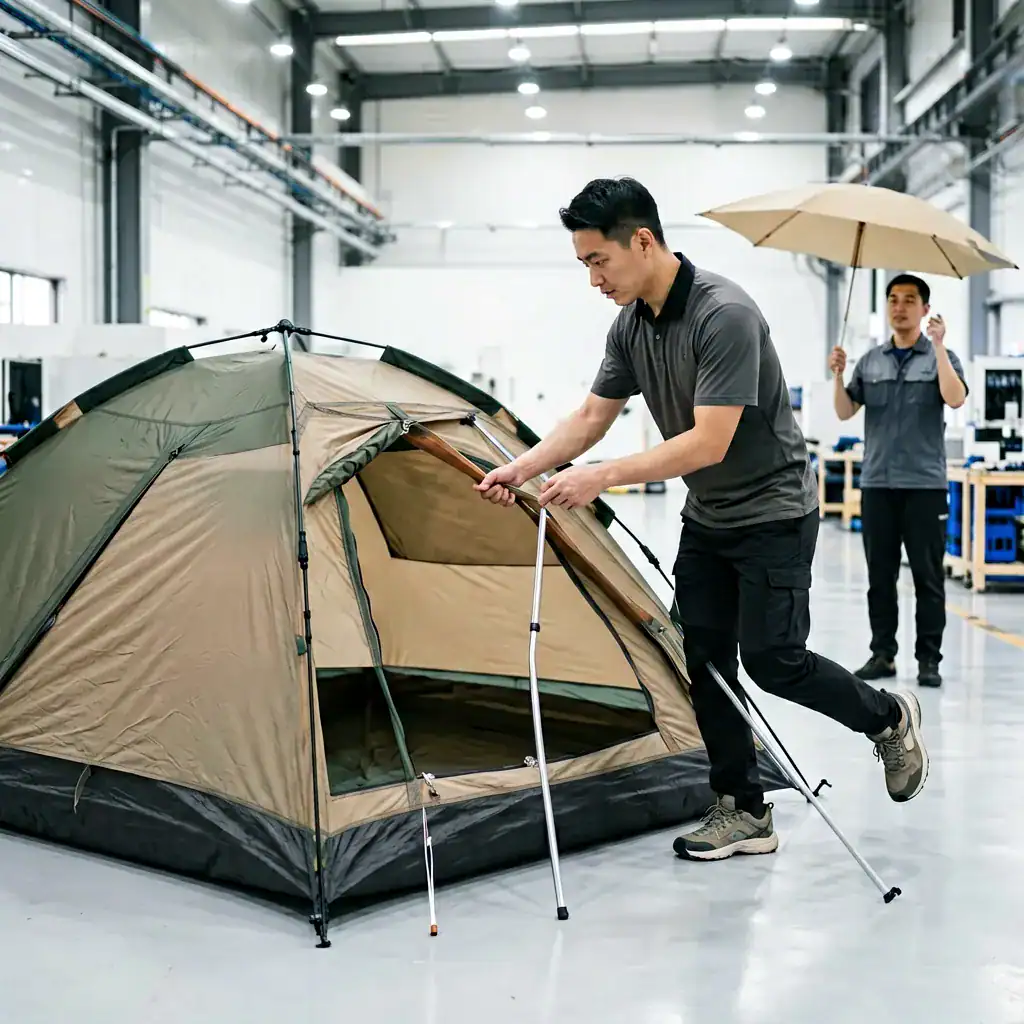
Failure Mode: Aluminum Poles vs TPU Air Tubes
Pole tents fail in milliseconds.
The manufacturing difference between an aluminum-pole tent and an air-frame tent comes down to how each structure fails. Pole tents snap without warning. Air tents sag with time to react. That distinction drives every warranty number in this comparison.
Aluminum Poles: Stress, Microfracture, Sudden Snap
A 7075 aluminum pole with an 8.5–9.5mm diameter looks bulletproof during setup. Inside the fabric sleeve, the ferrule junction takes repeated flexing. After 3,000–5,000 flex cycles, microfractures form where the pole segments join. In a 45–50 km/h gust, the ferrule buckles and the tent edge collapses instantly. The occupant gets no noise, no warning — just a broken pole in the middle of the night.
TPU Air Tubes: Gradual Deflation Instead of a Crash
A three-layer TPU air tube is structurally different. At 16–20cm in diameter and inflated to 4–6 PSI, it behaves as a continuous arch. Wind load transfers along the full curve, not through a metal joint. Seam structures in this configuration survive more than 10,000 pressure cycles. Puncture damage produces a slow bleed, not an immediate snap. The tent loses height progressively, giving the user time to secure it or exit.
Factory QC Data and the Warranty Divide
Kelyland’s inflatable-tent QC line pressure-holds beams at 5 PSI and logs the decay. A sound beam retains about 96% pressure over an eight-hour hold. That 4% loss is the difference between a unit that ships and one that leaks. Below roughly 2 PSI, the geometry gives up: headroom drops 30–40cm, and the tent stops functioning as shelter.
Compare the repair path. A snapped OEM pole set costs $30–60 to replace and can take up to 90 days to restock from overseas. A punctured TPU tube patches with a $4 kit in 10–15 minutes. The first is a warranty claim against inventory. The second is customer-service hand-holding. For a brand forecasting return rates, the failure mode determines which department absorbs the cost.
-
- Wind behavior: Pole tent: 7075 aluminum pole snaps at the ferrule in 45–50 km/h gusts. Air tent: TPU beam flexes and sheds live loads; a puncture causes gradual deflation.
- Flex endurance: Pole tent: aluminum ferrules buckle after 3,000–5,000 flex cycles. Air tent: TPU seams survive 10,000+ pressure cycles.
- Field repair: Pole tent: replace the full pole set, $30–60, up to 90-day lead time. Air tent: $4 patch kit, 10–15 minutes.
Why Competitors Publish No Blowdown Data
Most spec sheets call both systems ‘stable’ and stop. No pressure-decay curves, no flex-cycle counts, no blowdown data. Without that data, a buyer cannot estimate seasonal return rates or set service budgets. Kelyland includes blowdown curves and pressure-loss results in its OEM technical packs, so the private-label decision rests on measured behavior instead of marketing language.
Weight, Pack Size, and Setup Time
Pole packs smaller.
Start with the packed unit, because that is what freight quotes and warehouse slots actually see. A 3-person pole tent lands around 2.6 kg with a packed length near 45 cm; an equivalent air-frame tent runs roughly 3.4 kg and 55 cm in the same accessory-free configuration. For bulk tent shipping, that per-unit weight gap changes how many cartons sit on a pallet.
FOB pricing rarely exposes this. Quotes are per unit, while the cost of occupying cubic volume hits at container stuffing. A longer packed bag can push a carton to a different layer height or cut the number of units along the container’s length. That is where the pole tent’s compact advantage turns into landed-cost savings.
Setup Time: Strokes vs Poles
Inflation runs 60-90 full strokes with a manual pump, or 1-2 minutes with an electric blower. Pole assembly for the same 3-person tent takes 5-7 minutes with a modern clip-and-sleeve system. The labor inversion matters more than most category managers assume: air frames move effort from bending and threading to pumping, which is faster for glamping operators resetting multiple units before check-in and easier for less mobile campers.
Scaling Laws for Larger Tents
At 6-8 person sizes the comparison flips. Air-frame construction replaces three or four heavy sectional poles with a set of laminated TPU beams, and frame weight drops by up to 35% versus steel-pole designs. That is why the glamping segment in Kelyland’s lineup leans on air tubes: the strength-to-weight ratio improves exactly where manual handling hurts most.
During sample approval, ask for packed length measured with the production carry bag, not the prototype bag. Kelyland’s Ningbo tent factory, which holds CE, BSCI, and ISO 9001 certifications, records packed dimensions as part of its pre-shipment quality checks. If a supplier can’t state packed weight and length on the approved sample, the final batch will drift — and you’ll discover it after the container lands.
-
- Choose pole if: your range prioritizes compact pack size, low per-unit shipping weight, and simple spare-part logistics.
- Choose air if: your target is 6-8 person family tents, glamping, or any program where setup speed and one-person assembly drive the purchase.
| Metric | Pole Tent (7075 Aluminum) | Air-Frame Tent (TPU Beams) | Sourcing / Logistics Impact |
|---|---|---|---|
| Packed Weight (3-Person Model) | ≈2.6 kg with 45 cm packed length | ≈3.4 kg with 55 cm packed length | Air frame is ~30% heavier and ~22% longer per unit — directly reduces units per pallet. |
| Setup Time | 5–7 min with clip-and-sleeve pole assembly | 3–4 min manual (60–90 pump strokes) or 1–2 min with electric blower | Faster inflation reduces retail demo labor and customer setup complaints. |
| Frame Weight at 6–8P Scale | Steel/aluminum telescoping poles add significant weight | Hollow TPU laminate beams cut frame weight by up to 35% | Larger glamping tents narrow the weight penalty of air frames. |
| Packed Carton Dimension | ~45 cm rolled length | ~55 cm rolled length | 22% longer cartons lower pallet density; plan warehouse cube accordingly. |
| Container Utilization | Higher unit count per 40′ container | Fewer units due to longer packed dimension | Critical for bulk tent shipping weight per container and landed cost. |
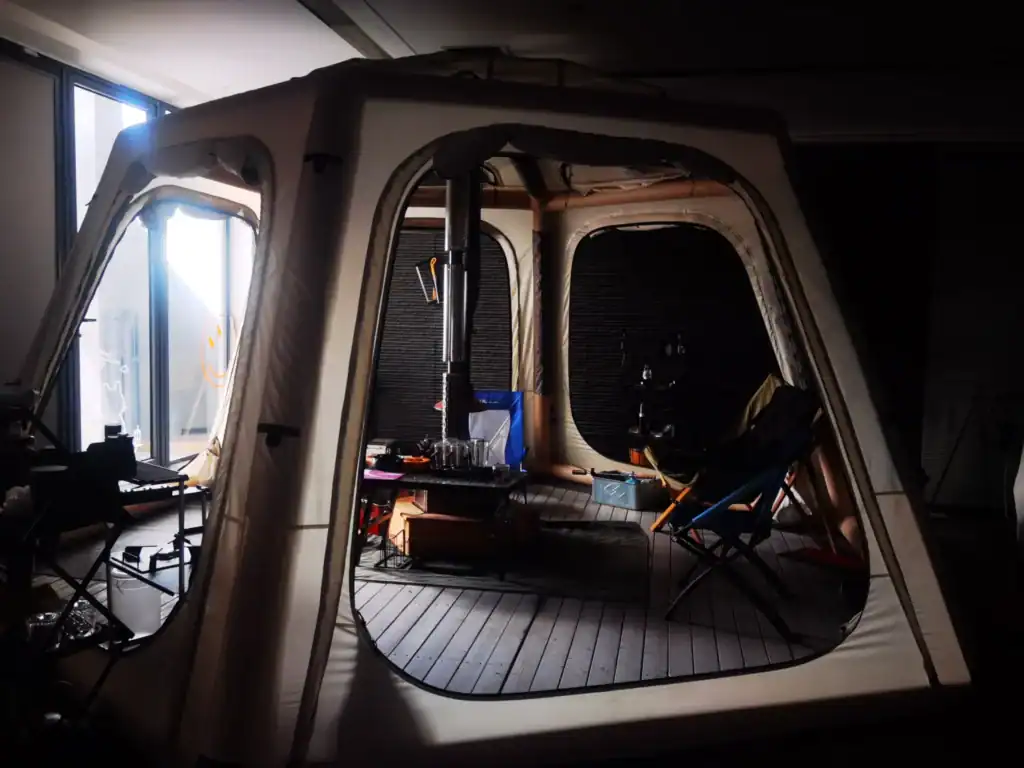
Equipment Logistics Impact on Bulk Orders
The 30% weight premium and 22% length premium change container math before a single unit sells.
A 3-person pole tent packs to roughly 2.6kg and a 45cm roll. The equivalent air-frame runs about 3.4kg and 55cm. That difference — 30% heavier, 22% longer in the box — directly determines how many cartons sit on a pallet, how many pallets slide into a 40ft container, and how much racking space your warehouse gives up per unit.
Warehouse Cube and Seasonal Replenishment
Warehouse cube is where the pain shows up second. Pole tents stack tight, giving a distributor deeper SKU counts per racking bay. Air-frame tents consume more cube per unit. For a UK or European buyer staging spring stock in January then reordering in March, that extra cube eats into buffer space exactly when the warehouse is fullest.
Australian buyers run a different calendar but hit the same wall. Counter-seasonal restocking means new air-frame units arrive while the tail of the previous range is still in the building. The 30% heavier, 22% longer package lands at peak changeover — the one moment when warehouse flexibility is already gone.
What the Factory Side Does About It
The logistics conversation belongs earlier than most buyers expect. Kelyland’s standard process includes export paperwork and customs guidance as part of a full 10-step workflow, so container clearance issues don’t surface after loading. Pre-shipment inspection runs on the tent line before the container ships, catching a carton or labeling mismatch while it’s still fixable.
The supplier network matters here too. With 17 core factories and 200+ manufacturing partners, a buyer can run pole tents and air-frame tents through the same sourcing team instead of onboarding a new factory for a new technology. That removes the classic risk of inheriting a new partner’s container planning mistakes.
-
- Container utilization: Pole tent packs ~45cm and ~2.6kg per 3-person unit, yielding more units per 40ft container | Air-frame packs ~55cm and ~3.4kg, reducing units per container and raising volumetric freight per unit.
- Warehouse cube: Pole tent stacks tighter, allowing deeper seasonal SKU depth | Air-frame consumes more cube per unit, cutting buffer space during EU/UK spring staging and AU pre-Christmas windows.
- Seasonal replenishment: Pole tent suits lean reorder cycles with a smaller footprint | Air-frame needs earlier slotting and larger reserve pallet positions in the same distribution center.

Cost Analysis: Warranty Liability Comparison
Pole tents break in one gust.
Warranty cost isn’t about the price of the tent. It’s about the cost of the failure event after the customer calls. For a snapped 7075 aluminum pole, the damage is total: the set costs $30–60 to replace, and OEM-specific pole geometry can stretch lead times past 90 days.
A punctured TPU air tube costs $4–8 to patch and takes the customer 10–15 minutes. No technician. No replacement inventory. Same windstorm, completely different after-sales burden.
Per-Failure Cost Breakdown
The pole failure forces you to stock replacement sets, manage fitment checks, and pay freight both ways. The air-tube failure sends the customer a patch kit and a short instruction sheet. One routes to your warranty parts desk. The other routes to your customer-service inbox, where the resolution cost is close to zero.
-
-
- Snapped aluminum pole set: $30–60 per incident plus technician time for restringing and fitment confirmation. OEM pole sets can take up to 90 days to replace.
- Punctured TPU tube: $4–8 patch kit, no technician time. Field repair takes 10–15 minutes when the patch cures.
- Full beam replacement: $35–70 per piece plus shipping lead time from the supplier. This is the air tent’s version of a structural failure — rarer, but slower to resolve than a patch.
-
Why the Failure Mode Changes Your Liability
A pole tent snaps at the ferrule in a 45–50 km/h gust with zero warning, so the customer opens a warranty claim that day. An air tent bleeds pressure over minutes, giving the customer time to secure it or get out. For buyers comparing failure modes, the serviceable one wins the P&L argument every time.
Kelyland’s factory QC pressure-hold tests apply a strict quality tolerance: a TPU tube at 5 PSI retains about 96% pressure over eight hours, and headroom only drops 30–40 cm once pressure falls below 2 PSI. That predictable decay is why a puncture is a field repair, not a structural replacement.
Once sample approval locks the pole geometry, replacement pole sets become custom parts — expensive to stock and easy to obsolete. A private-label brand sourcing through a network like Kelyland’s, with 17 core strategic factories and most partners ISO 9001:2015 certified, can instead pack a $4 patch kit in every carton and skip regional spare-pole warehousing entirely.
-
- Choose air frames if: Your return rate is sensitive, your customers are non-technical, and you want warranty events resolved without a service technician or spare-parts logistics.
- Choose pole tents if: You’re optimizing packed weight — a 3-person pole tent runs ~2.6kg vs ~3.4kg for air — and your retail channel can process pole-set replacements without supplier backup.
| Failure Type | Replacement Part Cost | Technician Time | Average Processing Days | Warranty Cost per Claim |
|---|---|---|---|---|
| Snapped aluminum pole set | $30–60 per set | Restringing + fitment confirmation required | Same-day if stocked locally | ~$60 |
| Punctured TPU tube patch kit | $4–8 per kit | None — customer self-repair | Immediate via digital instruction sheet | ~$4 |
| Full beam replacement bundle | $35–70 per piece + shipping | None — plug-and-play beam swap | 7–45 days depending on stock and freight | $70–100+ |
Conclusion
Choosing between an inflatable tent and a pole tent is not about peak wind ratings; it’s about how each frame fails and what that costs your after-sales team. Pole tents snap at the ferrule without warning, while TPU air beams deflate gradually enough to patch on-site. The frame system you put your logo on determines whether you replace parts or manage customer service.
-
- Do you have TPU pressure decay data? A quality beam at 5 PSI retains about 96% pressure over eight hours.
- Will you warranty aluminum ferrules past 5,000 flex cycles? Pole sets fail at the joint, driving $30–60 warranty claims.
- Can a customer patch a punctured TPU tube in 10–15 minutes with a $4 kit? Replacement poles take up to 90 days.
- Does your wind rating compare failure modes? Pole tents snap at 45–50 km/h; air frames deflate slowly.
Before speccing the next shelter line, compare supplier test packs the way you compare fabric swatches. Request the inflatable tent samples and the EU customs checklist from Kelyland’s 17 core factories, then decide which failure mode your warranty desk can actually service.
Frequently Asked Questions
Which tent is safer in high wind?
Inflatable TPU tents are safer in sustained winds because they bleed air and give occupants time to react, while pole tents collapse suddenly. This holds only with quality TPU air beams inflated to. Specify TPU tubes and confirm PSI requirements before ordering.
What is the warranty cost difference?
A snapped pole set costs $30–60 to replace per incident, while a punctured TPU tube costs only about $4 to patch. The larger hidden cost for inflatables is the customer-service labor and repair. Budget for repair labor if you choose inflatable tents.
How do pole tents fail in wind?
Aluminum poles snap at the ferrule junction after repeated flexing, collapsing the tent edge instantly. The crack often develops inside the fabric sleeve, so it is invisible during setup. Build ferrule inspections into your quality control checklist.
What wind speed breaks pole tents?
Aluminum pole tents typically fail around 48 km/h gust loads after microfractures start forming above 40 km/h. TPU air tubes, by comparison, retain roughly 96% pressure over eight hours at 5 PSI. Use these thresholds when writing your product spec sheet.
Which tent should I source for windy markets?
Source inflatable TPU tents for windy coastal markets if you can support repair logistics, but choose pole tents if packed size and lowest upfront cost matter more. The real decision is warranty cost. Match the failure mode to your after-sales service capacity.

 English
  Español
  Deutsch
  Français
  Português do Brasil
  Русский
  العربية
  한국어
한국어  日本語
日本語