 跳到内容

Most buyers discover the TPU vs PVC air beams problem only after the order ships, not during sample approval. A $50K run of inflatable tents looks flawless on the factory floor — the pre-production beam holds pressure, the seams sit straight, the logos line up. Three months later, dealers start returning tents with beams that sag overnight. The quality tolerance written into the purchase order never gets triggered, because the beams hold pressure fine in warm weather. Just not in the cold.
The gap usually comes down to thickness. High-end tents run 0.5–0.7mm TPU laminates that stay flexible in freezing conditions, while budget lines often spec 0.3mm PVC that stiffens and micro-cracks under the same loads. You can see the difference in FOB pricing — PVC costs less per meter, which makes the quote look attractive. The real cost lands in warranty claims and brand reputation after the first winter season.
Two details separate professionals from amateurs here. RF welding fuses TPU into a bond that survives years of cold and rain, while heat-sealed or glued laps leak gradually; valve placement decides whether the beam survives repeated inflation cycles or fails at the stress point where the valve meets the laminate. Ask for a burst pressure test report on the exact beam design and get the weld method in writing. If the factory hedges on either, walk.
Raw Materials for Air Beams
Spec a 0.5–0.7mm TPU air beam.
The air beam laminate is the single most important material decision in an inflatable tent. Budget builds drop to roughly 0.3mm PVC, while high-end tents specify 0.5–0.7mm TPU. That thickness gap is the difference between a beam that holds pressure through a season and one that splits along the weld on a cold morning.
TPU vs PVC Laminates
TPU resists UV degradation, stays flexible in sub-zero weather, and weighs less per meter than PVC at equal wall thickness — a real advantage when packed weight is part of your product spec. PVC cuts the upfront material bill, but it stiffens as temperatures drop and plasticizers migrate out over time, leaving the beam brittle. A tent that performs on a summer lawn can fail on a frosty morning.
-
- TPU 0.5–0.7mm: Lighter per meter, stays flexible in cold, UV-stable. Higher material cost; used in tents built to survive multi-season field use.
- PVC 0.3mm: Cheap to source, heavier, stiffens below freezing, plasticizers degrade. Behind most blowout failures at weld lines.
Kelyland’s air mattress factory partner in Xiangyang, Hubei — certified to CE, ETL, and ISO 9001, producing 2.5 million units annually — laminates at 0.4mm–0.6mm puncture-resistant thickness as its standard floor. That production baseline sets expectations for inflatable structures coming out of the same supply network. If a supplier quotes a beam wall thinner than that, ask why.
Fabric Weight and Denier
The thickness spec is only half the story. The fabric carrier inside the laminate determines puncture resistance, tear strength, and foldability. Higher denier carriers survive rough campsite floors and aggressive packing, but they add weight and reduce packability. The 600D–900D Oxford range — common across heavy-duty outdoor gear like folding wagons — offers a practical benchmark for specifying air beam carriers.
During sample approval, push for the laminate spec in writing: material type, wall thickness, carrier denier, and test pressure. The 0.7mm TPU air beam specification belongs in your product documents, not in a verbal promise. Suppliers who hesitate on paper are usually hoping you won’t check.
| Material | Specification | Key Advantage | Best For |
|---|---|---|---|
| TPU Laminate | 0.5–0.7mm film; ~30% lighter than PVC per meter | Excellent low-temperature flexibility, high burst strength, superior air retention | Premium and expedition-grade inflatable tents |
| PVC Laminate | 0.3mm typical for budget line; heavier material weight | Lower material cost; strong at room temperature but prone to cold cracking below -5°C | Budget-friendly, warm-weather tent lines |
| Polyester Fabric Base | 210D–300D weave, 64–110 g/m² | Dimensional stability and strong lamination bond for airtight seams | Standard air beam construction |
| Nylon Fabric Base | 210D–840D ripstop weave | Higher tensile and tear strength, better puncture resistance | Heavy-duty high-pressure beams |
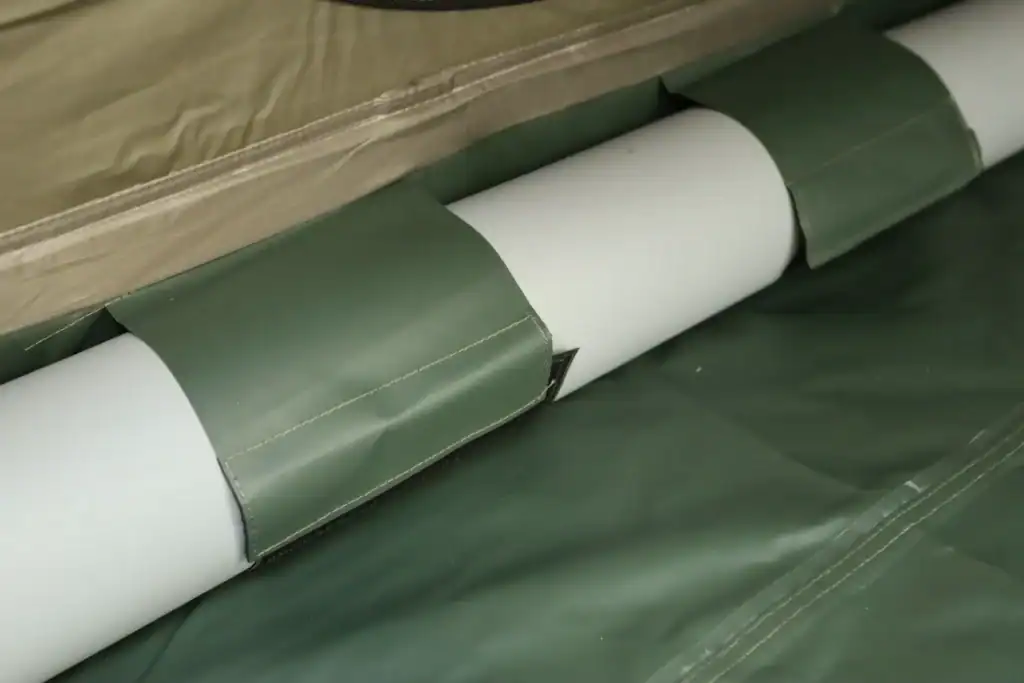
Cutting and Sealing
Most air-beam failures start at the seam, not the material.
Cutting happens before sealing, and it sets the stage for everything else. Air beams are cut from laminated rolls with hot cutters, die cutters, or ultrasonic cutters. A hot or ultrasonic cutter seals the edge as it cuts. A dull blade leaves loose fibers in the weld zone, and those fibers turn into micro-leak channels once the beam is pressurized.
That is why a 0.7mm TPU beam can fail at the seam even when the material spec is correct. And a thin 0.3mm PVC beam can blow out in cold weather even with a clean weld. Material choice and sealing method are two halves of the same decision.
RF Welding Process
RF welding uses electromagnetic energy to heat polymer molecules from the inside. The material itself forms the bond, leaving no adhesive layer to dry out or weaken. For TPU, this produces the fully waterproof seam expected on a premium tent. For PVC, RF welding works too, but the weld window is narrower and parameter control matters even more.
Die temperature, pressure, and cooling time all determine whether the bond holds. A factory that cannot document these settings is guessing. At Kelyland Outdoors, partner factories log production parameters and keep batch-level inspection reports, so seam quality is traceable from material input to finished beam.
Heat Sealing vs Gluing
Valve Installation
Two-way valves beat one-way for inflatable tents — if the flange weld matches the beam film.
One-way valves seal with an internal flap once pressure builds. That works on a camping mattress. On a tent air beam, it means a second, separate deflation port — another hole in the film, another welded flange, another potential leak.
One-way vs two-way
Two-way valves move air in and out through the same port. Twist the collar open to inflate or deflate, close it to hold pressure. Fewer ports make the beam less complex and the setup faster. That is why most serious inflatable tent programs spec two-way valves.
-
- One-Way: Internal flap seals automatically; requires a dedicated deflation port, doubling the number of valve welds per beam.
- Two-Way: Twist-lock collar opens the port for inflation and deflation; reduces leak points and shortens setup time.
- Failure risk: A PVC valve body on a TPU beam separates under cold-weather flexing. The valve and the beam film must come from the same polymer family.
Placement decides how long the valve lasts
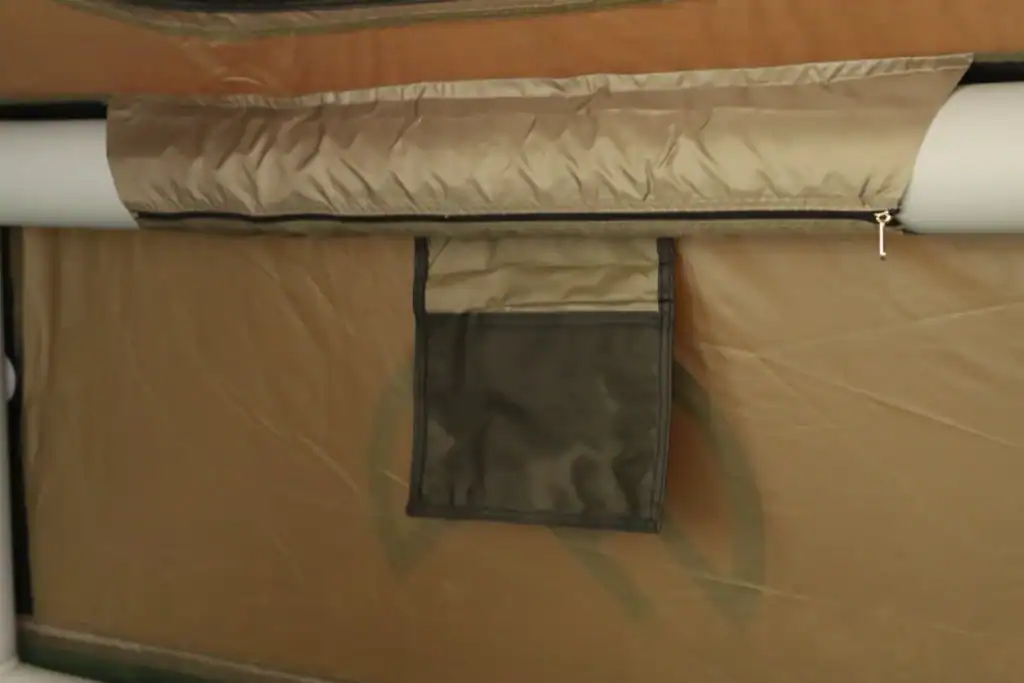
Most air beam valve placement durability failures trace back to one decision: mounting the valve on a curved end cap. That joint bends every time the tent is packed or unpacked. Flat side-panel placement spreads the stress evenly, especially when the beam is rolled for storage.
Material thickness changes the risk too. High-end beams use 0.5–0.7mm TPU, which gives the valve flange a stable base. Cheap 0.3mm PVC flexes more and gets brittle in cold air, so the flange starts micro-cracking around the weld. RF-welded flanges hold up better than heat-sealed ones for exactly this reason.
At Kelyland’s partner air-mattress factory in Xiangyang, Hubei, valve welding is handled as a dedicated QC gate on lines that produce 2.5 million units a year under ISO 9001. A buyer sourcing inflatable tents should expect that same discipline: a valve sample mounted on a beam sample, pressure-tested before the pre-production run.
Pressure Testing
A burst test that only measures working pressure is not a burst test.
The gap between working pressure and burst pressure decides whether a tent folds in a wind gust or fails at the seam. Budget tents often use 0.3mm PVC beams that blow out under a pressure load a 0.5–0.7mm TPU beam handles without strain. That margin is the real price difference between a cheap model and a durable one.
Burst Pressure Tests
A genuine burst test inflates the beam until it fails and records peak pressure plus failure location. The report should also list the inflation rate and ambient temperature, because both shift the result. When the seam splits before the film, the welding process is the weak point. When the film ruptures, the material thickness is the problem.
-
- Batch frequency: Burst reports from the development sample tell you what the design can do. Batch-level reports tell you what the factory actually shipped. Demand the latter.
- Failure location: A seam split points to the RF welding setup; a material rupture points to the film grade. Each requires a different fix.
- Dual ratings: The spec sheet should state working pressure and minimum burst pressure, so you compare suppliers on identical terms.
Kelyland Outdoors coordinates pressure testing before pre-shipment inspection across its partner network, where the air mattress factory in Xiangyang, Hubei operates under ISO 9001:2015 with CE and ETL certification on qualifying models. That sequencing matters: defects should surface before the goods are packed for export, not after arrival.
Leak Detection
Pressure decay testing sets a baseline: inflate the beam to working pressure, rest it for 24 hours, and measure the drop. A sound TPU beam holds its pressure overnight with minimal loss. A beam that goes soft by morning has a pinhole or a valve weld that is leaking, not a normal settling issue.
Soap solution testing along RF-welded seams and around the valve housing exposes micro-pinholes that pressure decay alone might miss. RF welding fuses TPU layers at the molecular level, which is why it beats heat sealing or glued construction for waterproofness. Glues age and degrade; welded bonds do not.
Valve placement is a durability factor, not just a convenience one. Valves seated in curved beam sections take repeated flexing stress every time the tent is packed down, a frequent cause of early failure. A straight-section valve seat with a reinforced weld area eliminates that bending stress at the connection point.
Assembly into Tent
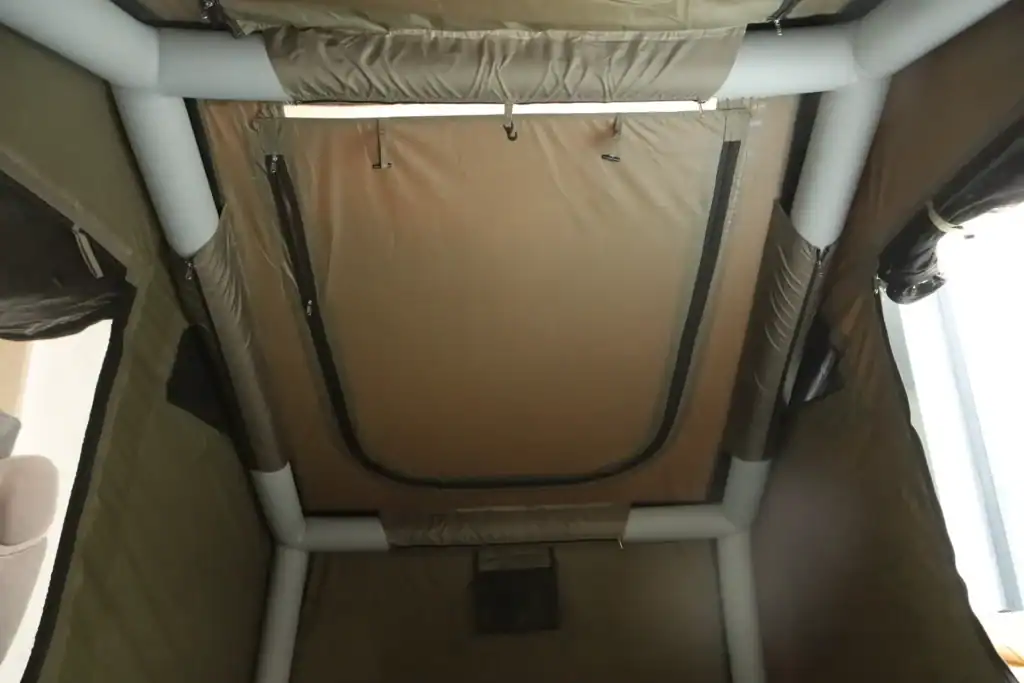
Sleeve tolerance decides whether an inflatable tent survives ten seasons or fails at the first gust.
The sleeve is the structural interface between the air beam and the tent body. A beam built from 0.5–0.7mm TPU can last for years, but if the sleeve fabric stretches, the seam allowance is inconsistent, or the channel is too loose, the tent sags and the beam twists. Sleeve integration is sewing engineering, not a simple fabric tube.
Beam-to-Sleeve Fit
An air beam expands slightly under inflation pressure. The sleeve must match the beam’s outer circumference at that operating pressure, not at zero pressure. Too tight and the beam can’t fully straighten, creating kinks along the frame. Too loose and the beam shifts inside the sleeve, wearing the seam and unbalancing the tent in wind.
Where Sleeves Fail First
The seam at each end of the sleeve is the first failure point. That’s where the beam presses hardest during setup and where sideways wind loads concentrate. A plain straight stitch won’t survive repeated insertions. The factory needs to bar-tack or back-stitch the ends, and the seam allowance should be pressed flat, not rolled, so the beam slides through without snagging.
What the Supplier Should Prove
-
- Sleeve Fabric: Sleeves should use a heavier Oxford or polyester weave than the fly sheet, with a tight weave that resists abrasion and UV breakdown.
- Seam Allowance: The allowance must stay consistent across every sleeve. During production, an operator checks it against the approved sample before final assembly.
- Tolerance Check: The sleeve opening should be measured at multiple points to confirm the beam slides in with slight resistance, not friction.
At Kelyland Outdoors, this step is part of the quality-control inspection that follows mass production. Partner factories operate under ISO 9001:2015, and the tent line runs through a final seam inspection before pre-shipment. The beam may be the expensive part, but the sleeve is what keeps it aligned in a storm.
Quality Checks
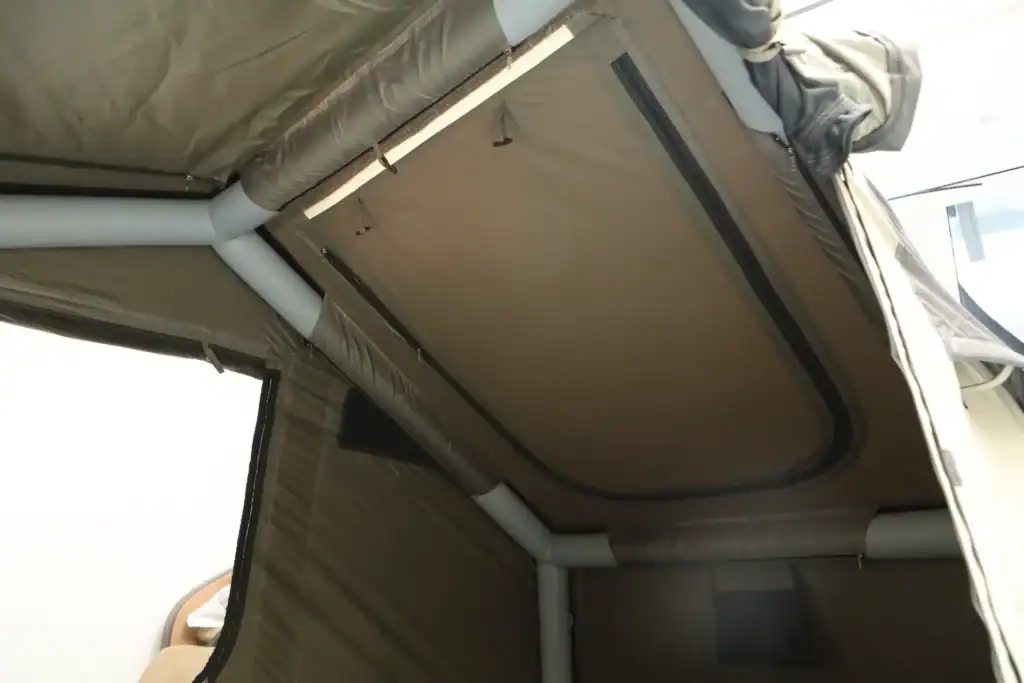
The difference between a 3-season tent and a warranty claim usually shows up in the QC room, not the showroom.
Air beam failures trace back to two things: material thickness and weld integrity. Neither shows up in a product photo. Both show up in the factory inspection reports that Kelyland’s partner facilities produce at every production stage, with ISO 9001:2015 oversight on the line.
Visual Inspection
A proper visual inspection starts with the welded seam. RF-welded beams should display a consistent melt width across the entire length — no thin spots, no bubbles, no scorching. Inspectors also check the area around the valve housing, where stress concentrates every time the beam is inflated.
The next check is material thickness. High-end air beams run 0.5–0.7mm TPU laminate, while budget PVC drops to 0.3mm — thin enough to blow out under repeated inflation cycles and prone to cold cracking below freezing. A caliper measurement takes ten seconds and tells you which tier a supplier actually uses.
Air Retention Test
The air retention test measures pressure drop over a fixed window, usually 24 hours after the beam is inflated to its rated working pressure. A quality beam holds steady within a small tolerance. A leaking beam loses pressure visibly, often at the valve seat or along a weld defect that visual inspection missed.
Buyers should ask for retention test data before approving a production run. Kelyland’s network, which produces 2.5 million air mattress units annually at its Xiangyang facility, runs retention checks across batches rather than testing a single golden sample — and shares the reports on request.
Conclusion
The material spec on your air beam determines how long your inflatable tent survives field use. The factory’s welding process and valve placement decide whether that spec holds up over time. Choose the cheapest laminate and you accept the warranty risk that comes with it.
-
- High-end air beams use 0.5–0.7mm TPU; budget lines use 0.3mm PVC that can blow out.
- RF welding creates a more waterproof seal than heat sealing or gluing alone.
- Insist on a burst pressure test report in PSI and a cold cracking temperature spec.
- Valve placement near stress points remains the most common cause of premature failure.
When you request quotes for inflatable tent OEM orders, put these three checks in the RFQ: Ask for the laminate thickness statement in writing. Request the RF welding process documentation. And require a burst pressure test report from a certified lab. If a supplier hesitates on any of the three, walk away. Review Kelyland’s air mattress page to see how a factory handles TPU lamination, RF sealing, and pressure testing in one integrated production setup — then compare that against what your current supplier provides.
Frequently Asked Questions
Which lasts longer: TPU or PVC air beams?
TPU air beams generally last longer than PVC because TPU resists hydrolysis, cold cracking, and repeated folding better. Real-world lifespan depends more on seam and valve weld quality than raw material alone. Choose TPU for cold or humid field conditions.
What TPU thickness should I spec for air beams?
For inflatable tents, spec a 0.5–0.7mm TPU air beam as a durable baseline. Validate the thickness against pressure and puncture requirements before approving the final build. Prototype at 0.6mm and pressure-test first.
Why do air-beam failures start at the seam?
Most failures start at the seam because welding creates a stress concentration weaker than the beam material. Seam construction and weld testing matter more than raw material choice alone. Require seam burst tests on every sample.
Are two-way valves better for inflatable tents?
Two-way valves are better for inflatable tents because they speed inflation and simplify deflation, but only if the flange weld matches the beam film. Test the welded valve flange under pressure before committing to mass. Verify valve weld quality on pre-production samples.
What is the MOQ for custom inflatable tents?
MOQ depends on customization scope: some Kelyland items support 50–100 pieces for custom orders, while standard inflatable tents usually sit in the 300–1,000 piece range. Beam material, valve type, and printing complexity. Get a confirmed MOQ after finalizing beam specs and quantity.

 English
 Español
 Deutsch
 Français
 Português do Brasil
 Русский
 العربية
 한국어
 日本語