 跳到内容
跳到内容 
folding wagon corrosion resistance is the first checkpoint buyers should lock before they approve a supplier, budget, or production slot. The rust doesn’t show up in the factory. It shows up eight months later, on a customer’s beach blanket, when the folding wagon’s frame leaves orange streaks on their towels and the wheels start to seize. That’s the moment your brand absorbs a warranty claim and a one-star review — not the supplier’s problem anymore. For anyone sourcing wagons for coastal retail, folding wagon corrosion resistance isn’t a spec sheet checkbox; it’s the difference between a repeat buyer and a returned unit.
Here’s what most buyers miss: the corrosion battle is won or lost before the first production run, in the coating line and fastener selection. A standard powder-coated Q235 carbon steel frame might look identical to an e-coated version at sample approval, but after a season of salt air and rain, one will hold its color while the other bleeds rust from every drilled hole and weld joint. The cost gap between those two frames is roughly $1.50 to $2.50 per unit — less than the shipping cost of one warranty replacement.

Steel Frame Corrosion: How Rust Starts and Spreads
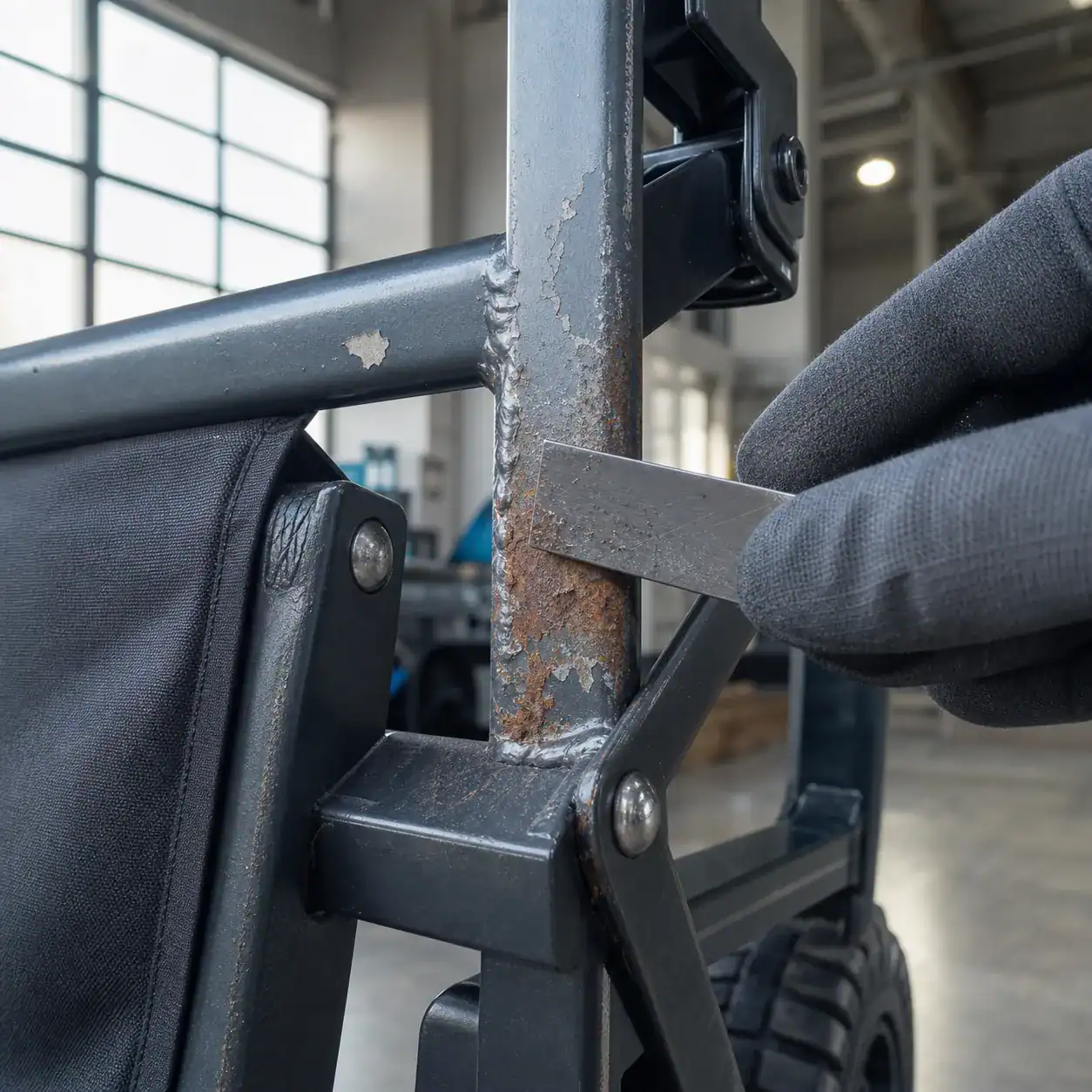
A scratched weld joint on a Q235 steel frame can show red rust in under 48 hours of salt spray.
Most folding wagon frames are made from Q235 carbon steel. It’s cheap, strong, and easy to weld. But it has no natural corrosion resistance. In a coastal environment, a bare Q235 frame will start to rust within hours of exposure to salt-laden air. The oxidation process — Fe + O₂ → Fe₂O₃·nH₂O — creates that familiar red-brown flaking. Once it starts, it spreads under the coating, lifting it from the inside out.
Rust Formation on Q235 Carbon Steel
Q235 is a low-carbon structural steel. Its corrosion rate depends on humidity and chloride concentration. In a standard ambient environment, the corrosion rate is around 0.1–0.2 mm per year. Multiply that by the typical wagon frame tube thickness of 0.8–1.2 mm, and you can see why pitting through the wall happens within 3–5 years if the coating fails. The factory network behind Kelyland Outdoors — including their ISO 9001 certified folding wagon partner in Jinhua, Zhejiang, which produces 1 million units annually — applies powder coating as the primary barrier. But the coating is only as good as the surface preparation.
Weak Points: Welds, Drill Holes and Scratched Coating
The most corrosion-prone areas on a folding wagon frame are not the long straight tubes. They are the drilled holes for rivets, the weld joints, and any edge where the coating is cut or ground off during fabrication. At the factory, the powder coating line applies a continuous layer over the assembled frame. But after welding, the heat-affected zone can have a different surface profile, and the coating may not adhere as tightly. When the wagon is folded or loaded, these joints flex and micro-cracks appear. Saltwater seeps in, and rust blooms from the inside. Experienced buyers request edge-sealing or touch-up specifications after fabrication — a step that many standard production lines skip.
-
- Drilled holes: The raw steel edge is exposed. Even with a post-drill touch-up, the coating thickness at the hole rim is often below 30 microns — half the recommended minimum.
- Weld joints: The weld bead creates a rough surface. Powder coating may not cover the peaks evenly, leaving thin spots that initiate corrosion.
- Scratches from assembly: During folding mechanism assembly, tools can scratch the coating. A scratch that exposes bare steel is a direct path for rust to start.
Where Powder Coating Protects (and Fails)
Powder coating is a thermoset polymer layer, typically 60–80 microns thick on a well-managed line. It provides excellent barrier protection against moisture and oxygen — as long as it remains intact. The problem is that folding wagons see constant flexing, abrasion from the fabric side panels, and impact from loading. Once the coating is breached, the exposed steel corrodes rapidly because the surrounding intact coating traps moisture against the damaged area. For inland use, a standard powder coat often lasts 3–5 years. For coastal markets, the same frame may show rust within 12 months. That’s why the Kelyland Outdoors sourcing team recommends e-coating (EDP) as a primer layer under the powder topcoat for beach-use wagons. The e-coat layer covers every edge and internal cavity, providing a second line of defense even if the topcoat gets scratched. The additional cost is roughly $1.50–2.50 per frame, but it can reduce corrosion-related warranty claims by up to 50%.
Aluminum Frame Corrosion: Different Metal, Different Risks
Aluminum doesn’t rust, but it corrodes differently — and sometimes faster.
Aluminum frames are common in premium folding wagons because they’re lighter than steel and don’t produce red rust. That leads many buyers to assume aluminum is corrosion-proof. It’s not. Aluminum corrodes through a different mechanism, and in coastal environments the failure mode can be just as destructive.
Aluminum Oxide: Natural Protection and Its Limits
When bare aluminum is exposed to oxygen, it instantly forms a thin oxide layer — typically 2-4 nanometers thick. That layer is hard, adherent, and self-healing in clean air. Scratches seal themselves within minutes under normal conditions. But saltwater changes the chemistry. Chloride ions penetrate the oxide layer at weak points — grain boundaries, surface scratches deeper than the oxide thickness, or areas where the alloy contains copper or zinc. Once the chloride breaches the oxide, localized pitting corrosion begins. The pit grows inward while the surface looks intact. A frame that appears fine externally may have lost 30% of its wall thickness at a single corrosion site.
Galvanic Corrosion When Aluminum Meets Steel Fasteners
This is where most aluminum wagon frames fail in practice. The frame is aluminum, but rivets, bolts, axle brackets, and hinge pins are often zinc-plated carbon steel or plain steel. Aluminum sits anodic to steel on the galvanic series scale. In the presence of salt moisture — exactly what a beach wagon encounters — electrons flow from the aluminum to the steel fastener. The aluminum around the fastener hole dissolves preferentially. The hole enlarges by tenths of a millimeter per season until rivets loosen or brackets separate entirely.
Coating Technologies Compared
E-coating plus powder topcoat adds $1.5–2.50 per frame but can cut corrosion warranty claims by half.
Most folding wagon frames leave the factory with a single layer of powder coating. It looks good in the showroom, but the real test is what happens after 48 hours in a salt spray chamber. The coating technology you specify determines whether that wagon survives two seasons on a beach or ends up in a warranty return pile by month eight.
Powder Coating Thickness Specs: 60–80 Microns
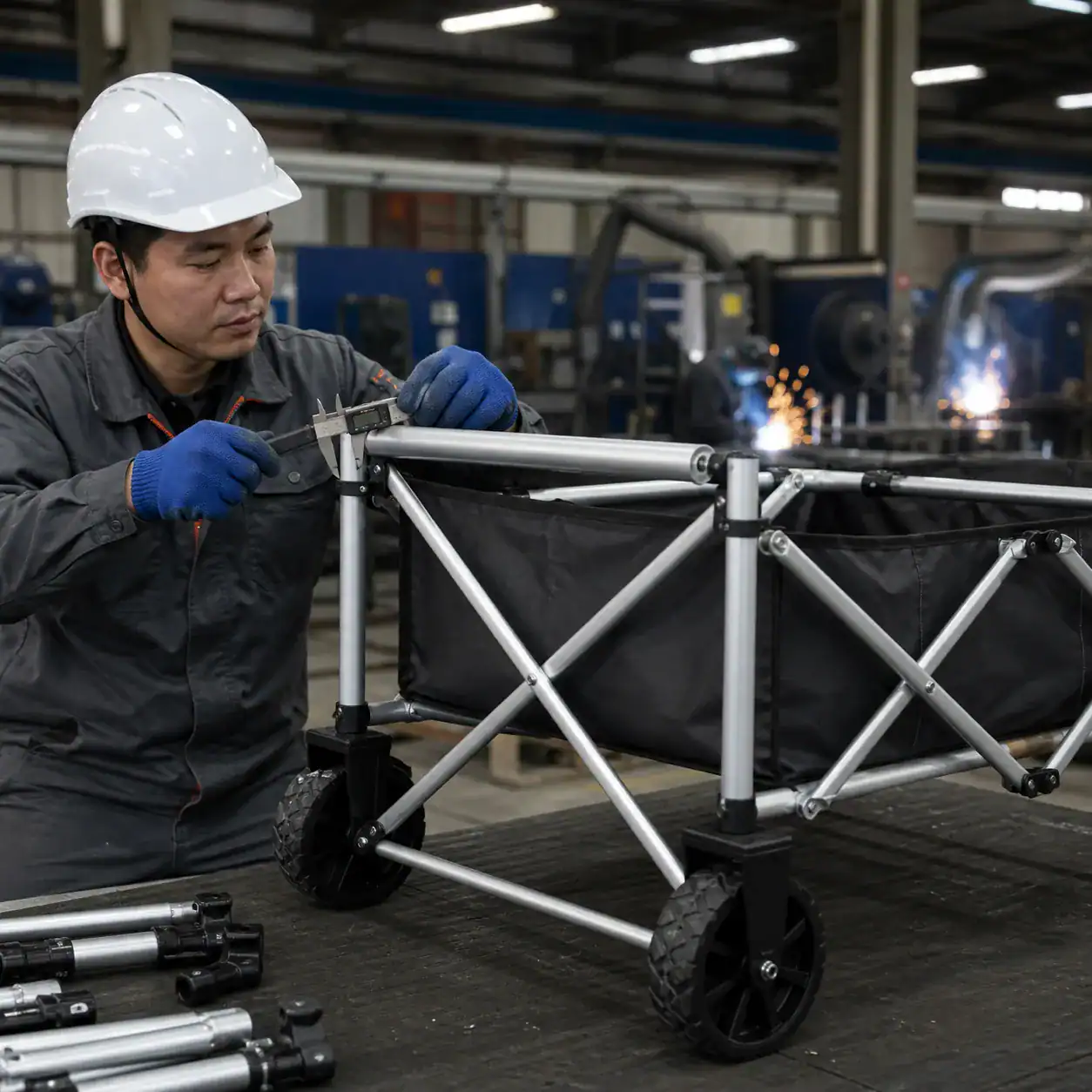
Standard powder coating on a carbon steel folding wagon frame runs between 60 and 80 microns. That’s roughly the thickness of a sheet of printer paper. At this range, the coating provides adequate protection for inland use — weekend camping trips, park outings, occasional rain. The problem is consistency. A frame with 50 microns at the corners and 90 on the flat sections will fail at the thin spots first. The coating thickness spec is only useful if the factory measures it with a calibrated gauge and provides a per-frame report.
Thicker isn’t always better. Above 120 microns, powder coating becomes brittle and can crack during frame folding or under load. The 60–80 micron sweet spot balances flexibility with coverage. For coastal markets, that single layer is often insufficient. Salt spray penetrates through pinholes in the coating — microscopic gaps that form during the curing process — and once the corrosion starts under the film, it spreads laterally. You get blistering before visible rust appears.
E-Coating (EDP) + Powder Topcoat for Maximum Protection
This is the combination that changes the warranty math. E-coating, also called electrodeposition or EDP, applies a thin epoxy primer layer — typically 15–25 microns — before the powder topcoat. The key difference is how it’s applied. The frame is submerged in a bath and an electrical current drives the primer into every crevice, weld joint, and interior tube surface that a spray gun cannot reach. The powder topcoat then goes on top as the color and UV-resistant layer.
The cost adder is real: roughly $1.50 to $2.50 per frame depending on frame complexity and order volume. But the return on that investment is measurable. Internal production data from folding wagon factories shows that e-coat plus powder reduces corrosion-related warranty claims by up to 50% compared to single-layer powder coating. For a buyer sourcing 5,000 units per year for a coastal retail chain, that $7,500–$12,500 upfront cost avoids tens of thousands in replacement shipments and negative reviews.
Galvanized Steel: Is It Used in Folding Wagons?
Hot-dip galvanizing — dipping steel into molten zinc — creates a thick, sacrificial layer that protects even if the coating gets scratched. It’s common on trailer frames, construction equipment, and marine hardware. For folding wagons, it’s rare. The reason is geometry. Galvanizing adds 50–100 microns of zinc, which changes the fit tolerance on folding joints and rivet holes. The process also leaves a rough surface finish that doesn’t accept powder coating well, limiting color options. Most buyers prefer the appearance of a smooth powder-coated frame over the raw metallic look of galvanized steel.
That said, some heavy-duty wagon models use galvanized steel for the main lower frame rails, then powder-coat the visible upper structure. This hybrid approach works for beach-use wagons where the bottom of the frame contacts saltwater directly. If you’re sourcing for a coastal market, ask whether the factory can apply a zinc-rich primer as an alternative. It’s not as durable as hot-dip galvanizing, but it adds corrosion resistance without the fit issues.
Anodizing for Aluminum Frames
Aluminum frames don’t rust, but they corrode. Anodizing is the standard protection method. It thickens the natural aluminum oxide layer through an electrochemical process, creating a hard, porous surface that can be sealed or dyed. For folding wagons, a Type II (sulfuric acid) anodize at 5–15 microns is typical. It provides good abrasion resistance and a uniform matte finish. Type III (hard coat) anodize at 25–50 microns is overkill for a wagon frame — it’s used on aerospace components and firearm receivers.
The critical spec for aluminum wagon frames is the anodizing seal quality. If the pores aren’t properly sealed after anodizing, the coating remains porous and traps moisture against the aluminum. This leads to a white, powdery corrosion called aluminum oxide bloom. It’s cosmetic initially, but it weakens the metal over time. A simple field test: wipe the anodized surface with a clean cloth. If the cloth picks up a white residue, the seal is compromised. For beach-use aluminum frames, specify a minimum 72-hour salt spray test per ASTM B117. Aluminum that passes 72 hours without pitting will hold up through multiple seasons of coastal exposure.

Corrosion Testing Standards Buyers Should Know
ASTM B117 salt spray at 48 hours is the minimum for steel; coastal products demand 72+ hours.
Salt Spray Test (ASTM B117): The Industry Benchmark
The salt spray test exposes a coated frame to a continuous fog of 5% sodium chloride solution at 35°C inside a sealed chamber. It simulates years of coastal exposure in a compressed timeframe. For powder-coated steel frames on folding wagons, the common acceptance standard is 48 hours without red rust on the main tube surfaces. That means no visible corrosion beyond tiny spots at cut edges or scribe marks. Buyers specifying for beach or saltwater environments should push that to 72 hours minimum — and require that any rust be limited to less than 1mm from a scribe line.
A partner factory in Jinhua, Zhejiang, which produces over 1 million folding wagon units annually, runs in-house ASTM B117 chambers as part of its standard QC protocol. This allows them to validate coating batches before production ramps up — not after defects appear in the field. If your supplier cannot provide a third-party salt spray report for the exact coating specification you’re ordering, you are buying blind.
Humidity Testing: What It Measures
Humidity testing places samples in a chamber held at 95-100% relative humidity and 38-40°C, typically for 240 hours (10 days). Unlike salt spray, which accelerates electrochemical corrosion via chloride ions, humidity testing evaluates how moisture alone degrades the coating system — blistering, softening, or adhesion loss. A frame that passes salt spray but blisters under humidity has a poor primer bond or trapped solvent under the topcoat. This failure mode shows up as bubbling under the paint within months in humid retail storage or damp climates like Florida or Southeast Asia.
-
- Spec: 240-hour humidity exposure per ASTM D1735 with no blistering rated worse than ‘few’ per ASTM D714.
- Risk: Coating blistering leads to flaking at rivet holes and weld joints within one season — direct path to warranty claims.
Coating Thickness Measurement with a Micron Gauge
Writing Corrosion Requirements into Your Product Spec
Specify edge-sealing after fabrication to prevent corrosion at weld joints and drill holes.
Writing corrosion resistance into your product spec sheet is more than selecting a coating type. The real protection comes from specifying thickness tolerances, test acceptance criteria, fastener grades, and packaging measures. Without these details, the factory will default to the cheapest option that passes visual inspection — and rust will appear within 12 months on a coastal beach wagon.
Minimum Coating Thickness Tolerance
For powder-coated carbon steel frames — the most common material in folding wagons produced by ISO 9001-certified factories like those in Kelyland’s network — specify a minimum dry film thickness of 60 microns. The acceptable range is 60-80 microns. Below 60 microns, the coating becomes porous enough for moisture to reach the Q235 carbon steel substrate. Above 80 microns, you risk cracking at hinge points during folding. Include a clause requiring verification with a calibrated micron gauge at three points per frame: the main crossbar, a weld joint, and a drilled rivet hole.
Salt Spray Test Acceptance Criteria
State ASTM B117 as the test method. For powder-coated steel frames bound for coastal retail markets, demand 48 hours of exposure with zero red rust on cut edges or weld zones. For aluminum frames — which are increasingly specified for beach wagon use — target 72 hours minimum without pitting corrosion on anodized surfaces. Write this into your quality agreement before mass production begins. A supplier who runs in-house salt spray testing can deliver results within the standard 30-45 day lead time; one who outsources it adds two weeks and often misses the pre-shipment window.
Fastener Grade: Stainless Steel vs Zinc-Plated
Questions to Ask Your Factory About Corrosion Protection
48-hour ASTM B117 salt spray is the minimum for steel frames.
When a folding wagon lands on a retail shelf, the frame coating is the only thing between the customer and a rust claim six months later. The corrosion journey starts at the factory, and most buyers never ask how it’s managed until the warranty returns pile up. Here are three questions that separate a supplier who understands corrosion from one who just sprays paint and hopes.
Does the Factory Have In-House Salt Spray Testing?
This is the fastest way to gauge a supplier’s quality control depth. A factory that runs its own ASTM B117 salt spray cabinet can verify coating performance on every batch, not just when a buyer demands a certificate. For powder-coated steel frames, 48 hours without red rust is the common acceptance standard. Aluminum frames targeting beach use should hold 72+ hours. If the supplier outsources testing to a third party, ask how often — once per production run or once per year? The difference tells you whether they’re managing quality or just collecting paperwork.
How Are Weld Joints and Cut Edges Sealed?
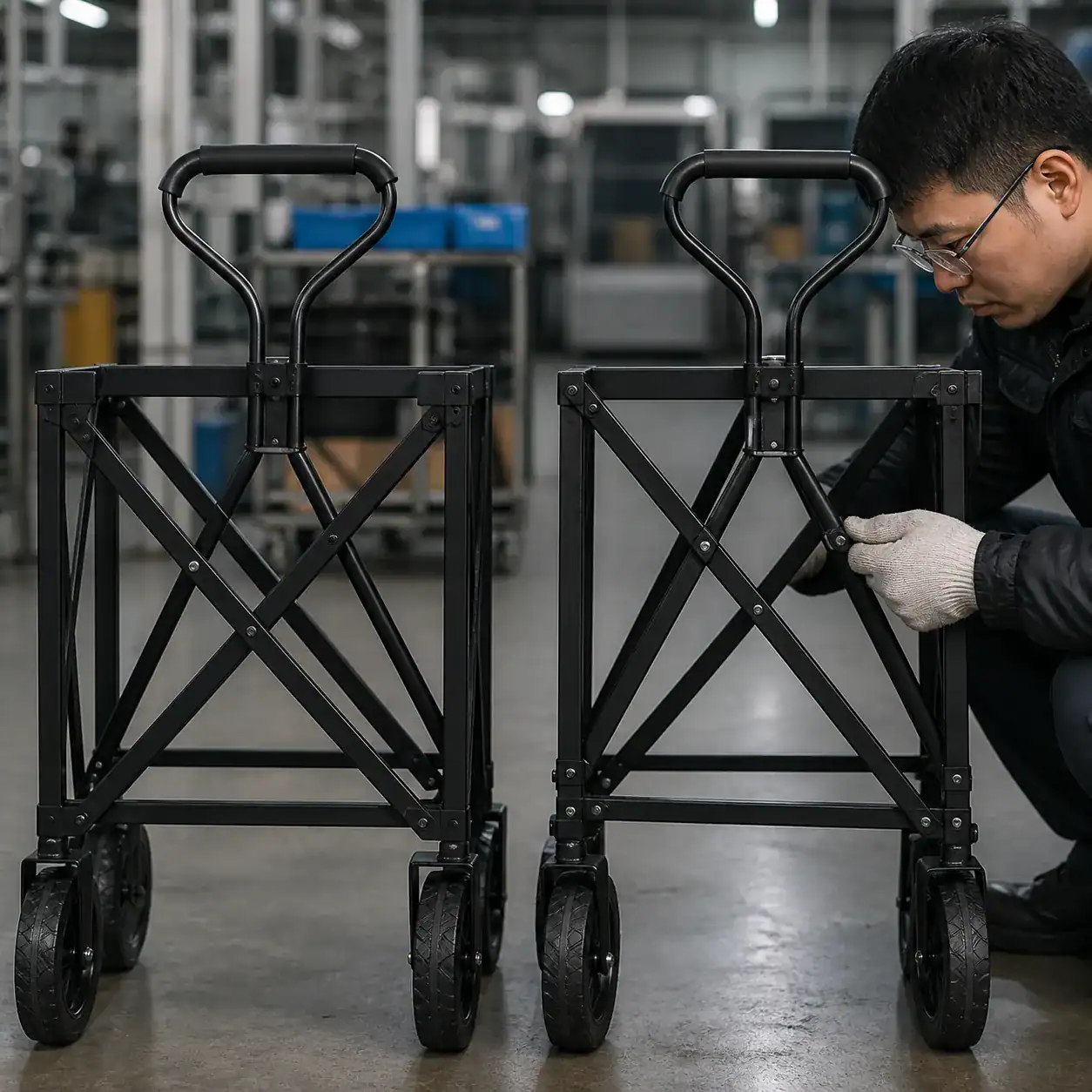
The most corrosion-prone areas on a folding wagon frame are drilled holes for rivets and weld joints. During fabrication, these spots get damaged by the coating process — heat burns off powder near welds, and drilling exposes raw metal edges that never see paint. Experienced buyers request edge-sealing or touch-up specifications after fabrication. Some factories apply a zinc-rich primer to welds before powder coating; others rely on post-coating sealant applied by hand. Neither approach is expensive, but skipping it guarantees rust blooms along every joint within two seasons.
What Coating Process Is Applied to the Frame?
Conclusion
The difference between a folding wagon that lasts two seasons and one that lasts five is rarely the brand logo. It’s the coating spec, the fastener grade, and whether the factory seals the drilled holes after fabrication. For coastal markets or any environment with salt exposure, standard powder coating alone is a gamble you don’t need to take.
-
- Specify ASTM B117 salt spray testing for at least 48 hours on steel frames and 72+ hours on aluminum frames.
- Request e-coating (EDP) plus powder topcoat for coastal markets — adds roughly $1.50-$2.50 per frame.
- Require stainless steel fasteners to prevent galvanic corrosion between aluminum frames and steel rivets.
Now take that spec sheet and add two lines before sending it to your factory partners. First, a minimum coating thickness tolerance of 60-80 microns measured with a micron gauge at three points per tube section. Second, a requirement for touch-up sealing on all weld joints and cut edges after fabrication — this is the detail that separates professionals from amateurs in corrosion prevention. Review current folding wagon OEM/ODM capabilities from ISO-certified factories to see how these specs translate into production costs and warranty timelines.
Frequently Asked Questions
What causes folding wagon frame corrosion?
Salt, rain, and coastal humidity accelerate rust on steel frames and pitting on aluminum. The worst damage starts at scratched welds, drill holes, and unsealed cut edges where moisture penetrates the. Specify sealed welds and full coating coverage to prevent early failure.
Which frame material resists corrosion best?
Aluminum frames resist general corrosion better than Q235 carbon steel because they form a protective oxide layer. However, aluminum is vulnerable to galvanic corrosion when paired with steel fasteners, so stainless. Use stainless steel fasteners with any aluminum frame for coastal use.
What coating stops rust on folding wagons?
E-coating (EDP) plus a powder topcoat provides the best protection for steel frames, adding $1.50–2.50 per unit but cutting warranty claims significantly. Standard powder coating alone at 60–80 microns fails quickly. Require E-coat + powder for any wagon destined for coastal markets.
What salt spray test should I specify?
Specify ASTM B117 salt spray testing for at least 48–72 hours with no red rust on cut edges or weld joints. This standard directly simulates coastal use and gives you a. Include the test requirement in your spec sheet before sample production.
How do I verify factory coating quality?
Request both test results before approving mass production.

 English
  Español
  Deutsch
  Français
  Português do Brasil
  Русский
  العربية
  한국어
한국어  日本語
日本語