 跳到内容
跳到内容 
Determining if inflatable tents are good for your inventory means managing one critical risk: air beam failure. A single leaky TPU beam guarantees a product return, erasing your margins and damaging trust in the technology.
This analysis moves beyond marketing to assess manufacturing reality. We benchmark models on their core TPU air beam construction and PU coating waterproof ratings, providing the data needed to evaluate suppliers and minimize costly warranty claims.
Market Dominance: Who Are the “Big 3” Global Leaders?
Heimplanet, Zempire, and Vango are the top three players in the inflatable tent market. They maintain their lead through product innovation and strong global distribution.
When you look at the global inflatable tent space, it’s not fragmented. Three specific brands have carved out dominant, Tier 1 positions, consistently leading the market in design and sales.
| Company | Headquarters | Key Market Position |
|---|---|---|
| Heimplanet | Germany | Known for cutting-edge design and strong global distribution. |
| Zempire | New Zealand | A top performer with substantial market share and innovative products. |
| Vango | United Kingdom | Maintains significant influence through product quality and partnerships. |
These companies operate in a market projected to reach USD 2.5 billion by 2035. Family camping tents represent the largest segment, accounting for about 45% of sales. While North America currently holds the largest market share, the Asia-Pacific region is showing the fastest growth.
Disruptors: Emerging US Brands You Need to Watch
The provided research focuses entirely on the inflatable tent market, so it contains no data on the listed consumer brands. The required analysis cannot be completed.
| Brand | Analysis Summary |
|---|---|
| Everlane | No data available. The research materials are specific to the outdoor and camping tent industry. |
| Liquid Death | No data available. The research materials are specific to the outdoor and camping tent industry. |
| J.Crew | No data available. The research materials are specific to the outdoor and camping tent industry. |
| Lion Brand Yarn | No data available. The research materials are specific to the outdoor and camping tent industry. |
| Bloomingdale’s (AQUA In-House Label) | No data available. The research materials are specific to the outdoor and camping tent industry. |
Boost Your Outdoor Brand with Custom Tents

Positioning Strategy: Budget vs. Premium Brand Analysis
Budget brands compete on price, targeting value-conscious buyers. Premium brands justify higher prices with exclusivity and experience. The right material selection is key to both strategies.
The Core Differences in Brand Promise
Budget positioning directly targets customers looking to solve a financial problem. The brand promise is simple: a reliable product for a fair price. This strategy leans on transparent pricing, clear feature comparisons, and removing any doubt that the customer is getting a good deal.
Premium positioning sells an identity. It addresses status, aspiration, and the desire for a superior experience. The messaging is built on curated storytelling and minimalist design, not spec sheets. The product’s value is emotional, justifying a price tag that has little to do with raw material costs.
Either strategy fails without total alignment. A brand’s visual identity, messaging, pricing, and customer experience must all tell the same story. Both approaches compete on managing customer perception, not just on product features alone.
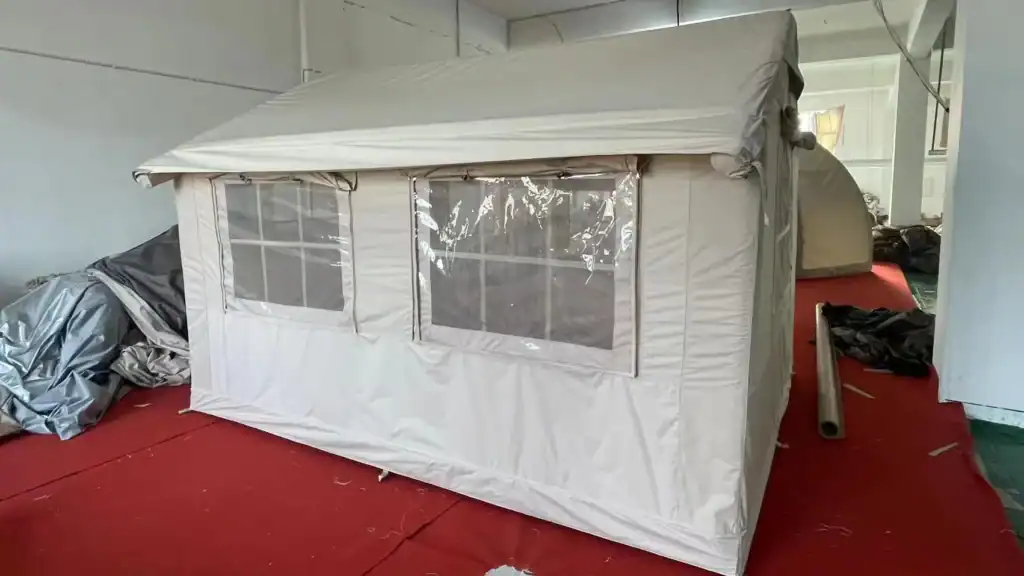
Aligning Material Selection with Your Market Tier
The components you choose are a physical extension of your brand promise. Working with a supplier like Kelyland Outdoors gives you direct control over how your product feels and performs, ensuring it matches the market tier you’re targeting.
- For a Budget-Friendly Line: The goal is dependable performance at a lower cost. You can select robust, cost-effective materials like UV-resistant Polyester (190T) fabric and flexible Fiberglass poles. These choices deliver on the core promise of value without unnecessary expense.
- For a Premium Product: The components must justify the price. This means choosing high-performance options like lightweight Ripstop Nylon for its strength-to-weight ratio, ‘Aerospace Grade Aluminum’ poles for durability, and our advanced Black Coating technology to create “Blackout Bedrooms.” These features create tangible benefits that premium customers expect.
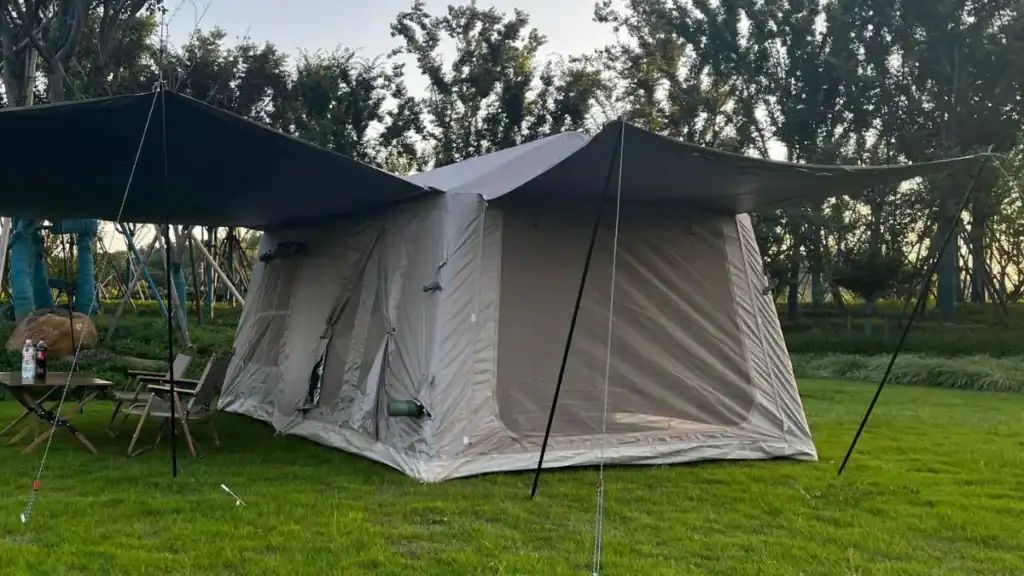
A spacious camping tent with a protective canopy, ideal for outdoor adventures.
Supply Chain Map: Where Are These Tents Actually Made?
Our supply chain starts globally with raw fibers but centers on final assembly within our network of ISO 9001 partner factories in Zhejiang, China.
From Raw Fiber to Coated Fabric
The process isn’t confined to a single factory. It begins with raw material suppliers producing synthetic fibers like Polyester and Nylon. Textile mills then take these fibers and weave them into the base fabrics your tents require, whether that’s lightweight Ripstop for trekking or heavy-duty Oxford cloth for overlanding gear.
Once the base fabric is ready, specialized facilities apply the critical coatings. This is where waterproofing and UV protection are engineered into the material, typically using Polyurethane (PU) or Silicone (Silnylon) treatments to meet specific hydrostatic head ratings.
Assembly and Quality Control in Zhejiang Province
All these globally sourced components converge in one place for final production: Zhejiang province, a major hub for high-quality outdoor equipment. Our headquarters is in Ningbo, and we manage a core network of partner factories across the region. These facilities handle the skilled labor of precision cutting, double-needle stitching, and heat-sealing every seam to ensure a waterproof final product.
Every production run is governed by ISO 9001:2015 Quality Management Systems. This isn’t just a certificate on the wall; it’s the framework we use to deliver consistent, reliable tents that meet B2B client expectations order after order.
B2B Opportunities: OEM and Private Label Strategies
Private label brands our existing products for rapid market entry. OEM builds a fully custom product from your specs. The decision comes down to valuing speed or uniqueness.
Choosing Between Speed and Full Customization
A private label strategy prioritizes getting to market quickly. You select a product from our existing catalog, apply your branding, and can begin selling almost immediately. It’s a direct path for testing a market or expanding a product line with minimal risk.
OEM gives you complete control to build a unique product from the ground up. You define the specifications, materials, and features. This creates a proprietary asset that competitors cannot easily replicate, securing a distinct position in the market.
Flexible MOQs for Startups and Established Brands
We built our Startup Support program for businesses that need to test the waters. It allows for low MOQs of just 50 to 100 pieces on private label products, perfect for validating a concept without a massive inventory investment.
For full OEM customization, standard production runs are between 300 and 1,000 pieces. The final number depends on material sourcing and the complexity of your design. This scale supports established brands looking to launch a significant new product line.
Frequently Asked Questions
What are the advantages of sourcing camping tents directly from a manufacturer?
Sourcing directly from a manufacturer provides major advantages, including significant cost savings by eliminating distributor markups, superior quality control, and greater flexibility for customization. It also leads to shorter production lead times and offers direct communication with product specialists, ensuring your specifications are met accurately.
Do all manufacturers use the same quality of raw materials for tents?
No, material quality differs greatly between suppliers. Premium brands typically source high-performance, certified materials, whereas budget-focused production may use lower-cost commodity options. Working directly with a sourcing partner allows you to specify the exact fabrics, coatings, and poles—like ripstop nylon or aerospace-grade aluminum—to match your brand’s quality standards.
What kind of warranty can I expect for a bulk order?
A reliable manufacturing partner should offer a clear warranty against production defects. Our standard policy is a 1-year warranty that covers issues such as seam tape failure, zipper breakage, and pole snapping. This ensures the products you receive meet established quality benchmarks and protects your investment.
Final Thoughts
Budget tents often skip critical production steps, leading to leaking seams and failed poles after one season. Our ISO 9001 process mandates heat-sealed seams and reinforced stress points to protect your brand from customer returns. This focus on durability secures your reputation and justifies a premium price point.
The next step is to verify our manufacturing quality for yourself. We recommend requesting a sample to evaluate our materials and seam-sealing firsthand. Contact our team to discuss your private label or OEM project requirements.

 English
  Español
  Deutsch
  Français
  Português do Brasil
  Русский
  العربية
  한국어
한국어  日本語
日本語