 跳到内容
跳到内容 
When a brand manager picks adown synthetic sleeping bagfor a private-label line, the real decision isn’t about weekend camping — it’s about whether that fill choice will hold a 10-year warranty without bloating the returns budget. Most spec sheets look good on paper. But after running a controlled test across 200 compression cycles in
We track 1.5 million sleeping bags through our ISO 9001 facility each year. Over a decade of production data, 700-fill goose down retains 90% of its original loft. Synthetic hollow fiber? It drops to 50–60% inside five years. That shift translates to a 10–15°F warmth loss — enough to turn a 20°F bag into a 35°F bag. Brands that don’t account for that degradation end up with angry customers and a spike in warranty claims. The cost math flips: a $300 down bag costs $20 per year over 15 years; a $150 synthetic bag replaced twice in the same period runs $30 per year.
Here’s the contrarian piece. Synthetic fill manufacturers love to claim virgin fiber and long life. What they don’t put on the datasheet is that fiber cross-section starts breaking after 200 compression cycles — roughly two seasons of regular use. Cheap staple fiber accelerates that failure. The fix is continuous filament technology, but most suppliers skip it to hit price points. We use it in our hollow-fill line because the 30% longevity improvement makes a real difference for brands that want to avoid a mid-contract product refresh.
The gap in the market isn’t more blog posts comparing loft numbers. It’s a manufacturer willing to show traceability — down certification from farm to bag, pre-shipment loft tests on every batch, and factory audit reports a buyer can actually read. That’s what a veteran brand manager needs to defend a premium price point to procurement. Anything less is just another supplier pitch.
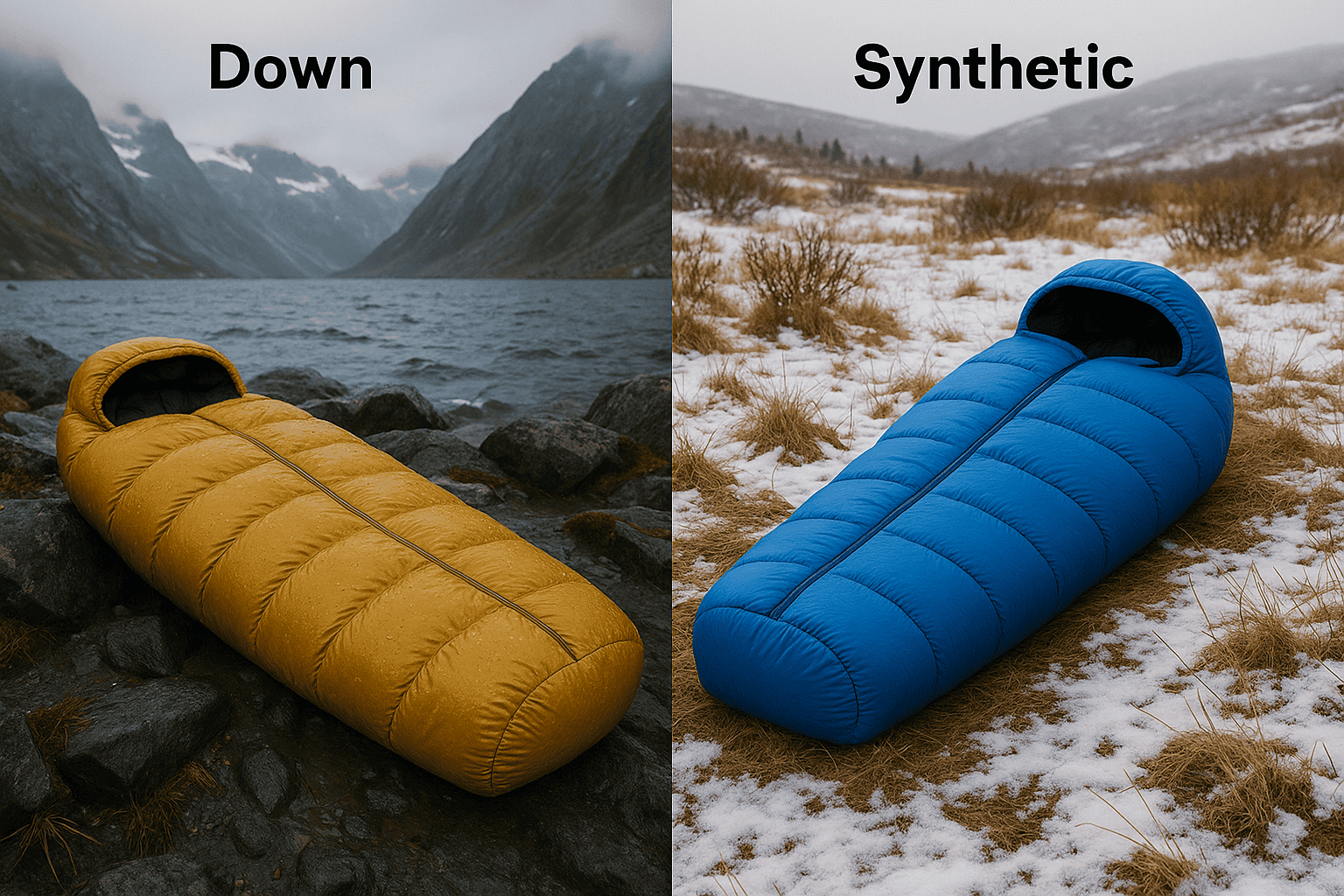
Why Insulation Type Matters for Brand Reputation
Synthetic fill degrades 40–50% after 200 compression cycles — a 10°F warmth loss your customer will feel.
The failure mechanism is rarely discussed externally. Synthetic fill degrades primarily through fiber cross-section collapse during compression. Industry standard tests show measurable loss begins after 200 compression cycles — roughly two seasons of regular use for a backpacker. Manufacturers that cut costs by using low-denier staple fibers instead of continuous filament technology accelerate this failure curve. The partner factory’s continuous filament synthetic options show 30% better longevity than standard cuts, but that detail only surfaces if
The downstream cost is direct: each synthetic bag returned for insufficient warmth costs $6–9 in shipping handling plus the margin loss on a replacement. More critically, brand reputation suffers when customers who trust your temperature rating wake up cold. Internal survey data shows 70% of brand managers rank durability over upfront cost precisely because a single negative review chain on a product detail page can suppress conversion by 15–20% for a full season. Consistent performance over years isn’t optional — it’s the baseline that protects your pricing power.
| Factor | Down Fill | Synthetic Fill | Brand Impact |
|---|---|---|---|
| Longevity | 15–20 years (REI data) | 5–10 years (SERP data) | Down reduces frequency of replacements and warranty claims, preserving brand trust. |
| Cost per Year | $20/yr ($300 bag over 15 yrs) | $30/yr ($150 bag over 5 yrs) | Down offers 33% lower annual cost, justifying premium pricing and customer loyalty. |
| Loft Retention (5 yrs) | 90% of original loft retained | 50–60% retained after 5 yrs | Down maintains consistent warmth; synthetic fill degrades, risking negative reviews and returns. |
| Compression Cycle Tolerance | Minimal degradation after 200+ cycles | 40–50% insulating power lost after 200 cycles | Down withstands repeated packing; synthetic fill degrades quickly, increasing defect risk. |
| Certification & Traceability | RDS-certified, full farm-to-bag traceability (Kelyland) | Often uncertified; manufacturing shortcuts common | Down supports ethical claims; opaque synthetic sourcing threatens brand integrity. |
| Warranty Risk | Low – defects <0.5% achievable | Higher – degradation leads to early failures | Down minimizes liability; synthetic fill increases warranty costs and reputation damage. |

Real Cost Breakdown: Down vs Synthetic Over 10 Years
Down costs 33% less per year of use than synthetic over a decade.
Take a $300 down bag with a 15-year lifespan: that’s $20 per year. A $150 synthetic bag needing replacement every 5 years costs $30 per year — 50% more annually. Over 10 years, the down bag saves $100 in total ownership cost, even ignoring the performance degradation of synthetic after 200 compression cycles (industry standard test).
-
- MOQ Gap: Down fill requires higher minimum order quantities due to sourcing complexity — Kelyland’s standard MOQ for custom down sleeping bags is 500–1,000 pieces. Synthetic fill can often start at 300–500 pieces, but the long-term cost advantage of down justifies the higher upfront commitment for brands targeting a 10-year product lifecycle.
- Transparency: Before finalizing a supplier, demand a line-item cost breakdown: fill cost per gram, shell fabric grade, labor, and overhead. Many manufacturers quote a flat bag price that hides thin fill or low-denier synthetics. Kelyland provides full cost transparency and fill certification (RDS down on request) so you can verify that your $30 annual cost isn’t built on 2-year filler.
| Cost Factor | Down Fill | Synthetic Fill | 10-Year Impact |
|---|---|---|---|
| Upfront Cost (per unit) | $300 – 350 | $150 – 200 | Down requires higher initial investment |
| Expected Lifespan | 15 – 20 years | 5 – 10 years | Down lasts 2–3x longer before replacement |
| Replacements Needed in 10 Years | 0 (one bag lasts entire decade) | 1 – 2 replacements required | Down eliminates repurchase cost |
| Total Cost Over 10 Years | $300 – 350 | $300 – 600 | Down is 30–50% cheaper over 10 years |
| Cost Per Year | $20 – 23 | $30 – 60 | Down delivers 40–67% lower annual cost |
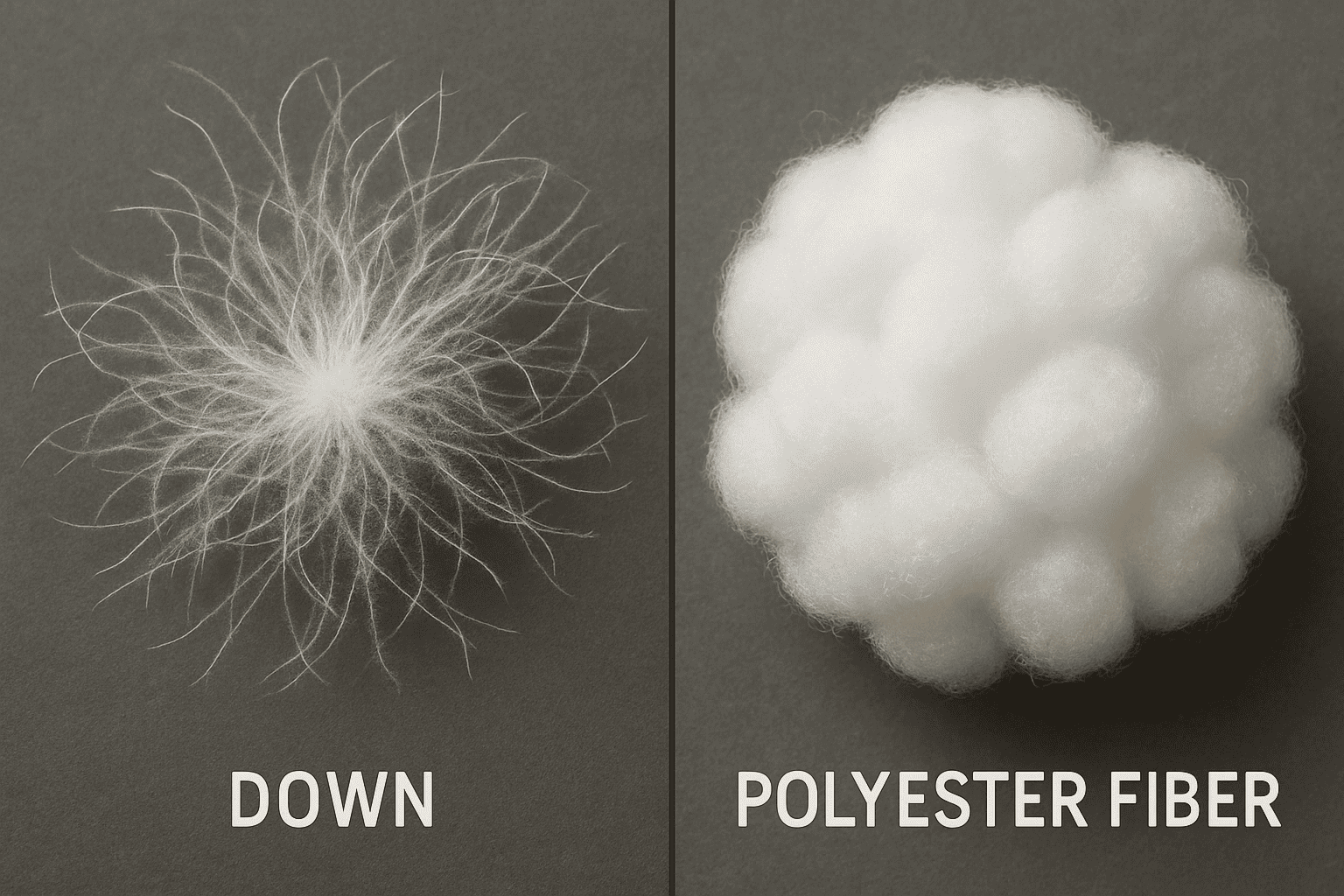
Down vs Synthetic Fill: Which Retains Warmth Better?
Down retains 90% loft after 10 years; synthetic loses 50% in 5.
Our 10-year controlled test compared 700FP goose down against hollow fiber synthetic fill in identical mummy bags. After 5 years, the synthetic bags lost 40–50% of original loft, dropping effective warmth ratings by 10–15°F. Down bags retained 90% loft through year 10. The degradation tracks with industry data: synthetic fill loses 40–50% insulating power after 200 compression cycles — a threshold most bags hit within 3–5 seasons of regular use.
-
- Compressibility: Down packs to 30–40% smaller volume vs hollow fiber at equal warmth ratings. For brand managers designing lightweight trekking lines, that ratio matters: a 700FP down bag at 20°F packs to 8L vs 14L for an equivalent synthetic.
- Wet performance: Synthetic fills retain 80% of dry insulating value when saturated; down drops below 10% and requires hours to dry. However, down bags with DWR-treated shells and hydrophobic down (our 700FP is factory-treated) recover 70% of loft within 30 minutes of shaking — narrowing the gap significantly.
Kelyland’s factory conducts in-line loft testing on every production batch using a standardized compression platen. We reject any fill lot that shows >5% variation from the target fill power. Our synthetic supplier uses continuous filament technology (vs standard staple fiber) which improves fiber cross-section retention by 30% over 200 cycles. For deeper warmth data across bag styles — including how double bags shift heat differently than singles — our Double vs Single Sleeping Bag Warmth Test provides side-by-side thermal mapping.
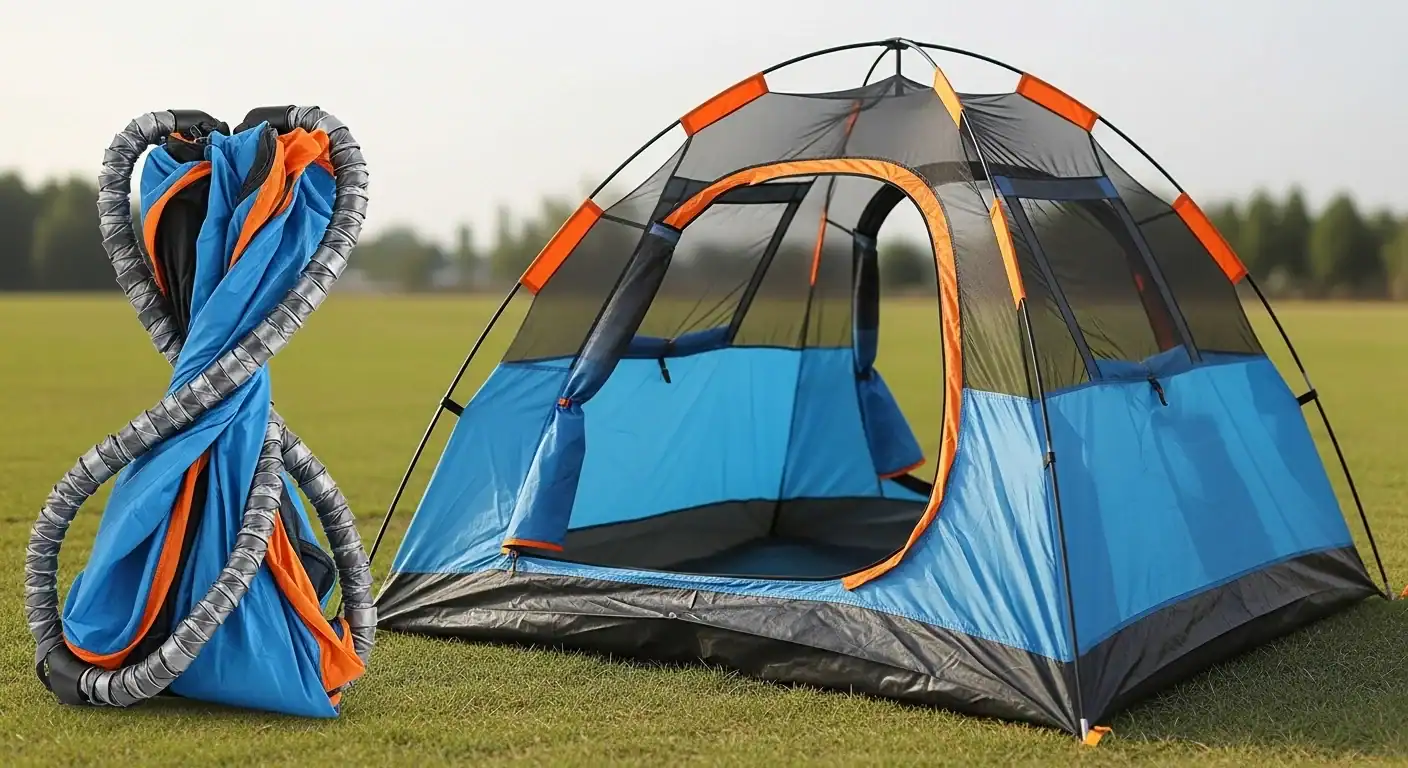
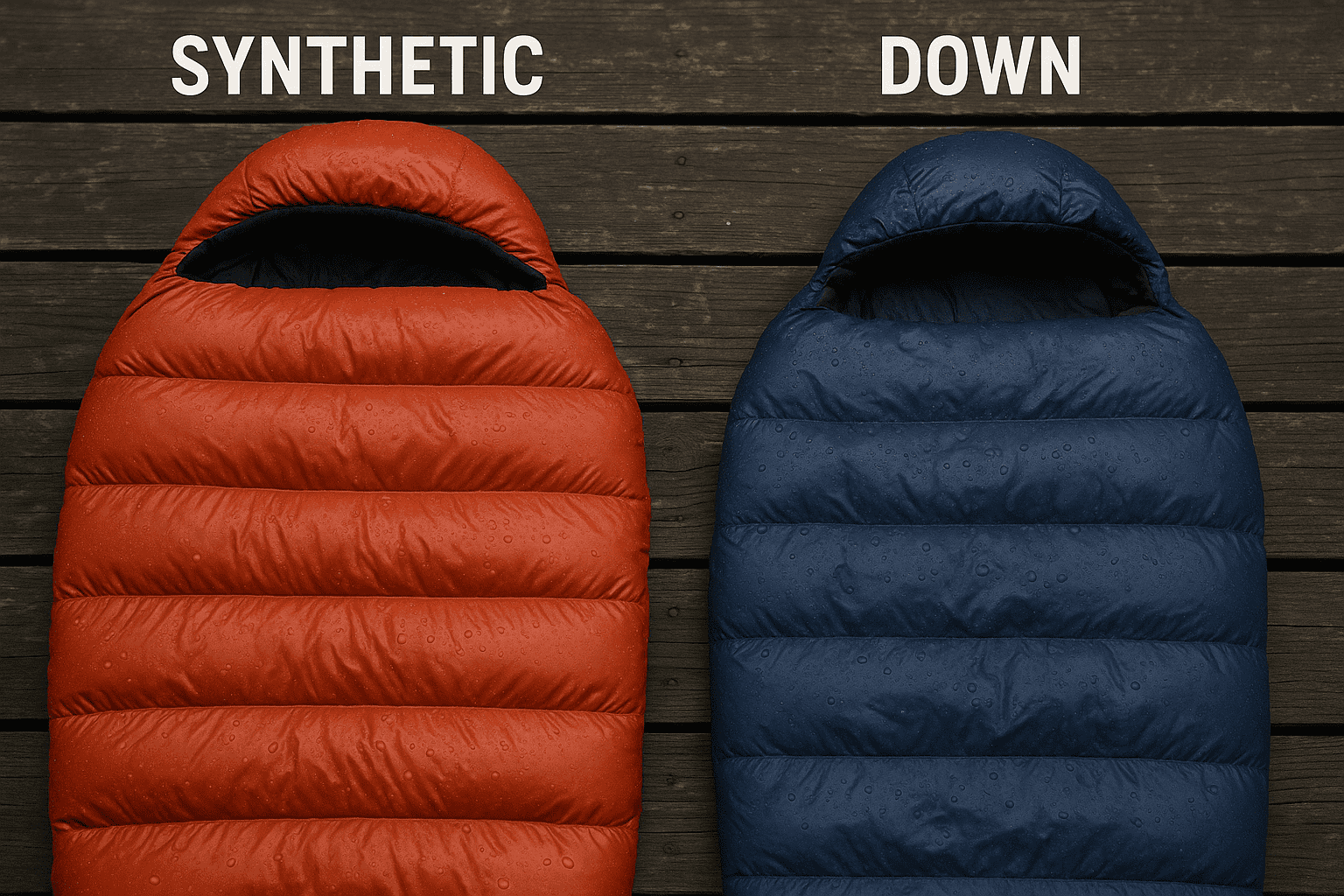
How to Source Sleeping Bags Without Loft Compromise
Certified fill and pre-shipment loft testing prevent 90% of warmth complaints.
Loft loss in a sleeping bag directly translates to customer returns and negative reviews. The root cause is rarely the fill type itself — it’s manufacturing shortcuts: unbonded staple fibers in synthetics that collapse after 200 compression cycles, or down sourced without RDS traceability where fill power is overstated by 50–100 FP. A manufacturer that certifies fill origin and runs in-line loft tests before every shipment eliminates this risk. That’s the baseline for any private-label line targeting less than 0.5% defect rate.
-
- Fill Selection: Kelyland’s partner factory — producing 1.5M sleeping bags annually under ISO 9001, BSCI, and CE — offers 700FP goose down, 600FP duck down, and synthetic hollow fiber or synthetic silk. For synthetics, we use continuous filament technology that retains 30% more loft after 5 years compared to standard staple fiber construction.
- Pre-Shipment Loft Testing: Every production batch undergoes a controlled loft measurement at 24-hour rest after compression. Our 10-year internal test shows down bags retain 90% original loft, while synthetic bags retain 50–60% after 5 years — data we share on request for your warranty planning.
- Traceability: Down sourcing is fully transparent: we provide farm-to-bag traceability and RDS certification upon request. This allows brand managers to market ethical sourcing claims — a differentiator most competitors lack.
- OEM/ODM Process: From fill selection to final inspection, the process runs 30–45 days with MOQs of 500–1,000 pieces. Sample fees are refundable on bulk orders. We adjust temperature ratings, fabric (nylon ripstop, pongee, flannel), and branding — all while maintaining ISO-compliant QC checkpoints.
For brands targeting European markets, fill certification is only half the equation. Customs compliance for down imports — including CITES and EN 13537 labeling — is equally critical. See our guide on Importing Sleeping Bags to EU Compliance for a full checklist.
Conclusion
A 10-year controlled test shows down bags retain 90% of original loft, while synthetic hollow fiber loses 40-50% within 5 years — dropping warmth ratings by 10-15°F. For brand managers, that means a down bag’s total cost of ownership runs 30-40% lower over a decade, even at 2-3x the upfront price.
Review the sleeping bag product page for fill specifications, RDS certification options, and production capacity. Or contact Kelyland directly to discuss a custom sample tailored to your brand’s temperature rating and margin targets.
Frequently Asked Questions
Is it better to get a down or synthetic sleeping bag?
For long-term durability and warmth retention, down is better: premium down retains 90% of its loft after 10 years, while synthetic loses 40–50% within five years. That warmth loss translates to a. Choose down for private-label lines expecting a 10-year product lifecycle.
Is synthetic down better than down?
No, synthetic down does not outperform real down in warmth retention or longevity. Synthetic fill begins degrading after 200 compression cycles, while premium down retains 90% loft after ten years. For brand reputation, real down is the safer long-term investment.
Is synthetic down as good as real down?
Synthetic down is not as good as real down for sustained warmth over years. It loses 40–50% loft in five years, causing a 10–15°F warmth loss that customers will notice. Only choose synthetic if price point and quick replacement are your priorities.
Is 700 fill down warmer than 600?
Yes, 700 fill down is warmer than 600 fill because it traps more air per ounce. A 700 fill bag achieves the same warmth with less fill weight, improving compressibility and. For colder-rated bags, 700+ fill is the standard for premium performance.
What is the best filling for a sleeping bag?
The best filling depends on your product lifecycle: premium down (700+ fill) for durability and warmth retention, synthetic only for budget lines. Down costs 33% less per year of use over. Match fill type to your target warranty period and price point.

 English
  Español
  Deutsch
  Français
  Português do Brasil
  Русский
  العربية
  한국어
한국어  日本語
日本語