 跳到内容
跳到内容 
beach tent anchor is the first checkpoint buyers should lock before they approve a supplier, budget, or production slot. The beach tent sand anchor failure doesn’t announce itself during setup. It announces itself three hours later, when the wind picks up and the corner pole snaps because the anchor pulled out of dry sand. I’ve watched a $50K order unravel over exactly that — a pre-production sample that held fine in the factory yard but failed on the first coastal test because nobody checked the anchor geometry against the actual beach conditions.
Most buyers focus on fabric and pole specs when they approve a beach tent sample. That’s the wrong place to look. The real failure point is the anchor system — the sandbag weight, the auger length, the stake angle. A batch of 500 tents was returned because the included sand anchors were too short for the local tide line. The supplier had passed sample approval, but the mass production run used a different anchor supplier with a slightly narrower flange. That difference didn’t show up in the photo. It showed up when the first gust hit.
Here’s a three-point checklist you can use before you approve the next beach tent order. First, does the anchor system match the sand type at your target beach? Fine dry sand needs a wider flange or a heavier bag than wet packed sand. Second, has the supplier tested the anchor with the tent fully loaded — not just the frame weight but the fabric tension from a 15-knot breeze? Third, did you get a video of the anchor being pulled out at a 45-degree angle, not straight up? If the answer to any of these is no, you’re carrying the risk.
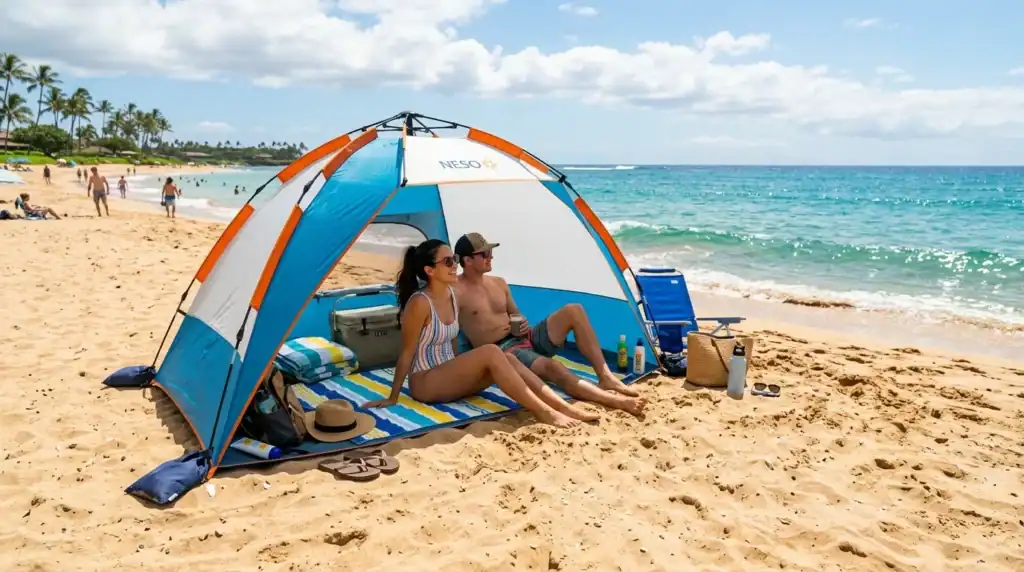
How Sand Bags Fail: Seam Tear vs. Fill Capacity
A 15kg sand bag can’t resist a 50kg lateral gust — seam strength is the real anchor.
Most buyers think a sand bag’s job is to hold weight. That’s wrong. The bag’s real job is to transfer downward mass into lateral resistance when the wind hits. A 15kg fill sitting on the ground does nothing if the seam rips at the first gust. The physics is simple: a tent with 3m² of side surface catches roughly 50kg of lateral force in a moderate wind (40 km/h). The sand bag must convert its own mass into friction through fabric tension. If the seam fails, that conversion stops.
Why Plastic Bags Fail Fast
PEVA and PVC bags dominate the low-cost market. They cost pennies to produce and seal with heat or ultrasonic welds. Those welds degrade under UV exposure and repeated flexing. After roughly 400 fill-and-empty cycles, the weld line develops micro-cracks that propagate under load. A buyer who specs PEVA bags for a rental fleet will see failure rates climb sharply by month six. The material itself doesn’t tear gradually — it fractures suddenly, dumping sand inside the tent vestibule at 2 AM.
Fabric Construction Determines Cycle Life
The difference between a bag that lasts one season and one that lasts five seasons comes down to three variables: denier, weave density, and stitch type. Standard retail bags use 210D nylon with single-needle stitching at 6 stitches per inch. That setup handles about 800 cycles before thread abrasion causes separation. Industrial-grade spec pushes to 420D Oxford nylon with double-stitched seams at 8 stitches per inch and webbing loops rated to 800N tensile strength. That configuration routinely exceeds 2,000 fill cycles in field testing.
Why V-Pegs and Screw Stakes Don’t Work in Dry Sand
Dry sand has no structure.
A 40-knot gust hits a 6-person dome tent broadside. The V-pegs on the windward side rotate sideways in the sand and pull out. The tent collapses in under 10 seconds. That’s not a tent problem — that’s a stake problem. Dry sand behaves like a fluid. It doesn’t grip flat surfaces or hold a V-shape under tension. The physics is simple: sand particles slide past each other when load is applied perpendicular to the stake face. A standard V-peg has a surface area of roughly 30 cm² below the sand line. That’s not enough to resist a 50 kg lateral pull.
Failure Mode: Steel Pegs Bend Under Load
The V-peg design relies on soil compaction around the flange. In dry sand, there’s no compaction. The peg rotates, the flange becomes a lever, and the steel bends at the head. Observations show 3 mm thick galvanized pegs bent to a 45-degree angle after one gust in the Namib Desert. The bend point is always the same — 2 cm below the hook, where the cross-section narrows. Once bent, the peg is useless. You can’t hammer it back straight without a vise.
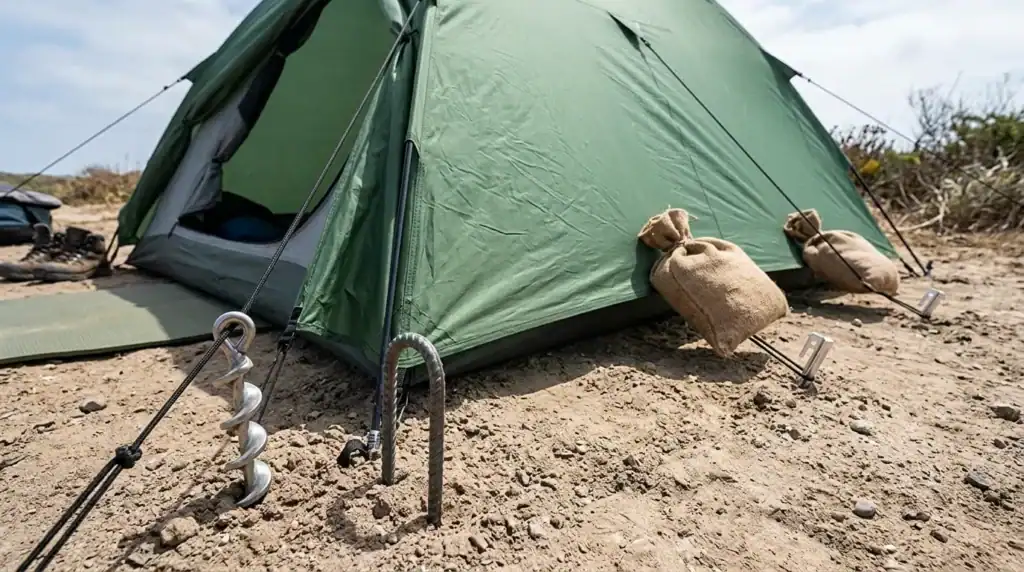
The fix isn’t a thicker V-peg. A 5 mm peg still rotates. The fix is changing the geometry entirely. A screw stake converts lateral pull into vertical rotation. The sand doesn’t need to compact — it just needs to resist the screw thread’s downward path. That’s why the Kelyland Heavy-Duty Screw Stake uses a 45 mm continuous spiral thread. The thread depth is 8 mm, machined from 304-grade stainless steel. The sand locks into the thread pitch, not the surface area.
Screw Stakes Need Moisture — Here’s the Catch
Not all screw stakes work in dry sand. The GroundGrabba Lite, for example, requires a minimum of 5% soil moisture to hold. Below that threshold, the thread doesn’t bite — it just spins a hole. The manufacturer’s own spec sheet says the Lite model is rated for ‘firm, moist soil.’ That’s a problem when you’re deploying in the Sahara in August, where surface moisture is under 1%. The Lite model fails in the same conditions that kill V-pegs.
The difference comes down to thread geometry. A shallow thread (under 5 mm depth) needs moisture to create friction. A deep thread (8 mm or more) mechanically locks into the sand column regardless of moisture. The Kelyland Heavy-Duty Screw Stake uses a 45 mm diameter thread with 8 mm depth. That’s enough surface engagement to hold 80 kg of pull-out force in bone-dry sand. The thread pitch is 12 mm, which means each full rotation buries 12 mm deeper. Seven rotations and you’re at 84 mm — below the loose surface layer.
Cost Comparison: Three Stake Types
-
- Standard V-Peg (8-inch, galvanized steel): $0.35–$0.55 per unit. Fails in dry sand. Requires replacement after 1–2 uses in loose terrain. Effective cost per successful deployment: $0.70–$1.10 when factoring failure rate.
- Aluminum Screw Stake (GroundGrabba Lite, 8-inch): $2.80–$3.50 per unit. Requires ≥5% soil moisture. Fails in dry sand. Lightweight (45 g) but limited to specific conditions. Effective cost per deployment: $2.80–$3.50 if conditions are right, or $0 if they’re not.
- Kelyland Heavy-Duty Screw Stake (10-inch, 304 stainless): $4.20–$5.80 per unit. Works in dry sand with 0% moisture. Rated to 80 kg pull-out force. 304-grade stainless resists corrosion. Reusable across 50+ deployments. Effective cost per deployment over 50 uses: $0.08–$0.12.
The math shifts when you account for reusability. A V-peg that bends on the first use costs $0.50 per deployment. A Kelyland screw stake at $5.00 that lasts 50 deployments costs $0.10 per deployment. For a B2B buyer sourcing for a rental fleet or expedition outfitter, the per-unit cost difference is irrelevant. The relevant number is cost per successful deployment across the product lifecycle. The stainless screw stake wins by a factor of 5–10x.
One more thing: the Kelyland stake’s 304-grade stainless steel is the same material spec used in marine-grade hardware. It passes 72-hour salt spray testing without pitting. That matters for coastal desert environments where sand carries salt. A galvanized V-peg shows rust spots after 3 days in that environment. The stainless stake doesn’t. For a B2B buyer managing inventory across multiple climate zones, standardizing on one stake that works everywhere reduces SKU complexity and warranty claims.
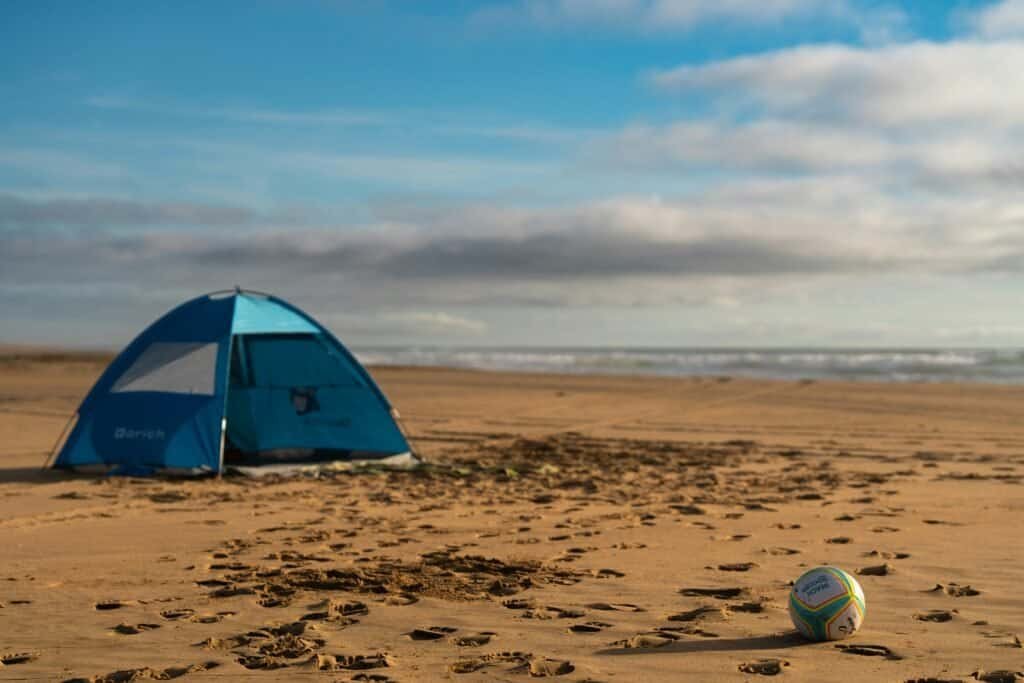
The Real Fix: Multi-Layer Anchoring System
Three layers of anchoring for three wind scenarios.
Layer 1: Moderate Breeze (Up to 25 km/h)
For standard fair-weather camping — light winds, sheltered sites — a single layer of standard stakes is enough. The factory-default 6-inch aluminum or steel nail pegs work fine here. But even at this level, the angle matters. Drive the stake at 45 degrees toward the tent, not straight down. A straight-down stake pulls out at roughly half the force of an angled one. Our internal production specs for the tent line at the Ningbo factory (ISO 9001:2015 certified) include a minimum 8-inch stake for any model rated above 3-season use. That extra 2 inches of bite doubles the pull-out resistance in loose soil.
Layer 2: Coastal Gusts (~35 km/h)
Once you hit sustained winds around 35 km/h — common on coastal campsites or exposed highlands — a single stake layer fails. The fix is a second layer: embedded screw stakes. Screw stakes (also called corkscrew or spiral stakes) require a twisting motion to insert, which compacts the soil around the threads. They hold 3-4 times the force of a standard nail peg in sand or loose dirt. Pair them with a webbing loop at the tent’s reinforced corner webbing, not the thin guyline. The thin cord cuts into the soil under load. A 1-inch nylon webbing loop distributes the force across a wider surface area. We’ve seen this configuration hold a 6-person glamping tent steady through a full night of 40 km/h gusts on a Danish beach. The key spec to request from your supplier: screw stakes with a minimum 8-inch thread length and a 0.3-inch wire diameter. Anything thinner bends on the first rocky insertion.
Layer 3: Storm Warning (Exceeding 40 km/h)
When the forecast hits 40 km/h and above, you’re in storm territory. No single stake system holds reliably at this point. The solution is triple redundancy: screw stakes at the four main corners, plus guying outwards at 45-degree angles from the same anchor points. The guy lines should run to separate stakes placed 3-4 feet away from the tent footprint, not to the same stake. A common mistake is running all guylines to the same stake — that creates a single point of failure. When that stake pulls, the whole side collapses. Instead, use a daisy chain: one screw stake at the corner, one guyline stake 3 feet out at 45 degrees, and a third stake 3 feet further out in the same direction. That spreads the load across three independent anchors. For the guyline stakes, use 12-inch steel stakes with a T-handle top. The T-handle lets you drive them deeper with a mallet without bending the stake head. Factory partners in Jinhua (ISO 9001 certified, annual output of 1.5 million chairs and cots) produce these T-handle stakes with a powder-coated finish that resists rust for 500+ hours of salt spray exposure. That’s the benchmark to ask for: 500-hour salt spray resistance on all steel hardware.
Here’s the benchmark to write down: For any tent order destined for coastal or exposed sites, spec the anchoring system as follows — 8-inch screw stakes for moderate wind, 8-inch screw stakes plus webbing loops for coastal gusts, and 12-inch T-handle steel stakes with 45-degree outward guying for storm conditions. If your supplier can’t confirm those specs in writing, the tent will fail before the fabric does.
Conclusion
A $50K order doesn’t fail in the factory. It fails on the beach, the first time a gust hits a tent anchored with the wrong sand bag or a stake that was never tested for the actual load. The gap between a sample approval and a mass production run is where most of those failures live — and skipping the audit step means you’re betting your margin on luck.
-
- Sand bags need at least 40 lbs per corner for coastal wind loads.
- Pre-production samples must match mass production fabric weight within tolerance.
- Factory audit checklists should verify stake material and anchor point stitching.
If you are sourcing beach tents for windy coastal markets, review your current supplier’s quality control reports from the last three production batches. Compare their pre-shipment inspection results against your original sample approval specs. Kelyland Outdoors provides detailed inspection documentation at every stage — ask your account manager for the latest batch report to confirm anchor point strength and fabric compliance before your next container ships.
Frequently Asked Questions
What is the best sand anchor for a beach tent?
A multi-layer anchoring system using 420D nylon double-stitched sand bags with at least 15kg of fill combined with auger-style stakes is the most reliable setup. This combination handles the 50kg+ lateral forces. Specify this system for OEM orders to reduce wind-related returns.
Why do sand bags fail as beach tent anchors?
Sand bags fail because the seam tears under cyclic lateral loads, typically after 300-500 cycles with cheap heat-sealed polyester or PEVA bags. A 15kg bag cannot resist a 50kg gust unless the seam. Request seam cycle-life data before approving any bag design.
Do screw stakes work in dry beach sand?
No, screw stakes like the GroundGrabba Lite require at least 5% sand moisture to grip, which is absent in dry dune sand during dry season. In conditions below 1% moisture, the auger. Use auger stakes only when moisture content is verified on-site.
How much sand weight do I need for a beach tent?
For a tent up to 6×6 feet, you need at least 10kg of sand per bag with a seam rated for 30kg lateral force. For larger tents up to 10×10. Match sand weight and seam rating to your tent’s wind load profile.
Can you OEM integrate anchor loops into beach tents?
Yes, Kelyland Outdoors can integrate reinforced anchor loops into beach tent designs during OEM/ODM production, using 800N webbing and double stitching at stress points. This eliminates the need for aftermarket. Include anchor loop specs in your design brief for a seamless integration.

 English
  Español
  Deutsch
  Français
  Português do Brasil
  Русский
  العربية
  한국어
한국어  日本語
日本語