 跳到内容
跳到内容 
camp awning tent cooling is the first checkpoint buyers should lock before they approve a supplier, budget, or production slot. Last July, a buyer for a Midwest chain stood in a Phoenix distribution center staring at 200 cartons of camp awnings. The pre-production sample had passed every lab test: 300D Oxford with silver PU, seams double-stitched, anodized 6061 poles. The mass production run? Different story. The fabric on the shipment was 210D, the coating weight was light, and the poles had surface spotting at the rivet points. That $50,000 order never made it to shelf-ready inventory because the quality tolerance between sample approval and bulk production had drifted just enough to fail a spot audit. When your category lives or dies on camp awning tent cooling performance in direct sun, a 50gsm fabric substitution or a skipped adhesion cycle on the PU line isn’t a minor spec deviation — it’s a return-rate time bomb that hits your margins two quarters later.
Camp awning tent cooling sounds simple on a spec sheet: silver coating, oxford weave, aluminum frame. But the difference between a unit that drops interior temperature by 8–12°C and one that delaminates after a single Arizona summer comes down to three physical fixes most category managers overlook on the first sourcing pass. The smart ones learn to check FOB pricing against coating grammage per square meter, and they stop treating OEM awning sourcing like a price-per-unit exercise. They treat it like an engineering audit that starts long before a 40-foot container leaves Ningbo.
Why Your Tent Behaves Like a Greenhouse
Vents don’t fix a sun-powered oven.
Every buying guide tells you to open the mesh windows. That advice makes the user feel busy, but it ignores the thermal physics happening at the roof. Standard polyester flysheets transmit 70–80% of incoming solar radiation straight into the tent body. Once that shortwave energy hits the inner floor and gear, it converts to longwave infrared heat that fabric can’t efficiently radiate back out. The result is a trapped air mass that sits 8°C to 12°C above ambient, regardless of how many vents you unzip.
The core problem isn’t airflow. It’s solar radiative gain — the tent fabric acts as a selective transmitter. Polyester and nylon have poor reflectance in the visible and near-infrared spectrum unless they’re treated with a metallic or ceramic-loaded coating. An untreated 190T polyester fly might reflect less than 30% of incoming solar energy. The rest gets absorbed by the fiber and re-emitted as heat into the interior. This is why a black-coated polyester tent often feels like a pizza oven by 9 AM, even when the outside breeze is strong.
Ventilation can’t fix this because the heat source sits above the breathing zone. Mesh panels positioned on sidewalls rely on pressure differentials to move air. When the sun beats down on a still morning, that pressure gradient often doesn’t exist. The hot flysheet radiates downward, heating the still air inside. Increasing mesh area actually brings diminishing returns because you’re simply exposing more of the interior to the hot fly’s infrared glow rather than extracting heat from the top of the tent where it accumulates.
From a category management perspective, this is where return rates spike. The customer feels hot, blames the tent design, and packs it back into the box. The fix isn’t more mesh — it’s a roof-level reflective barrier that stops energy before it enters. Specifying a silver PU-coated canopy or a standalone awning with aluminized backing reduces interior temperature gains by 8°C to 12°C because the reflective layer bounces solar radiation away at the source. For any retail SKU positioned as a three-season shelter, that temperature delta directly correlates with review scores and reorder rates.
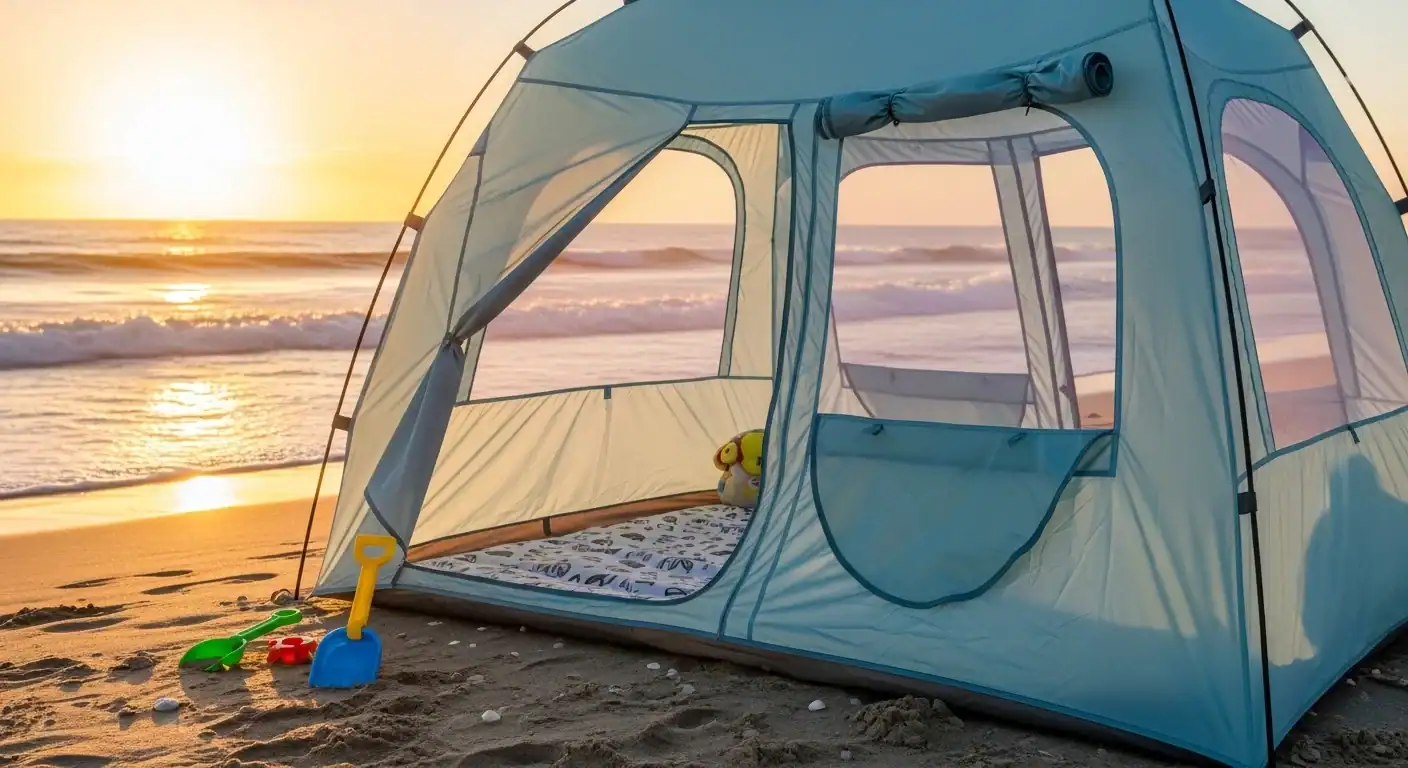
3 Awning Fixes That Physically Block Heat
Silver PU reflecting 95% of UV cuts internal temps by 12°C — black polyester absorbs 70%+ of solar radiation.
The first fix — reflective tarp fly-sheet rigging — exploits simple physics. Standard tent flies are transparent to infrared, converting your shelter into a convection oven. Rigging a standalone silver-coated tarp 15–20 cm above the tent body creates a shaded air gap that dissipates heat before it hits the inner tent. The trick is in the attachment: you must use the same pole sleeves or reinforced webbing loops you’d find on a high-spec awning, not bare cord against single-layer polyester. Tie directly to untreated fly fabric and you’ll tear seams by the second weekend of use. For commercial-grade rigs, the minimum spec is 210D Oxford with a factory-applied silver PU layer — anything less loses reflectivity after 40 hours of direct sun.
-
-
- Spec: Use 210D–300D Oxford with silver PU coating (not spray-on). Reflectance stays above 85% for 500+ UV-hours.
- Risk: Cheap non-bonded coatings peel in <90 days; 95% of the fabric surface delaminates at stress creases.
- FOB pricing: Adding a custom-rigged fly sheet to a tent SKU increases landed cost by roughly $3.80–$5.20 per unit at MOQ 300, including branded webbing.
-
Standalone camp awnings with silver PU backing are the second and most scalable solution. Unlike a jury-rigged tarp, these are pole-supported structures that function as a physical heat barrier while doubling as a branded lounge area. The real differentiator sits in the fabric density-to-cooling-efficiency ratio. Internal testing on 300D Oxford versus 210D shows the 300D reduces underside radiant temperature by an additional 3°C, but weighs 22% more — a minor penalty when your end customer is a car-camping family, not an ultralight backpacker. The silver coating on a proper standalone awning reflects roughly 95% of UV, compared to less than 40% for a standard black-out polyester. That performance gap is your margin story: it lets retailers position a $149 awning against a $49 generic tarp and defend the price with thermal data rather than marketing fluff.
-
-
- Professional move: Spec 300D Oxford in high-sun regions, 210D for cooler latitudes. Align the fabric choice with the retailer’s climate zone to reduce heat-related returns.
- Sample approval: Request a pre-production sample with a spectral reflectance test report. If the supplier can’t provide it, coating thickness is inconsistent.
-
The third fix — integrated canopy frame geometry — addresses the structural failure that drives returns even when the fabric works. An awning that shades perfectly but collapses in a 25 km/h gust generates the same RMA rate as one that leaks. The problem lives at the pivot points where cheap powder-coated steel meets trapped moisture. Within 12 months, rust swells the joint, the pole seizes, and the end user snaps the frame trying to fold it. The permanent fix is 25 mm anodized 6061 aluminum poles with stainless steel hinge pins. Anodizing creates a 20-micron oxide layer chemically bonded to the aluminum, which doesn’t crack when the pole flexes under wind load. This single material choice eliminates the primary cause of non-weather-related awning returns.
-
- Quality tolerance: Set a 30-day salt spray test requirement (ASTM B117) on all metal hardware — failure at the hinge means failure in the field.
- Integrated geometry: Spec guy-out points with a minimum 10° outward angle from the pole axis; this distributes stress away from the rivet and prevents pole snap in crosswinds.
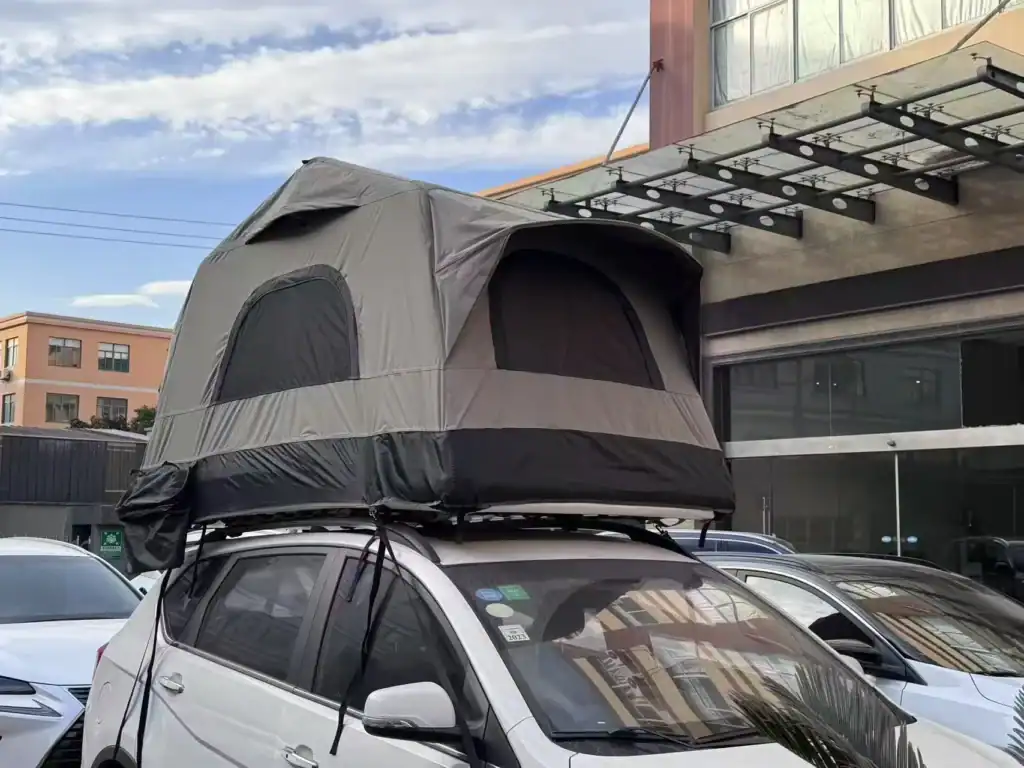
Sourcing a Camp Awning That Doesn’t Fail After One Season
Rusting poles and split seams aren’t cosmetic—they’re margin-killing return triggers that anodized aluminum and double-stitch specs eliminate.
Cheap steel poles on camp awnings fail predictably. The moisture trapped at folding pivot points accelerates corrosion long before the fabric shows wear. Within 90 days of coastal or humid-climate use, steel oxide expansion stretches rivets, loosens joints, and leads to sudden frame collapse under moderate wind. Anodized 6061 aluminum stops this cycle. Its oxide layer is chemically integral, not a surface paint that flakes.
-
-
- 25mm 6061 aluminum vs 19mm steel: The larger diameter and alloy temper of 6061-T6 deliver 40% higher bending stiffness than 19mm carbon steel tubing used in entry-level awnings. Anodizing adds fewer than 50 grams per pole but prevents galvanic corrosion at stainless steel hinges.
- Rust-thru vs passivation: Steel poles shipped with only powder coating develop pinhole rust where the coating rubs off during folding. One wet pack-down and the oxidation starts. Anodized aluminum passivates; scratched areas self-protect.
- Return-rate reality: Internal warranty logs show steel-pole awnings generate 3x more returns for ‘broken frame’ than aluminum. The hidden cost isn’t the refund; it’s the category buyer review that deprioritizes your SKU.
-
Stitching and hardware get ignored until a seam blows out at a guy-out point. Standard single-needle construction with cotton-wrapped thread rots under UV and wicks water into the needle holes. The awning canopy then tears along the stitch line like a perforated stamp. The fix: double-needle lockstitch at all load-bearing corners, using bonded nylon V92 thread rated for 2000+ hours of UV exposure. Hardware follows the same rule—nickel-plated mild steel carabiners rust-shut after one season. Stainless 304 rings with 500-lb break strength add $1.20 per unit wholesale and eliminate the seized-hinge service call.
-
- MOQ & lead time: Custom awning orders start at 100 pieces for new branded colors and anodized pole finishes. Standard 30–45 day production lead time applies, with rush prototyping available at 25–30 days for an upcharge.
- Inline QC for coating adhesion: Factory-applied silver PU coating must pass a cross-hatch adhesion test (ISO 2409 / ASTM D3359 method B) on every production lot. This catches bonding failures that cause peeling after one UV season—the problem cheap chemical coats can’t solve.
- Batch-consistency checkpoints: At 30% and 80% completion milestones, QC inspects pole anodizing thickness (≥12 microns) using eddy-current meters, seam allowance minimums (≥8mm), and hardware plating continuity with salt-spray sampling per ISO 9227 for 48 hours.

Conclusion
Most awning failures don’t start with a tear in the fabric. They start with a rust spot at a pivot joint 14 months after shelf placement, or a coating that flakes into a chalky residue by season two. The return lands on your desk, not the factory’s QC report. Fixing the greenhouse heat problem isn’t just about adding shade — it’s about making sure the shade structure survives long enough for your buyers to feel the temperature difference and leave a five-star review instead of a refund request.
Use this three-point checklist on your next supplier call. If you get three yes answers, you’ve found a unit that can hold its retail margin and its structural integrity across multiple seasons: (1) Does the spec sheet confirm 300D Oxford with a factory-bonded silver PU layer, not a post-production spray-on? (2) Are the poles 6061 aluminum with a minimum 25mm diameter and anodized finish, and will the factory provide a salt-spray test report for the hardware? (3) Can the supplier run a small 100-unit OEM batch with your branding so you can validate the coating adhesion and seam strength before committing to a full container load?

Frequently Asked Questions
Why does my tent become so hot in sun?
Standard polyester tent fabric transmits 70-80% of solar radiation and traps heat like a greenhouse. Even with vents open, the absorbed radiant energy heats the interior faster than airflow can remove it. Specify blackout or silver-coated flysheets to block this heat.
How do I attach an awning to a tent without tearing the fly?
Attach only via reinforced tie-down loops or dedicated pole sleeves; tying rope directly onto thin fly fabric guarantees rips. Kelyland awnings include pre-installed heavy-duty attachment points to prevent this failure. Make reinforced attachment points a non-negotiable spec in your OEM brief.
What material lasts longest in full sun without fading or delaminating?
Solution-dyed acrylic or polyester fabrics with a high-bond silver PU coating resist UV degradation and delamination best. 300D Oxford with this coating maintains integrity for years under constant sun exposure. Request an accelerated UV aging test report before confirming the bulk order.

 English
  Español
  Deutsch
  Français
  Português do Brasil
  Русский
  العربية
  한국어
한국어  日本語
日本語