 跳到内容
跳到内容 
Sourcing Custom Inflatable Tents directly impacts your event’s operational budget and liability. Generic models often rely on inferior air beams or fabrics that fail safety compliance, leading to on-site failures that increase labor costs and risk client relationships.
This OEM guide benchmarks production based on critical technical standards, including commercial-grade TPU air beams and CPAI-84 fire retardancy. We analyze printing options, mold fees, and MOQ flexibility to help you build a reliable and profitable supply chain.
2026 Trend Report: Top 5 Custom Shapes
Quick Comparison
| Product Name | Best For | Key Feature | Verdict |
|---|---|---|---|
Dome-Shaped Tents | Structural Stability | Maximizes Wind Resistance & Usable Space | The most preferred structural design, projected to capture 41.7% of the inflatable tent market revenue by 2025. Dome shapes offer superior aerodynamic stability in windy conditions and provide efficient internal space distribution. |
Self-Erecting & Tunnel Tents | Rapid Deployment | Fast Setup & Spacious Interiors | A dominant market segment contributing 53.4% of revenue, these designs feature integrated air beam support systems that eliminate traditional poles for rapid deployment. Tunnel shapes are particularly effective at creating spacious, linear interiors. |
Pop-Up Inflatable Tents | User Convenience | Instantaneous Setup for Casual Use | Designed for maximum convenience, these tents offer an almost instantaneous setup without requiring manual inflation, making them ideal for casual campers and festivals. Their ease of use is their primary market driver. |
Family & Multi-Room Configurations | Group Use | Enhanced Privacy & Organization | A growing trend for group camping, these larger tents feature multiple separate rooms, vestibules, and internal dividers. This modularity allows for enhanced privacy and better organization for families or groups. |
Ultra-Lightweight Solo Designs | Portability | Maximizes Mobility & Minimizes Weight | This minimalist design trend prioritizes portability for solo hikers, cyclists, and backpackers. The focus is on minimizing weight and packed size, making them ideal for long-distance travel where every ounce matters. |
KEY FEATURE
Dome-Shaped Tents
The Verdict: The most preferred design for its superior aerodynamic stability in windy conditions and efficient internal space distribution, making it a top choice for overall structural performance.
✅ The Good
- Excellent aerodynamic performance in windy conditions
- Even stress distribution reduces structural fatigue
⚠️ The Bad
- Interior vertical wall space can be limited by the curved design.
KEY FEATURE
Self-Erecting & Tunnel Tents
The Verdict: A dominant market segment contributing 53.4% of revenue, these designs feature integrated air beam support systems that eliminate traditional poles for rapid deployment. Tunnel shapes are particularly effective at creating spacious, linear interiors.
✅ The Good
- Air beam technology allows for setup in minutes
- Often includes premium features like enclosed porches and blackout bedrooms
⚠️ The Bad
- Requires a compatible air pump for inflation, which may be sold separately.
KEY FEATURE
Pop-Up Inflatable Tents
The Verdict: Designed for maximum convenience, these tents offer an almost instantaneous setup without requiring manual inflation, making them ideal for casual campers and festivals. Their ease of use is their primary market driver.
✅ The Good
- Incredibly fast, near-instant deployment
- Very user-friendly, especially for beginners
⚠️ The Bad
- Offers less structural rigidity and weather resistance compared to air beam models.
KEY FEATURE
Family & Multi-Room Configurations
The Verdict: These tents excel at providing privacy and organization for families or groups through modular, multi-room layouts, though their larger size demands more space and makes them heavier to transport.
✅ The Good
- Provides separate sleeping and living areas
- Accommodates larger groups comfortably with a flexible layout
⚠️ The Bad
- Larger footprint requires more ground space and can be heavier to transport.
KEY FEATURE
Ultra-Lightweight Solo Designs
The Verdict: This minimalist design prioritizes portability and minimal weight above all else, making it the top choice for solo adventurers like hikers and backpackers where every ounce is critical.
✅ The Good
- Extremely lightweight and compact for easy transport
- Ideal for solo adventures where gear weight is a critical factor
⚠️ The Bad
- Interior space is typically limited to sleeping only, with minimal room for gear.
Material Selection: Oxford, PVC, or TPU?
KEY FEATURE
PVC Tarpaulin
The Verdict: PVC Tarpaulin is a heavy-duty, composite material built for commercial applications where longevity and weather resistance are critical. Its inherent waterproof and UV-resistant properties make it a top choice for long-term outdoor use.
✅ The Good
- Inherently waterproof without needing extra coatings
- Exceptional tear strength and abrasion resistance
⚠️ The Bad
- Heavier weight reduces portability and increases setup difficulty
KEY FEATURE
Oxford Fabric
The Verdict: Oxford Fabric is a lightweight, woven material perfect for budget-conscious or temporary applications, offering great portability and cost-effectiveness. Its main drawback is the need for a waterproof coating that can degrade over time.
✅ The Good
- Lower initial cost makes it budget-friendly
- Lightweight and breathable, reducing condensation
⚠️ The Bad
- Requires a waterproof coating that can degrade under prolonged UV exposure
KEY FEATURE
TPU (Thermoplastic Polyurethane)
The Verdict: TPU stands out as a premium, eco-friendly alternative to PVC, offering superior performance and flexibility in extreme temperatures without requiring toxic plasticizers.
✅ The Good
- Superior flexibility in extreme cold
- More eco-friendly and resistant to yellowing
⚠️ The Bad
- Premium pricing reflects its advanced performance and sustainability benefits
Why Choose Inflatable Structures for Your Next Event?
Inflatable event tents offer a significant competitive advantage by blending rapid deployment with high-impact branding. They reduce labor costs through pole-free setup, provide a unique canvas for brand visibility, and deliver a strong return on investment with durable, versatile structures suitable for any professional event.
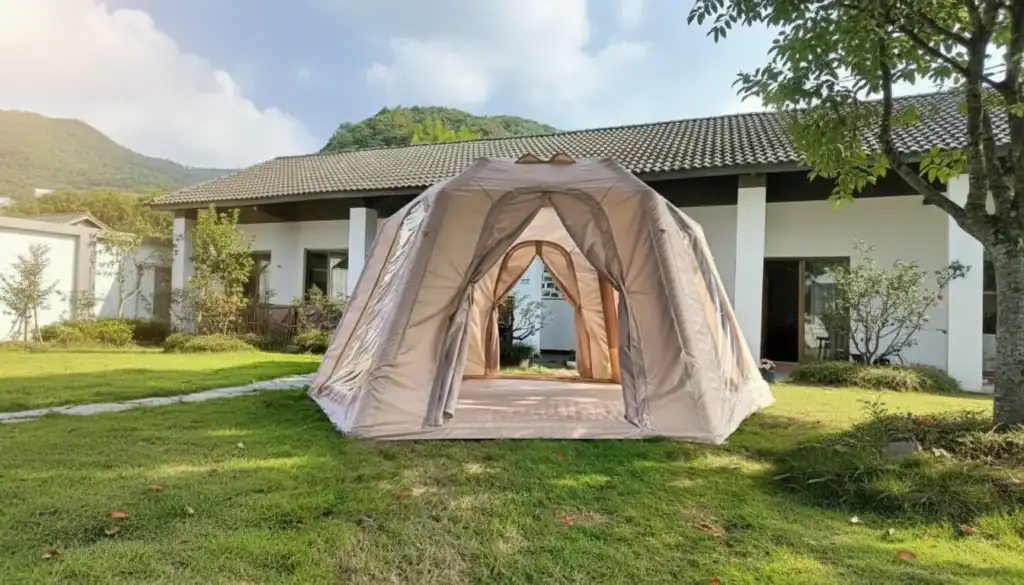
Speed and Operational Efficiency
Our inflatable structures use robust TPU/PVC air beams, enabling a single person to achieve a full setup in minutes with an electric pump. This ‘Instant-Up Mechanism’ eliminates the complexity of traditional pole systems, drastically cutting down on labor costs and event preparation time. Their compact, lightweight design also simplifies logistics, reducing shipping expenses and storage needs between events.
Brand Visibility and Market Differentiation
The smooth, curved surfaces of an inflatable tent offer a unique 360-degree canvas for your brand, making it a visual landmark that stands out in a crowded venue. We provide one-stop customization services, allowing for high-resolution graphics across the entire structure. This transforms your shelter into a powerful marketing tool that attracts foot traffic and creates memorable photo opportunities.
Long-Term Financial Value
Investing in an inflatable structure reduces long-term operational costs. You no longer need to budget for replacing bent aluminum poles, lost connectors, or cracked fiberglass frames common in traditional tents. Our durable air beam system is backed by a 1-year warranty against manufacturing defects, ensuring a reliable and reusable asset that delivers ROI across trade shows, festivals, and corporate tours for years.
Technical Advantages
We engineer our event structures with heavy-duty, 100% waterproof PVC/TPU Mesh Fabric for dependable all-weather protection. This material offers excellent durability and UV resistance. For clients with specific safety requirements, we can ensure the fabrics meet compliance standards like CPAI-84 for fire retardancy, providing a secure and professional solution for any public venue.
Digital vs. Silk Screen: Which Printing Tech Fits Your Brand?
The right printing choice depends entirely on your order volume and design complexity. Digital printing is best for detailed, multi-color graphics on small orders, offering flexibility for market testing. Silk screen printing provides superior durability and lower per-unit costs for large, simple-logo production runs, maximizing your profit margins.
Digital Printing: Best for Detail and Small Batches
Digital printing is the ideal solution when your tent design features intricate details, gradients, or photorealistic images. Because it works like a high-end inkjet printer, there are minimal setup costs. This makes it a perfect fit for smaller order quantities, aligning with our startup support MOQs of 50-100 units. It allows you to test new designs or create limited-edition products without a large financial commitment. The ink integrates directly into the fabric fibers, resulting in a soft finish that doesn’t crack or peel and maintains the material’s natural feel.
Silk Screen Printing: Ideal for Durability and Large Volumes
For large production runs with simpler, bold graphics like a company logo, silk screen printing is the most cost-effective method. While there is an initial setup cost for creating the screens, the per-unit price drops significantly as volume increases. This method applies a thick, durable layer of ink on top of the fabric, producing incredibly vibrant and opaque colors that stand out, especially on heavy-duty Oxford or Polyester materials. The resulting print is exceptionally resilient, built to withstand outdoor exposure and frequent use, which reduces long-term replacement costs and warranty claims.
Comparing Cost Structure and Your Strategy
Your choice directly impacts your budget and go-to-market strategy. Digital printing’s consistent per-unit pricing gives you predictable costs for small batches, perfect for prototyping or event-specific marketing. For established brands looking to scale, silk screen printing offers a clear path to higher profit margins on bulk orders of 300 units or more. We can help you analyze your designs and sales forecasts to recommend the printing technique that best supports your business goals, balancing visual impact with production efficiency.
Decoding Costs: How Do Mold Fees and MOQs Work?
Mold fees are one-time investments for creating unique tooling, while our Minimum Order Quantities (MOQs) ensure production efficiency. For our partners, we offer flexible MOQs, sometimes as low as 50-100 units for startups using ready-stock fabrics, to help you launch new products without a massive initial investment. Understanding both is key to calculating your total sourcing cost.
Understanding Mold Fees for Custom Shapes
When you need a truly unique tent shape, like a custom inflatable structure, a mold fee is an upfront investment. This one-time charge covers the engineering and fabrication of the specialized tooling required for your design. While sample production is a separate, smaller cost to validate the design, this mold fee is what allows us to bring your exclusive vision to life. Our team works with you to clarify these costs before any commitment.
Our Minimum Order Quantity, or MOQ, is the minimum number of units needed for a production run. For standard orders, this typically ranges from 300 to 1,000 units, which allows us to manage fabric sourcing efficiently. But we also understand the needs of new brands. That’s why we offer “Startup Support,” with MOQs as low as 50-100 units for projects using our ready-stock fabrics or involving simple modifications. This flexibility helps you get to market faster.
How These Factors Impact Unit Pricing
The final unit price is a direct result of your material choices. A family tent with a cost-effective 190T Polyester flysheet and PE floor will have a lower unit cost than a professional trekking tent using 40D Ripstop Nylon and an Oxford floor. While it might be tempting to choose the lowest price, investing in a higher-grade material or a certified factory like ours (ISO 9001:2015) improves your long-term profit margins by reducing defect rates and warranty claims from your customers.
Timeline Considerations for Custom Orders
Planning your inventory requires factoring in production timelines. Once your sample is approved, our standard bulk production lead time is 30 to 45 days. Keep in mind that unique customizations, like custom fabric dyeing or complex printing, can add a little extra time. It’s also smart to plan ahead for the peak production season, which runs from October to January, to ensure your stock arrives exactly when you need it.
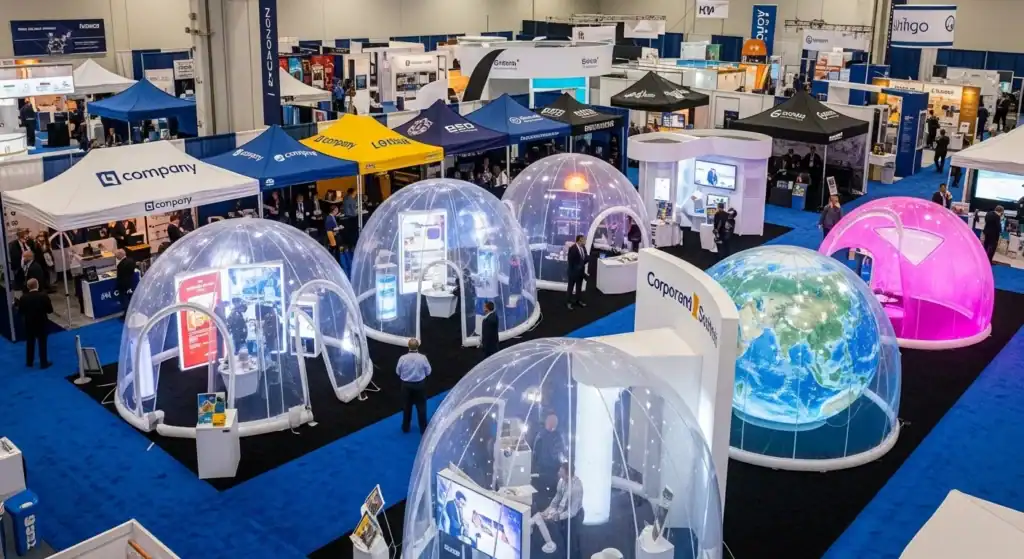
Success Stories: Case Studies in Brand Activation
Successful brand activations using inflatable structures consistently rely on key engagement drivers like interactive photo opportunities, product sampling, and voting. These activations create highly shareable social media moments, serve as central event landmarks, and extend visitor dwell time. Operationally, their rapid setup, portability, and scalability offer significant advantages over traditional static structures for multi-city campaigns.
Top Pick
TentCraft: Large-Scale Corporate Activations
Verdict: Specializing in custom tents and inflatable domes for high-profile experiential marketing, TentCraft is a go-to for Fortune 500 brands seeking rapid, nationwide deployment for major events.
✅ The Good
- Proven track record with Fortune 500 clients like Toyota and Geico.
- Offers rapid deployment and comprehensive nationwide event support.
- Versatile product range for tours, sports, and retail promotions.
⚠️ The Bad
- Premium services likely result in higher project costs.
- May not be ideal for small-scale or budget-conscious clients.
Top Pick
Inflatable Design Group (IDG): Driving Social Media Engagement
Verdict: IDG excels at creating highly interactive and shareable inflatable experiences, like three-story slides and character domes, that generate massive social media buzz for major brand campaigns.
✅ The Good
- Generated 148 million social impressions for a single campaign.
- Creates unique photo opportunities that drive organic sharing.
- Integrates interactive elements like sampling and voting into activations.
⚠️ The Bad
- Focus is on large, bespoke projects, not standard tents.
- Lead times for complex custom designs may be longer.
Top Pick
Boulder Blimp: Creating Memorable Event Landmarks
Verdict: Boulder Blimp focuses on creating giant, landmark inflatables that serve as towering billboards, effectively increasing brand awareness and driving foot traffic at large-scale events like marathons.
✅ The Good
- Creates highly visible landmarks that attract attention.
- Proven to increase booth dwell time with interactive designs.
- Effective for sponsorships at large public events.
⚠️ The Bad
- Primarily for large-scale visual impact, not functional shelters.
- Designs are typically static landmarks rather than interactive spaces.
Top Pick
MVP Visuals: Maximizing Sponsor Visibility
Verdict: MVP Visuals provides practical and effective solutions for sponsor visibility, specializing in custom inflatable arches for races and events that ensure brands are seen at high-traffic start and finish lines.
✅ The Good
- Enhances sponsor visibility in key event areas.
- Removable banner system allows for flexible use with multiple sponsors.
- Ideal for events like marathons and national championships.
⚠️ The Bad
- More focused on specific products like arches than full event structures.
- Less emphasis on highly interactive or complex inflatables.
Boost Your Business with Custom Tents

Final Thoughts
Generic inflatables present a trade-off: lower upfront cost for higher event-day risk. Our ISO 9001-certified process—using heavy-duty TPU and seam-sealed fabrics—is engineered to protect your client’s brand reputation. Quality production prevents field failures and eliminates costly warranty claims.
Don’t speculate on production quality—validate it. The logical next step is a custom sample to assess our materials and print work yourself. Send our team your design files to get a detailed quote and production timeline.
Frequently Asked Questions
How long does it take to set up an inflatable structure?
Our inflatable tents feature an “Instant-Up Mechanism” using robust TPU Air Beams, allowing a single person to complete the setup in just 5 to 15 minutes. This rapid, no-pole deployment system saves valuable time and labor costs at events, making logistics simpler and more efficient for your team.
What materials are used for durability and weather resistance?
We use heavy-duty, commercial-grade materials to ensure our inflatable structures withstand tough conditions. The air beams are made from high-grade TPU, and we use a 100% waterproof PVC or TPU mesh fabric for the floor. The tent body is typically constructed from abrasion-resistant Oxford fabric with a protective PU coating, and we apply heat-sealing tape to all seams for guaranteed weather protection.
Can multiple inflatable tents be connected to create a larger space?
Yes, our one-stop customization service includes creating modular connection systems. We can engineer your inflatable tents with heavy-duty zippers or weatherproof tunnel connectors, allowing you to link multiple units together. This provides the flexibility to create large, cohesive event spaces that can be scaled up or down based on your client’s needs.
What is the typical production time for a custom inflatable tent?
The lead time depends on the order stage. Creating a custom prototype or sample typically takes between 7 to 15 days. After the design is finalized and approved, a bulk production order has a standard lead time of 30 to 45 days. We always advise planning ahead, particularly during our peak season from October to January, to secure production slots.
What is the minimum order quantity for custom inflatables?
Our standard minimum order quantity (MOQ) for custom production is between 300 and 1,000 units, which depends on the availability of your chosen fabric and color. To support new brands, we also offer a startup program with a lower MOQ of 50 to 100 units for tents using our ready-stock materials or requiring simple modifications.
Can I change the branded cover for different events?
Our tents are built as integrated units where the branding is applied directly to the fabric for lasting durability. They are not designed with interchangeable covers for swapping between events. Our focus as a manufacturer is on creating a permanent, high-quality branded product that reliably represents your brand in the field.
How can I verify a factory’s printing quality?
You can verify our quality through our documented process and certifications. As an ISO 9001:2015 certified manufacturer, we adhere to strict quality management systems. Our protocol includes raw fabric inspection, automated precision cutting, and setup testing of random units. We welcome and facilitate pre-shipment inspections by you or a third party to confirm build quality and specifications before final payment.
Is digital printing better than silk screen printing?
The best method depends on your design and volume. For large orders with simple, bold logos on durable outdoor fabrics like Polyester or Oxford, silk screen printing offers superior durability and cost-efficiency. For smaller quantities or complex, multi-color graphics, digital printing can provide more detail. We advise on the optimal printing technology based on your specific project goals and budget.
Do custom shapes require a new mold fee?
Yes, creating a truly unique tent shape or a custom component that is not part of our existing product line requires new tooling, which involves a one-time development fee. This fee covers the engineering and manufacturing of the necessary patterns or molds. For standard customizations like changing colors, fabrics, or printing logos on existing models, no mold fees are required.

 English
  Español
  Deutsch
  Français
  Português do Brasil
  Русский
  العربية
  한국어
한국어  日本語
日本語