 Ir al contenido
Inflatable tent lead times look clean on paper: Day 1 the order is placed, Day 14 the pre-production sample arrives, Day 45 the container lands. Then Day 47 hits — the buyer unpacks a $50,000 order and finds the production run doesn’t match the sample. The seam tape is off, the air valve placement shifted, and the packed volume is 15% larger than the quote assumed.
Sample approval for an inflatable tent should never be a visual check. Ask for a 24-hour inflation retention test: inflate all chambers, mark the seams, and measure pressure drop after a full day. Small leaks at valve welds won’t appear in showroom photos, but they’ll generate returns in the field. When the tolerancia de calidad is defined only in a photo, subtle shifts in construction go unnoticed until the container arrives.
At Kelyland Outdoors, standard inflatable tent production runs 30–45 days once the design and Pantone colors are locked. Clients who supply an approved physical sample and a written quality tolerance can start mass production faster. Custom printing and special colors usually add 7–14 days — so build that buffer into your seasonal launch plan.
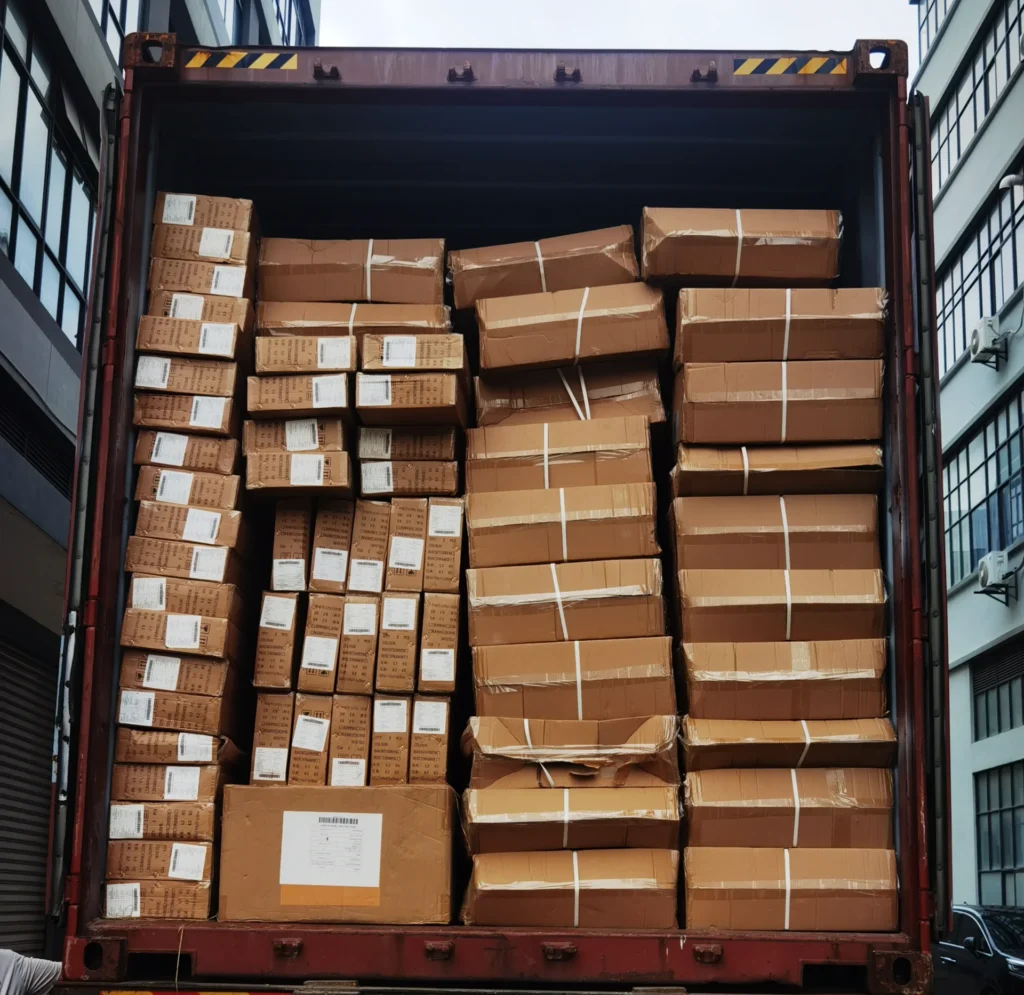
A Realistic Timeline for Inflatable Tent Production
Plan for 12 weeks from spec sign-off to factory gate; most delays happen before Week 6.
A realistic inflatable tent production timeline runs 12 weeks from signed spec sheet to factory gate. That assumes the design is final and the supplier has confirmed the bill of materials. The clock starts when your supplier sends a written production agreement — not when you send an inquiry.
Week 1: Demand collection and design spec agreement
Kelyland’s process starts with demand collection: brand identity, target market, and product specifications. For an inflatable tent, four specs matter most.
-
- Floor plan: Finished floor dimensions and peak height. Every pattern and air tube layout hangs on these numbers.
- Packed size: Inflatable tents ship deflated, so keep the packed volume target realistic for the carton you want.
- Fabric and coating: TPU-coated polyester welds differently and costs more than PVC-coated Oxford. Decide before sampling.
- Valve and pump: Confirm valve diameter and whether the price includes a pump. Retrofitting a valve after sampling is rework.
Week 2-3: Proto sampling and client feedback
The factory builds a prototype from the agreed design. For inflatable tents, the sample check goes beyond seams and zippers. Run a 24-hour inflation retention test before approving: inflate fully, mark the seams, and measure pressure loss the next day. Visual approval alone misses slow leaks at welded or glued joints — and that mistake will surface as production rework.
Week 4-5: Material sourcing and pre-production preparation
While the sample goes back and forth, the factory sources outdoor-grade fabric, TPU air tubes, valves, and zippers. This window is where the 30-45 day production clock starts. Clients who lock the approved sample and a confirmed bill of materials in this window protect their seasonal launch. Custom logo printing plus special Pantone colors usually adds 7-14 days — decide those details before Week 4, not after.
Week 6-10: Mass production and inline QC
Mass production runs five weeks for a typical inflatable tent order. The Kelyland tent factory in Ningbo, Zhejiang — ISO 9001:2015, CE, and BSCI certified — inspects at every production stage. Checks cover stitching, valve seating, and seam integrity, the three failure points that generate the most consumer returns. Inspection reports are available on request.
Week 11-12: Pre-shipment inspection and packing
The last two weeks cover the final quality check and packing. Inflatable tents ship deflated, so packed volume runs roughly 60-70% smaller than the assembled tent. That keeps box dimensions manageable, but carton size still drives LCL freight quotes. Confirm the pre-shipment inspection checklist before production finishes. A failed inspection at Week 11 means the container misses its sailing window.
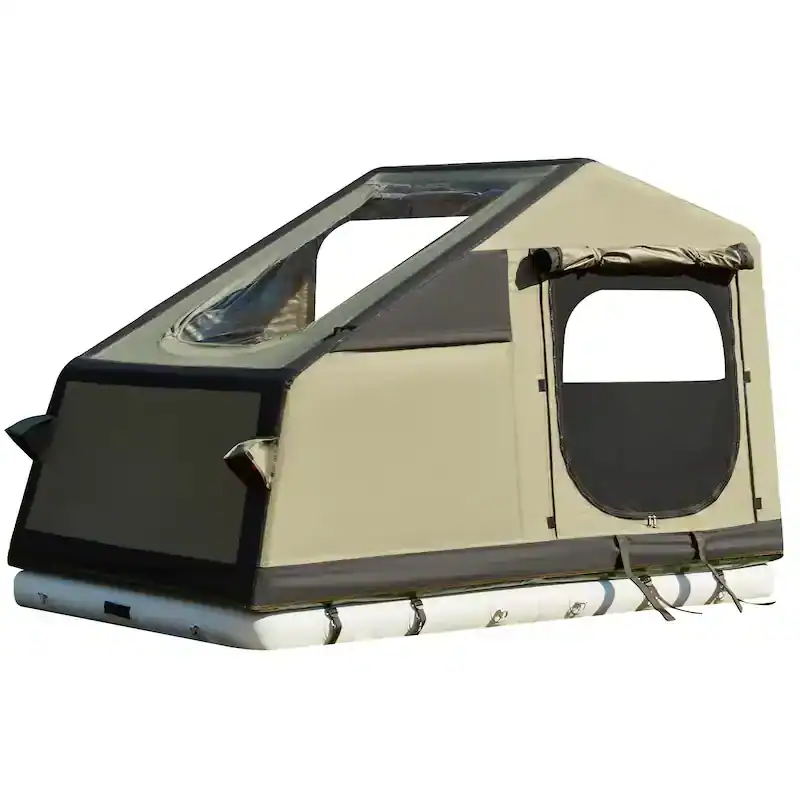
How MOQ Affects Your Lead Time
Under 100 units, you’re not buying a production slot.
A 50-piece order and a 1,000-piece order move through different calendars. The low-MOQ route works for testing a shape or validating demand, but it reacts to the factory’s schedule. A standard 300-1,000 piece run lets the factory reserve a dedicated line, order the exact fabric color, and lock in inspection points. That changes the lead time math.
Low-MOQ inflatable tents: 50-100 pieces
Kelyland can start inflatable tent orders at 50-100 pieces, but that quantity doesn’t justify a dedicated production slot. The factory slots small batches between larger runs. If your sample approval takes an extra week, the batch waits for the next gap. Custom logo printing plus special colors adds 7-14 days on top of the standard 30-45 day production lead time. A buyer who hesitates on Pantone colors loses the slot entirely.
The low-MOQ path is a demand test, not a calendar guarantee. Use it when you already have a proven design and want to enter a new market. Don’t use it when a seasonal launch date is fixed.
Standard MOQ range: 300-1,000 pieces
At 300-1,000 pieces, the factory treats it as a real production run. Material is sourced to your spec, the line is booked, and inline QC checks happen at defined stages. Kelyland’s tent and tarp factory in Ningbo holds ISO 9001:2015 and produces 800,000 tents a year. At this volume, the published 30-45 day lead time is realistic — if you supply approved samples and exact Pantone colors before the order enters the schedule.
Small-batch production vs. container-load planning
The piece count on your purchase order is not the same as the volume in your shipping container. Inflatable tents ship deflated, so packed volume runs 60-70% smaller than assembled tents. That helps, but box dimensions still decide whether you pay LCL or reserve a full container. Small batches under 500 pieces almost always move LCL, which means waiting for the consolidator’s schedule after production finishes. A container-load order can ship the day the goods clear inspection.
-
- 50-100 pieces: trial run; schedule buffer needed for slot gaps.
- 300-1,000 pieces: dedicated production block; standard 30-45 day lead time applies.
- Container planning: packed dimensions, not piece count, determine LCL vs FCL.
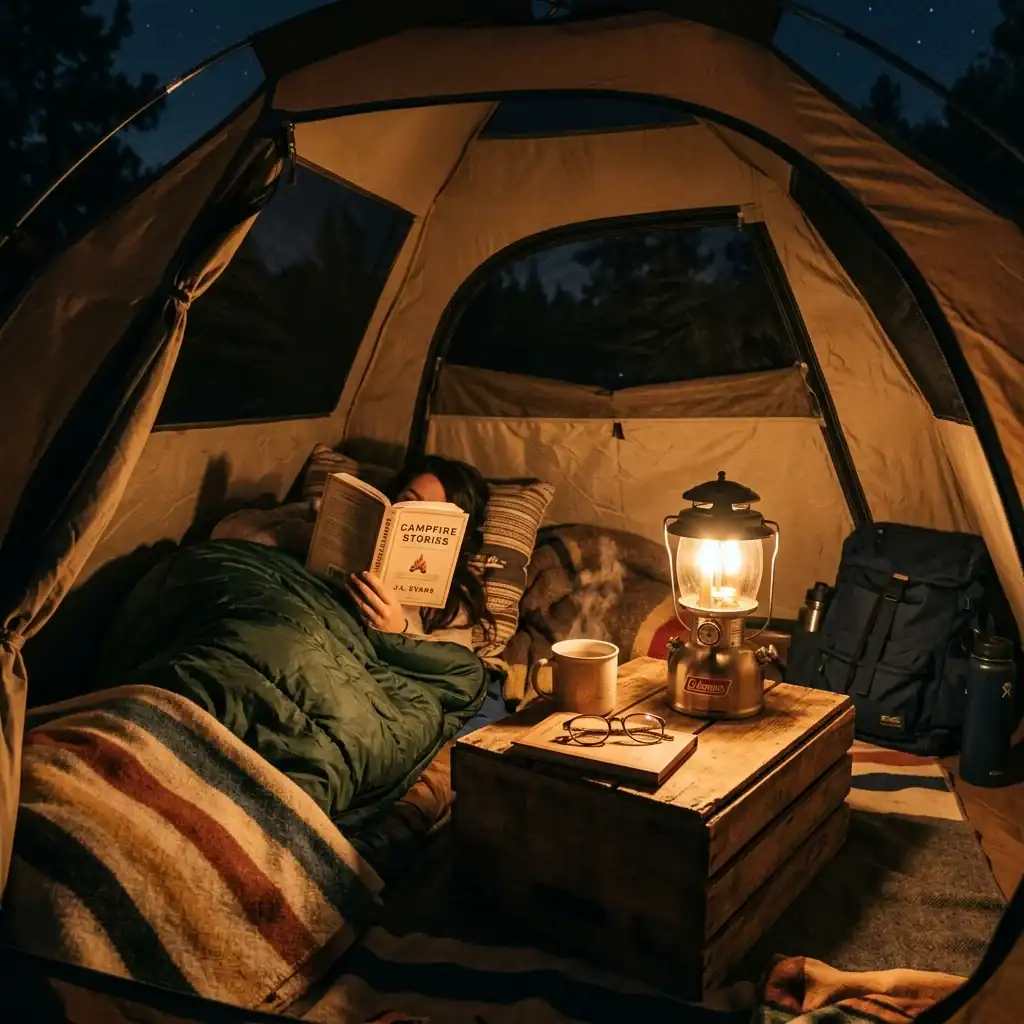
Sampling and Approval Steps
Run a 24-hour inflation retention test before approving any inflatable tent sample.
Paid samples are the standard gate before any bulk run, and the policy worth asking for is one that lets you recover the fee. At Kelyland Outdoors, sample fees are refundable when you confirm a bulk order, and low-cost samples can be free if you cover shipping. That structure matters because an inflatable tent sample is not a decoration — it’s the spec lock for 30-45 days of production.
Paid samples and refundable sample policies
Most serious suppliers charge for proto samples to filter out non-serious inquiries. The refundable part is the commercial signal. If the supplier credits your sample fee against the bulk order, they expect you to move into mass production. If they make you eat the sample cost even after ordering, factor that into your landed cost before you sign anything.
Beyond the fee, ask what the sample includes. A full inflatable tent sample should include the tent body, air pump, repair kit, carry bag, and the exact packaging spec you’re planning to sell in. A sample that ships without the retail packaging won’t tell you if the deflated tent fits your box dimensions — and packed volume drives LCL freight quotes.
How to approve a sample without slowing production
The fastest way to slow an inflatable tent timeline is to approve a sample based on looks alone. Every ecommerce seller who falls into that trap discovers the issue later: slow leaks at the seam welds. A proper sample approval includes a 24-hour inflation retention test. Inflate the tent to working pressure, wait 24 hours, and measure the pressure drop. This test costs you a day and saves weeks of rework.
Structural checks matter too. Inspect seam taping and seam stitching, valve base adhesion, and fabric coating consistency across the panels. Use the Pantone numbers from your spec sheet, not a quick phone photo. At Kelyland Outdoors, clients who supply approved samples and Pantone color codes can start mass production faster than those who approve by memory. Custom logo printing and special colors add 7-14 days to the schedule, so freeze those decisions during sample review — not after production starts.
Once the sample passes, write the approval as a spec freeze. State the exact fabric, air valve model, pump wattage, packed dimensions, and print placements on one document. Any change after that means the sample clock starts over. The factory with ISO 9001:2015 quality systems should be able to issue inspection reports at every production stage; ask for them and tie each approval to a dated revision.
Shipping Inflatable Tents from China
Inflatable tents ship deflated, so packed volume is roughly 60–70% smaller than an assembled tent.
Air Freight: Volumetric Weight and Packing
Air carriers charge by chargeable weight — the larger of gross weight and dimensional weight. Inflatable tent cartons are bulky because the folded air beams and fabric resist tight compression, so dimensional weight almost always wins. Air freight gives you a fast transit time, but you pay a premium for that speed. For a first test order, air freight can work; for a seasonal launch, the cost per unit usually kills your margin.
Packing method drives the quote. A factory that vacuum-compresses the tent before folding can shrink the carton by a meaningful margin. Ask for packed carton dimensions and a loading diagram before sample approval. Then verify those dimensions during pre-shipment inspection. A carton that grows by 3 cm after production changes your freight rate.
Sea Freight: LCL vs. FCL for Small Runs
LCL is the default for ecommerce launches. You pay only for the cubic meters your cartons occupy in a shared container. That keeps upfront costs low when your inflatable tent order is 50–100 pieces. But consolidation adds handling, and LCL transit times run longer because your shipment sits at a hub while the container fills.
FCL makes sense once your order volume fills most of a container. With FCL, the factory loads your cartons directly, the container is sealed, and the schedule is more predictable. If you’re ordering 300–1,000 pieces plus other camping SKUs, FCL may be cheaper per cubic meter — but only if you can use the space. For a single-SKU inflatable tent launch, LCL is usually the smarter call.
Customs Paperwork and HS Code Basics
Inflatable tents made from synthetic fabric typically sit under HS code 6306.22. Use the correct code upfront because it sets duty rates and any import documentation requirements. Some suppliers file under 6306.29 to “simplify,” but that can trigger a different tariff and slow customs clearance. Confirm the code with a licensed broker before the container leaves China.
-
- Documents: Commercial invoice, packing list, bill of lading, and a fumigation certificate if any wood packaging is used.
- Origin: A China certificate of origin can unlock preferential duty rates under your trade agreement.
- Support: Kelyland Outdoors coordinates export paperwork and customs guidance across its 17 core strategic factories, so the HS classification and packing list are handled by people who ship camping gear daily.
How to Protect Your Launch Date
Color matching and printing revisions can add 7-14 days — plan for them before you sign.
Most ecommerce sellers set their launch date by counting backward from the first day of the season, then subtract 30-45 days for production and call it a plan. What gets left out are the approval loops — color matching, printing revisions, sample shipping. Those loops routinely eat 7-14 days on a custom inflatable tent order.
At Kelyland Outdoors, custom logo printing plus special colors usually adds 7-14 days on top of the standard 30-45 day production timeline. That is the typical range, not the worst case. Fabric dyeing often needs two passes to hit a Pantone match, and every round trip between you, the sales team, and the mill adds days. Buyers who protect their launch date send Pantone references up front and keep the sample approval window wide enough to absorb a revision.
Color Matching and Printing Revisions
-
- Color matching cycles: Fabric dyeing rarely lands on the first pass. Budget for at least one revision round and build that into the production agreement before you commit.
- Printing revisions: Custom logo printing plus special colors adds 7-14 days to standard production. Approving the digital mockup before sampling shortens that window.
- Bulk confirmation: The sample that counts is the one pulled from the mass production run, not the prototype. Inline QC during production catches color drift before it becomes rework.
Seasonal Ordering and Factory Capacity
Production slots are finite. Kelyland Outdoors works with 17 core strategic factories and over 200 manufacturing partners, but those lines fill up ahead of peak camping season. An order placed in March for a May launch competes with every other brand that waited too long.
The 30-45 day lead time assumes the factory has open capacity. Buyers who lock in a seasonal launch place orders before the rush and confirm the slot with a 30% deposit — the standard for new clients. That deposit does more than cover materials; it reserves production capacity. Without it, another brand’s order lands ahead of yours.
If the tents arrive two weeks after the season starts, they sit in a warehouse until next year or get sold at a discount. The buffer you add for color and printing revisions is the cheapest insurance you will buy in this whole process.
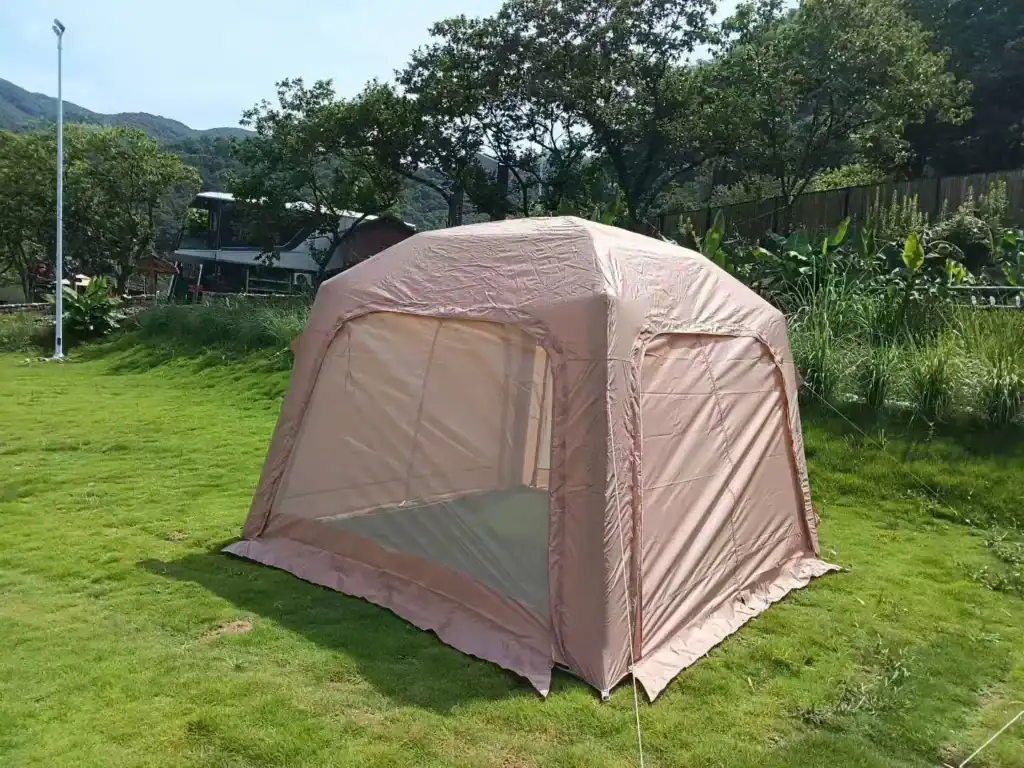
Conclusión
The inflatable tent lead time picture only holds together if sample approval catches what a visual check misses. A 24-hour inflation retention test reveals slow seam leaks. Approve the sample on that basis, and the 30-45 day production window holds without rework eating your launch buffer.
-
- Production runs 30-45 days once the sample and Pantone colors are approved.
- Custom logo printing and special colors add 7-14 days to the critical path.
- Run a 24-hour inflation retention test on samples; visual checks miss seam leaks.
- Minimum order quantities range from 50-100 pieces up to 300-1,000 for standard runs.
Before you commit to a seasonal launch date, map your sampling and approval workflow against the production calendar in this article. Browse the Kelyland Outdoors product lineup to compare inflatable tent configurations that match your target order size, and request a pre-production sample that includes the 24-hour retention check.
Preguntas frecuentes
¿Cuáles son los plazos de entrega realistas para carpas inflables?
El plazo de producción estándar es de 30 a 45 días, pero los cronogramas realistas rondan las 12 semanas desde la aprobación de las especificaciones hasta la salida de fábrica. La mayoría de los retrasos ocurren antes de la semana 6, durante el muestreo y el abastecimiento de materiales. Planifique con 12 semanas y fije las especificaciones desde el principio.
¿Cuál es el MOQ para las carpas inflables?
El MOQ varía según el producto; algunos artículos de carpas inflables comienzan en 50-100 piezas, mientras que los modelos estándar suelen oscilar entre 300-1,000 piezas. Por debajo de 100 unidades, trate el pedido como un lote de prueba pequeño, no como un espacio de producción completo. Confirme el MOQ después de concretar el alcance de la personalización.
¿Son gratis las muestras de tiendas inflables?
Las muestras son de pago, pero la tarifa se puede reembolsar cuando confirmes el pedido al por mayor. Realiza una prueba de retención de inflado de 24 horas antes de aprobar cualquier muestra.
¿Cuánto tiempo tarda el envío desde China?
No existe un único tiempo de tránsito aplicable; el flete aéreo se adapta a pedidos urgentes y pequeños, mientras que el flete marítimo es la ruta estándar para cargas a granel. Kelyland gestiona los trámites de exportación y el asesoramiento aduanero, pero el despacho de importación sigue siendo responsabilidad suya. Obtenga un calendario de puerto a puerto antes de realizar el pedido.
How can I protect my launch date?
Add buffer for color matching and printing revisions, and book production before peak season. Most delays happen before Week 6, so lock specs and approve samples quickly. Treat the first 12 weeks as your planning window.

 English
  Español
  Deutsch
  Français
  Português do Brasil
  Русский
  العربية
  한국어
한국어  日本語
日本語