 跳到内容
跳到内容 
inflatable tent air beam manufacturing is the first checkpoint buyers should lock before they approve a supplier, budget, or production slot. A buyer in Melbourne watched a $50,000 order sag and leak because the pre-production sample matched the drawings, but the mass production run used thinner laminate. Same drawings, different material. That’s the classic failure mode in inflatable tent air beam manufacturing, where sample approval checks looks rather than long-term air retention, and the factory’s material spec silently drifts between batches.
The material downgrade is the usual culprit. High-end beams run on 0.5–0.7mm TPU laminate, while budget versions drop to 0.3mm PVC, which softens in heat and loses burst pressure over time. RF welding fuses the laminate into a waterproof seam; heat sealing uses a lower-temperature bond that separates after repeated inflation cycles. A factory that can’t put laminate thickness and weld method on a datasheet is not ready for your volume.
Valve placement is the third item on a supply chain manager’s checklist. A poorly positioned one-way valve creates a stress point and slows inflation; a two-way valve with a solid flange holds up much better over years of use. Write the quality tolerance into the contract: seam peel strength, laminate thickness, and a documented burst pressure test with a leak-detection hold on every finished beam. Hold any supplier to 0.5mm TPU minimum, RF-welded seams, and batch-level pressure test data — those three numbers will tell you more than any sales pitch.
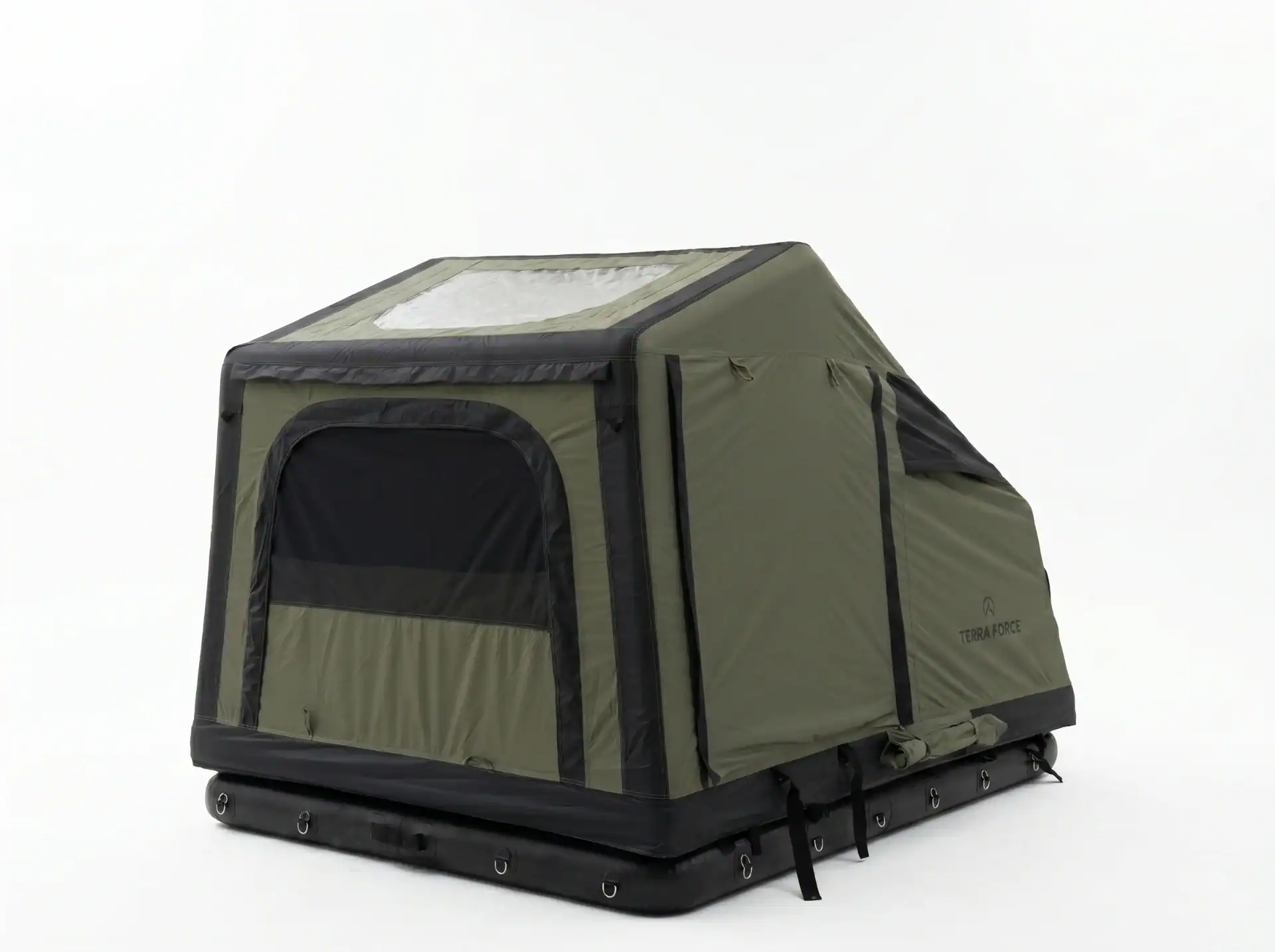
Raw Materials for Air Beams
The 0.2mm difference between 0.3mm PVC and 0.5mm TPU decides whether a beam survives its second season.
Air beam failures rarely start at the seam. They start with the raw material spec. Buyers who skip the laminate question at sampling often find the budget quote they approved used a thinner film than the sample they signed off.
TPU vs PVC Laminates
The industry split is simple: high-end tent beams run 0.5-0.7mm TPU laminates, while budget builds use 0.3mm PVC. That gap in film thickness maps directly to burst resistance, cold-weather flexibility, and how long the RF-welded seam holds its peel strength.
TPU resists hydrolysis, stays flexible below freezing, and welds into a homogeneous bond under RF energy. PVC does the job at lower cost, but plasticizer migration stiffens the film over time and degrades weld integrity. Kelyland’s air mattress line, manufactured in Xiangyang with CE, ETL, and ISO 9001 certifications, specifies puncture-resistant materials in the 0.4-0.6mm range — a practical baseline for what a durable inflatable structure requires.
-
- TPU: 0.5-0.7mm film for premium tents. Superior cold-crack performance, higher tear strength, and cleaner RF weld bonds.
- PVC: 0.3mm film for economy products. Acceptable for single-season use but vulnerable to stress cracking at weld points and stiffening below 0°C.
- Verification: Request caliper measurements on the finished beam. Raw film thickness can read correctly while the laminated end-product runs thin.
Fabric Weight and Denier
The laminate holds the air; the base fabric absorbs the handling. Air beam fabric is typically polyester or nylon, with denier determining puncture resistance. Higher denier means heavier fabric and a more durable beam, but it also increases packed weight and cost.
A 600D base fabric sits in the practical mid-range for air beam construction. Below that, suspect the beam quality irrespective of the film spec. Kelyland’s 17 core strategic factories operate under ISO 9001:2015 quality systems, and the camping tent and glamping tent partners in Ningbo and Shaoxing have the annual production volume to validate materials across large runs.
Ask the factory for the exact beam construction: base fabric denier, film thickness, and finished weight per square meter. A credible supplier has those numbers on a spec sheet. A supplier that quotes only ‘TPU’ or ‘PVC’ without film thickness is telling you they don’t track it either.
| Material Type | Typical Thickness | Key Properties | Best Use | Cost Tier |
|---|---|---|---|---|
| TPU Laminate | 0.5–0.7 mm | High tensile strength, puncture-resistant, excellent low-temperature flexibility | Premium inflatable tents, glamping air beams, high-pressure structures | Higher cost |
| PVC Laminate | 0.3–0.5 mm | Good stiffness and airtightness, lower cost, but can become brittle in cold and prone to blowout at thin gauges | Budget inflatable tents, entry-level air beams, short-term seasonal products | Lower cost |
| TPU Blended Fabric | 0.4–0.6 mm | Balanced durability and weight, superior waterproofness, UV resistant | Mid-to-high-end camping tents and air beam systems requiring repeated inflation cycles | Medium-to-high cost |
| Fabric Weight | 150D–300D polyester or nylon base | Higher denier increases abrasion resistance and seam strength; low denier reduces weight but risks tearing | Optimizing weight vs durability for backpacking vs family camping inflatable tents | Varies |
| Reinforcement Layer | Integrated mesh or scrim | Prevents beam elongation, maintains shape under pressure, improves dimensional stability | Structural air beams for large tents, tunnel tents, and high-pressure inflatable frames | Adds cost |

Cutting and Sealing
RF welding fuses TPU into one piece.
The sealing method decides whether an inflatable tent holds pressure through a storm front or deflates at midnight. For load-bearing air beams, RF welding is the only process that belongs in the spec. When you compare RF welding vs heat sealing air beams, the difference is at the molecular level, not just the surface.
RF Welding Process
RF welding uses high-frequency electromagnetic energy to excite polar molecules inside TPU, generating heat from within the material. The two film layers fuse together without glue or solvent. The result is a homogenous seam with no adhesive interface to age, crack, or slip. Seam peel strength standards are set by the material supplier, and a properly tuned RF press meets them consistently.
Because the heat is generated inside the material, RF welding handles thick films 0.5–0.7mm without overheating the exterior. Hot-bar heat sealing applies heat from outside, which can thin the film at the edge and create weak points under pressure. That is a critical difference for blowout failures.
Heat Sealing vs Gluing
Hot-bar heat sealing is cheaper to set up but depends on perfect contact pressure. If the bar temperature drifts, you get either a cold weld that peels or a melted edge that cracks. Gluing is the worst option for inflatable tents. Adhesives harden at low temperatures, break down under UV, and off-gas during production. None of those are acceptable for a private-label brand expecting repeat sales.
TPU vs PVC air beam durability also interacts with the sealing method. High-end inflatable tents use 0.5–0.7mm TPU film, while low-cost alternatives drop to 0.3mm PVC. A thinner PVC beam can RF weld fine, but it will fatigue and blow out after a few seasons. You do not see that in the sample; you see it in the field.
-
- Seam type: Do load-bearing beams use RF welding with calibrated dies, or hot-bar sealing? Ask for process photos.
- Material spec: Is the beam film 0.5–0.7mm TPU, or 0.3mm PVC? Check a cut piece with calipers.
At Kelyland Outdoors’ partner factories, RF welding is performed as a controlled production step, and every sealed seam goes through visual inspection before assembly. That is part of the ISO 9001:2015 routine across the network. When you source air beam tents, ask for the factory’s welding parameter sheet — not just the final sample.
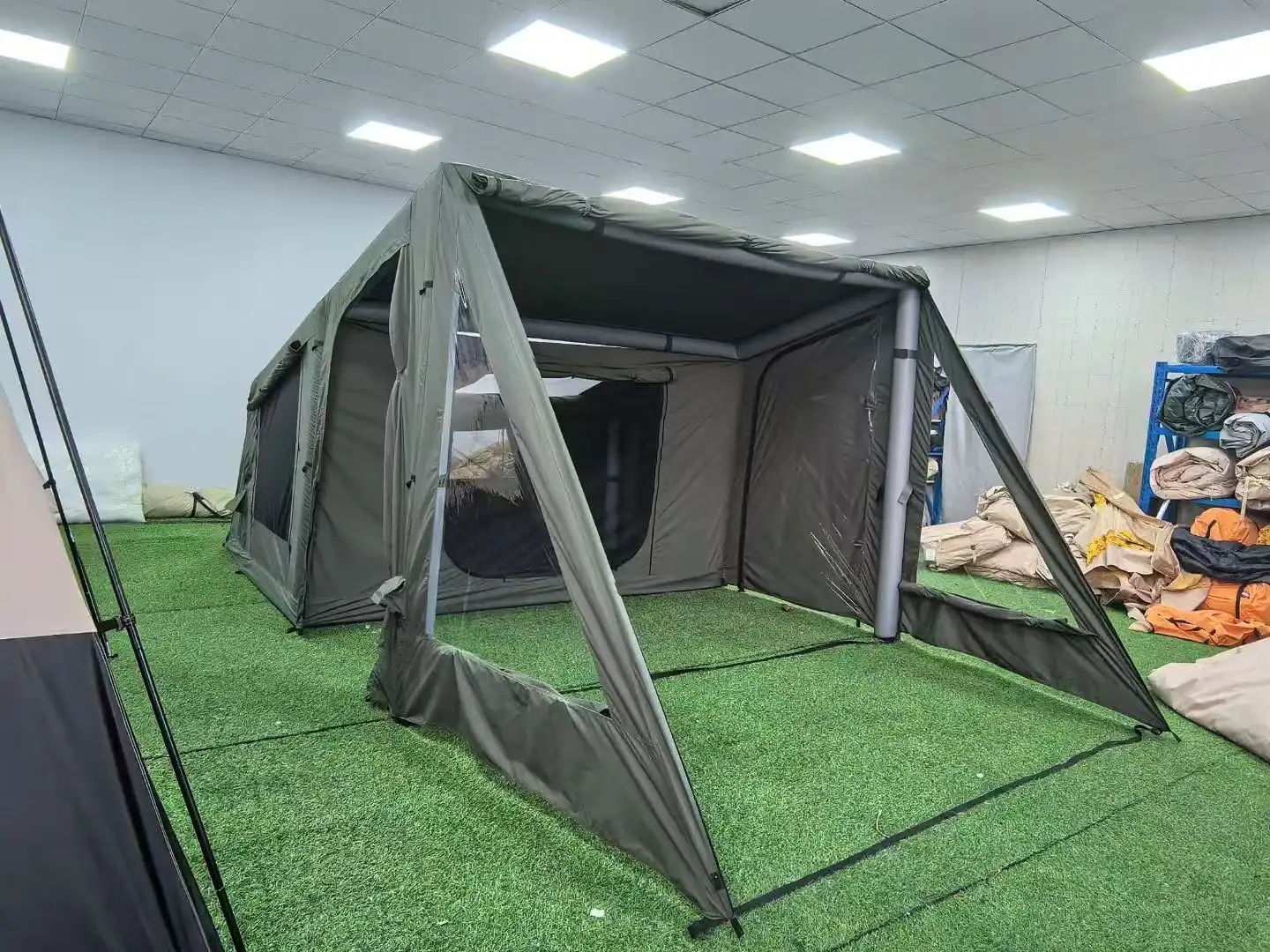
Valve Installation
The valve flange is the most common leak point on an inflatable tent.
The one-way versus two-way decision looks like a user convenience choice. In manufacturing, it is a reliability decision. One-way valves have fewer moving parts and seal well under backpressure. Two-way valves make deflation faster, but every spring, gasket, and threaded cap adds a potential leak path. On an air beam, a slow leak in one chamber weakens the whole shelter.
One-Way Valves: Fewer Leak Paths
A one-way valve uses a flap that closes when air pressure reverses. It inflates cleanly with a pump and loses pressure slowly if the flap seats properly. The tradeoff is takedown speed: without a two-way port, you either roll the tent or use a separate deflate opening to push air out. For a small trekking shelter, that extra minute is fine. For a crew-deployed glamping tent, it adds up.
Two-Way Valves: Speed With Structural Tradeoffs
Two-way valves let the same port handle inflation and deflation, which makes them the practical choice for large inflatable tents. The catch is structural: a larger opening interrupts the beam’s welded surface, and the flange becomes a stress concentration point. High-end beams use 0.5–0.7mm TPU around the valve; budget builds using 0.3mm PVC can tear at the flange during repeated inflation.
-
- One-Way: Best for small tents and occasional use. Simple seal, fewer leak paths, slower to deflate.
- Two-Way: Best for large shelters and frequent setup and takedown. Faster turnaround, more components to fail.
- Placement: Recessed valves survive folding; top-mounted valves are easier for pump access but take damage in transit.
Vetting the Valve Installation
Ask how the flange is attached. RF welding fuses the valve to the beam material and gives a stronger, more waterproof joint than heat sealing or gluing. During air leak detection in inflatable tent production, the valve flange is the first place bubbles show up. Kelyland’s partner factories run inspections at every production stage under ISO 9001:2015, and QC reports are available on request. If a supplier cannot show leak-test or burst-pressure records, expect the warranty claims to start at the valve.
Pressure Testing
Burst pressure tests expose manufacturing discipline better than any sales pitch.
Blowout failures don’t announce themselves during a sales call. The beam inflates fine in the showroom, survives a weekend of gentle use, then pops at the weld seam on a hot afternoon when internal pressure climbs. The root cause is almost never the pump. It’s the laminate thickness and seam integrity that were specified before production started.
Burst Pressure Tests
High-end inflatable tents use 0.5–0.7mm TPU laminate for air beams. TPU stretches under load and returns to shape. Cheap alternatives use 0.3mm PVC, which can blow out. Burst pressure testing exposes the difference: inflate the beam until it fails, and the recorded number reveals how much safety margin sits above the recommended working pressure.
-
-
- Working pressure vs burst pressure: A quality air beam carries a burst rating well above its working pressure. If the supplier can’t produce the test report, the test wasn’t run.
- Seam peel strength: RF welding fuses TPU at the molecular level, creating a bond that outperforms heat sealing or gluing. Peel strength testing verifies weld width and temperature parameters held throughout the production roll.
-
Leak Detection
Leaks concentrate at two points: the weld seam and the valve seat. A soapy-water brush test catches gross leaks, but production-scale air leak detection relies on pressure decay — inflate, seal, measure the drop over a set window. Kelyland’s partner factories, operating under ISO 9001:2015, document these checks at every production stage, with reports available on request. Ask for the latest batch report, not the pre-production sample from the sales pitch — burst data from the full production run is the only number that predicts field performance.
-
- Air retention test: Inflate the beam to working pressure and hold it overnight. A beam that loses pressure slowly at moderate temperature can fail fast when the laminate softens under direct sun.
- Valve seat integrity: The valve area takes repeated stress on every inflation cycle. A loose seat creates a slow leak that end users can’t diagnose — test it beyond nominal pressure, not just at spec.
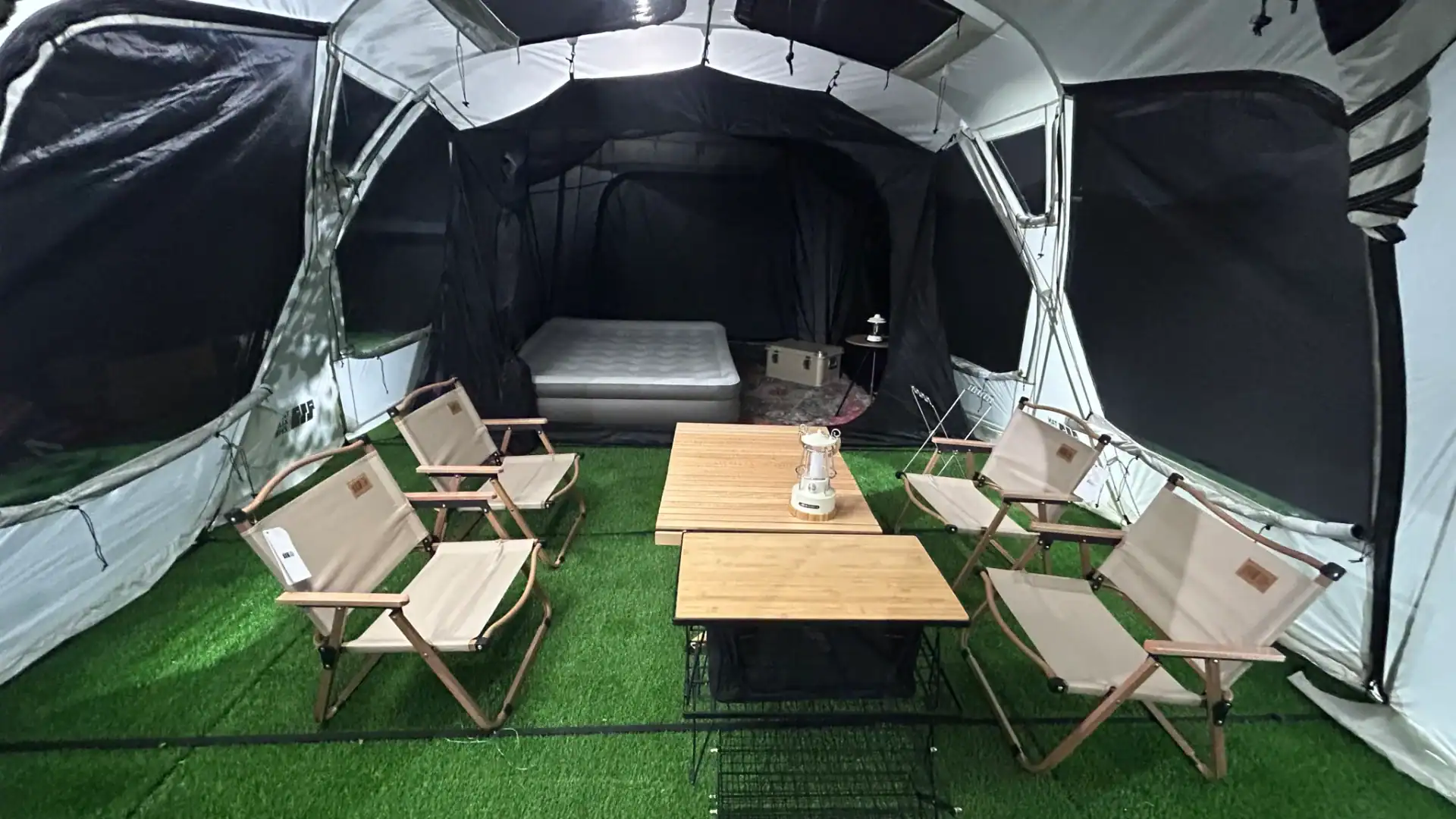
Assembly into Tent
A sleeve that fits when flat can bind when inflated.
The sleeve is the structural handoff between the air beam and the tent canopy. Wind load on a large glamping tent doesn’t stop at the fabric — it transfers through the sleeve seam into the beam. Get the sleeve tolerance wrong and the tent passes visual inspection but starts failing on the third campsite setup.
The spec that matters is sleeve width relative to the beam’s inflated diameter. Air beams change shape slightly under operating pressure. A sleeve cut to the deflated profile binds, creating friction wear against the beam surface over repeated inflations. Cut too loose and the beam shifts inside the channel, loading one side of the seam until it peels.
Three sleeve details to verify with any air beam supplier
-
- Anchor-point reinforcement: The ends of each sleeve channel take the highest bending stress when the tent shifts. Double-layer webbing at both ends stops seam tear-out. Check the work order — it should appear as a separate line item, not a verbal promise.
- Valve access cutout: The sleeve needs a reinforced opening aligned exactly with the valve position. A misaligned cutout forces users to wrench the beam in and out, and the fabric around the opening frays. Once that tears, a field repair is nearly impossible.
- Longitudinal seam placement: The sleeve seam should sit on the outer curve of the bend, not the inner curve. On the inner curve, it becomes a compression point — the first place delamination shows up.
Beam material changes the sleeve math. A high-end 0.5–0.7mm TPU beam holds its geometry differently than a budget 0.3mm PVC beam. Suppliers who skip the material spec on the sleeve drawing often end up with a tent that inflates fine in the showroom but bags and bows on the first windy site.
At Kelyland Outdoors’ partner tent factory in Ningbo, Zhejiang, production runs 800,000 camping tents per year under CE, BSCI, and ISO 9001 certification. Sleeve width tolerance and seam placement are locked into the pre-production sample, which becomes the reference for mass production. When vetting an inflatable tent air beam supplier, ask for the measured sleeve tolerance against the beam’s inflated diameter. If the factory can’t produce that document, it hasn’t measured it.
Quality Checks
A clean weld can hide a weak laminate.
The pre-production sample you approved weeks ago is not the product that ships. The QC gate between mass production and container loading is where air beam failures get caught. Kelyland’s partner factories run inspections at every production stage under ISO 9001:2015 protocols, and the inspection reports are available on request. The real question is what those inspectors check — and whether you know how to read the report.
Visual Inspection
-
-
- Weld seam continuity: The RF weld line must hold a uniform width along the full beam length. A narrow stretch or a cloudy weld zone means the dielectric field was uneven — a classic failure point when the machine operator shortens the cycle.
- Laminate thickness: Beam walls on air mattresses and inflatable tents should measure in the 0.4mm–0.6mm range per the factory standard. Cheaper alternatives drop to 0.3mm PVC; the material looks identical until the seam peels under inflation pressure.
- Valve flange seating: The valve base is the most stressed joint on an inflatable tent. Inspectors confirm the flange sits flush against the beam wall and the weld ring has no gaps. A misaligned valve concentrates stress at the seam and fails first in the field.
-
Visual checks catch surface defects, but the leak path is often invisible. Every air beam needs a pressurized retention test before it moves to tent assembly.
Air Retention Test
-
- Pressure hold: Beams inflate to the working pressure defined in the approved spec and hold for a set dwell period. The pressure-drop tolerance is locked during sample approval — if the pre-production beam held, every production beam should match that baseline.
- Soap-solution leak detection: For air leak detection in inflatable tent production, inspectors brush a soap-water mix along the full weld line and around the valve base. Micro-pinholes that a visual inspection cannot see bubble up immediately.
- Seam peel integrity: Ask to see the air beam seam peel strength record. A proper RF weld tears the surrounding laminate before the seam separates; a glued seam peels cleanly. That difference decides whether a tent survives a full season or fails in the field.
Conclusion
The gap between a reliable air beam and a blowout waiting to happen comes down to material thickness, weld integrity, and test documentation. A $50K order can pass sample approval and still fail in the field if those three specs aren’t verified. That’s the cost of treating air beam manufacturing as a black box.
-
- 0.5–0.7mm TPU laminate resists blowout; 0.3mm PVC film is the failure point in budget air beams.
- RF welding beats heat sealing for waterproof seams and holds up under repeated inflation cycles.
- Burst pressure and air retention tests reveal real structural integrity, not just sample appearance.
- Valve placement affects inflation ease and long-term durability; check one-way vs two-way designs.
Before you approve the next pre-production sample, ask the supplier for the TPU laminate thickness, the welding method, and the burst pressure report. If they hesitate, you have your answer. For a working benchmark, browse the inflatable tent range on the Kelyland Outdoors product page and compare the specs against what you’ve seen here.
Frequently Asked Questions
How are inflatable tent air beams welded?
RF welding fuses TPU-coated fabric into a single sealed beam, which is stronger than stitching or gluing. PVC air beams are usually heat-sealed or RF-welded depending on the laminate thickness and factory. Confirm the weld method before approving the mass production sample.
What is the difference between TPU and PVC air beams?
TPU is lighter, more flexible, and performs better in cold weather, while PVC is cheaper and heavier. For inflatable tents that need repeat use and export shipping, TPU laminate is the safer choice. Choose TPU for durability and PVC for budget-driven programs.
What pressure tests should inflatable tents pass?
Buyers should ask for burst pressure and air retention test reports before mass production. A production sample should hold the specified pressure for a defined period with minimal drop, not just match the. Set pass/fail targets before you approve the pre-production sample.
Where do inflatable tent air beams leak most?
The valve flange is the most common leak point on an inflatable tent. Assembly is where the beam sleeve, fabric panels, and valve are joined, so leaks often appear after stitching or seam finishing. Make valve inspection part of every sample review.
What fabric weight is used for air beams?
There is no single weight: air beam fabric is chosen based on the tent’s pressure rating, size, and target durability. For a custom inflatable tent, require the factory to state the denier, laminate. Lock the full beam construction into the production agreement.

 English
  Español
  Deutsch
  Français
  Português do Brasil
  Русский
  العربية
  한국어
한국어  日本語
日本語