 跳到内容
跳到内容 
A 20D nylon floor measures roughly 0.15mm thick. That single number sits at the center of tent floor durability. It’s also the line between a tent that sells for years and a $50K order that unravels on the first season. The classic version: the pre-production sample passes inspection, the bulk run swaps in a lower-tenacity yarn lot, and customers return tents with punctured floors before the second camping weekend.
The fix isn’t exotic. A 40D high-tenacity nylon floor runs about 70g/m², which adds 80-120g to a 2-person tent compared to a 20D floor — roughly the weight of an energy bar. In return, you get nearly double the tear strength and a hydrostatic head of 3,000-5,000mm instead of 1,500-2,000mm. That math settles most debates. A 1.4kg tent with a 40D floor is achievable, which means the old “make it light or make it durable” trade-off is mostly a sourcing excuse.
The hidden failure is the floor seams. Factories routinely tape the fly seams and leave the floor untaped to cut cost; the defect is invisible at sample approval and shows up as groundwater seepage on the third night out. Spec a bathtub floor with taped seams and a 3,000mm HH minimum, and make the quality tolerance explicit in the contract. That’s the difference between buying a spec sheet and buying a product people keep using.
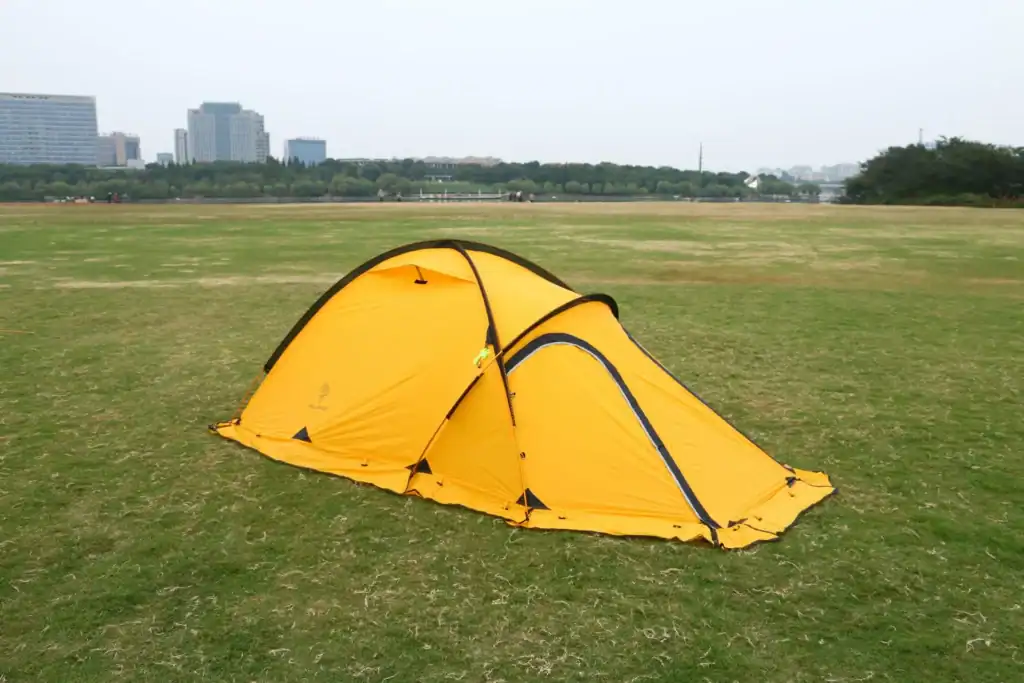
Why 20D Floors Are the First Thing to Fail
A 20D floor fails under point load, not because it’s defective.
The first failure point on any 2-person ultralight tent is the floor. A 20D nylon floor is roughly 0.15mm thick. When a knee or a chair leg pushes down on a small embedded stone, the point load exceeds the yarn’s breaking strength. The yarns snap. That is not a manufacturing defect; it is basic geometry working against thin fabric.
Why 20D Is the Default Floor Fabric
Most ultralight tents spec 20D floors to hit a 1.2kg marketed weight. A 20D nylon floor weighs about 40g/m². The standard 2-person floor area is around 2.3m², so the floor alone sits near 92g. Switch to a 40D high-tenacity nylon at 70g/m², and the floor jumps to roughly 161g. That 69g delta decides the spec sheet — which is why many brands stay on 20D and sell a footprint to fix the weakness.
-
- 20D Nylon: ~40g/m². Low tear strength — roughly 50% lower than 40D high-tenacity. Fails on exposed roots and granite after repeated pitching.
- 30D Nylon: ~55g/m². Medium tear strength. Better than 20D on mixed terrain, but still needs a footprint on rocky sites.
- 40D High-Tenacity Nylon: ~70g/m². High tear strength and a more robust PU coating. The standard for a field-reliable private label tent floor.
The total weight penalty for a 40D floor is 80–120g per 2-person tent once seams and reinforcement are factored in. That is roughly the weight of one extra water bottle. For most buyers, the durability gain is worth more than a number on the product page.
The Footprint Trap
Many brands protect a 20D floor by selling a separate footprint as an upsell. The customer pays an extra $30–50 and carries additional weight. A 40D floor eliminates that requirement for most campsites. You gain a pricing advantage over competitors who force the footprint purchase, and the end user gets a tent that handles real ground.
The proof is in production. Kelyland’s ISO 9001:2015-certified tent factory in Ningbo builds private-label ultralight tents at 1.4kg using a 40D floor. That sits inside the 1.3–1.5kg zone where weight still sells and floors still survive. If a supplier tells you 40D cannot hit that weight, question the rest of their spec sheet.
What To Check Before Sample Approval
Ask the supplier for the specific denier and g/m² of the floor fabric. Then test the sample the way your customers will use it: pitch on gravel, kneel on a small stone, and leave the tent set up on uneven ground for two hours. If the floor abrades or the coating peels, reject the sample. The cheapest factory move is to swap a 40D spec for 20D in mass production, so make the floor denier a line item on your OEM tent production quality checklist.
30D vs 40D vs 20D: What the Numbers Mean
40D costs 80–120g.
How the Weight Adds Up
A two-person tent floor runs roughly 2.3m². Move the floor from 20D nylon (40g/m²) to 40D high-tenacity nylon (70g/m²) and the increase is 69g. That is the floor alone, with no other fabric changes.
Extend the same fabric up the lower 15cm of the walls — the zone where boots, stake loops, and gear straps cause most abrasion — and you add 30–50g more. Total penalty: 80–120g on the finished tent.
Now stack that against the alternative. A mandatory footprint typically adds $30–50 to the retail bundle. Spec a 40D floor and the footprint becomes optional for most campsites. The trade is a net win for your margin and the customer’s packed weight.
Hydrostatic Head: What the Coating Actually Withstands
Hydrostatic head (HH) ranks the water pressure a coated fabric stops before leaking. It belongs on your spec sheet next to denier. A floor can carry a high denier and a weak coating — the two numbers do not automatically move together.
-
- 20D floor: 1,500–2,000mm HH: Fine on dry, well-drained campsites. It fails when a kneeling knee or chair leg presses down on wet ground — the point load pushes water through the coating.
- 30D floor: 2,000–3,000mm HH: A moderate step up, still below the safety margin most commercial buyers should accept for a product that will meet rocky, rooty campsites.
- 40D high-tenacity floor: 3,000–5,000mm HH: The grade to write into a private-label build. A heavier yarn carries a thicker PU coating, so the waterproof barrier survives ground pressure, folding, and seasons of use.
Tear strength follows the same curve. A 20D floor fails at roughly half the force of a 40D high-tenacity floor. That is not a subtle difference — it is the line between a pinhole you ignore and a rip that ends the tent’s life on the first trip.
The 1.4kg Benchmark
The counter-argument is always weight. Translate it: 80–120g against a 1.4kg tent is a 6–9% penalty, and it removes the single most frequent cause of field failure and retail returns.
Kelyland’s factory network builds most private-label ultralight tents at 1.4kg with a 40D floor. The Ningbo tent factory has an annual capacity of 800,000 units under ISO 9001:2015, so the 1.3–1.5kg class with a 40D floor is a production standard, not a special request.
Condensation and Seam Leaks: The Hidden Failures
Condensation and seam leaks cause most ‘wet tent’ returns.
Condensation catches most buyers off guard because it does not show up on a dry sample pitch. Two adults exhale roughly 1-2 liters of water vapor per night. In a double-wall tent with weak airflow, that vapor condenses on the fly and drips onto the inner tent. The floor can be totally dry, and the sleeping bags still soak.
The factory fix is ventilation, not a fancy coating
The factory solution is a ventilation layout. Specify two large mesh vents high on the inner tent, and require a fly that can be pitched high enough for air to move between fly and inner tent. Without that gap, condensation forms even on a fly rated at 3,000mm HH.
Seam leaks are a manufacturing defect
Seam leaks are different. They come from skipped production steps, not physics. Some factories apply cheap PU coatings that degrade after a few seasons. Others never tape the seams at all. The buyer only discovers this when the end customer unrolls the tent in the first rainstorm. That is why the tent floor seam sealing factory spec belongs in every RFQ.
The floor seam matters more than the fly seam. A tent floor sits directly on wet ground, and the stitching around the bathtub edge is the lowest point. If that seam is untaped, water wicks through within minutes. Do not accept a tent that is seam-sealed only on the fly.

Factory-level checks that prevent returns
-
- Floor HH: Specify 3,000mm hydrostatic head minimum. For premium private-label lines, go to 5,000mm.
- Seam taping: Require taping on all fly seams plus all floor seams. Verbal waterproofing claims mean nothing.
- Ventilation: Require two large mesh vents and a pitchable fly height. This controls the 1-2L of nightly vapor.
- Bathtub floor: Require seams 5-10cm above the ground. This keeps pooling water away from stitch holes.
Kelyland’s partner tent factory in Ningbo, which produces 800,000 tents per year under ISO 9001:2015, checks シームテーピング そして bathtub floor height during pre-shipment inspection. That is the kind of factory-level detail that keeps return rates down and protects your brand in the field.
Factory Spec Checklist Before You Order
A 40D floor adds 80-120g and removes the need for a $30-50 footprint.
Send this checklist to every factory before you discuss pricing. Most suppliers will happily quote a tent that looks right on paper. This list forces them to commit to the exact materials that determine whether your customers return the tent or keep it for five years.
The Spec Sheet That Separates Real Tent Factories
-
- Fly fabric: 20D-30D nylon ripstop, 3,000mm PU coating, all seams taped. Untaped fly seams are the cheapest factory cost-cut, and the buyer finds out in the first downpour.
- Floor fabric: 40D high-tenacity nylon, 3,000-5,000mm HH, bathtub construction. A 20D floor is around 0.15mm thick and punctures on a single kneeling motion over a small stone.
- Poles: 7075 aluminum. If the supplier tries to substitute 6061, the tent gains weight and loses strength. Get the alloy written on the quote.
- Guyline: 2.5mm reflective guyline minimum. Reflective rope prevents nighttime trips and holds up in wind better than 2mm cord.
- Stakes: 6-inch (15cm) aluminum stakes, 8-inch (20cm) for windy-season SKUs. Cheaper steel stakes add weight and bend.
- Packed dimensions: Under 50cm x 15cm. This is the maximum that fits inside a standard backpack side pocket. Anything longer changes your customer’s packing behavior.
- Target weight: 1.3-1.5kg without stakes. This is achievable with a 40D floor. Durable ultralight tents do not need to be 1kg with a fragile 20D floor.
A factory that cannot confirm these numbers in writing will also struggle with batch consistency. Kelyland’s tent factory, for example, runs 800,000 units per year under ISO 9001:2015 certification, and a custom tent MOQ starts at 300-1,000 pieces with a 30-45 day lead time. Those operational facts should be easy for a real production partner to state. Vague answers mean you’re talking to a trading desk, not a production line.
Sample Approval: Test the Floor Like a Customer Would
- Pitch on gravel: Set the tent up on coarse gravel and press down on the floor with your palms. This checks abrasion resistance, not appearance.
結論
The floor is the first point of failure on a 2-person ultralight tent, and the root cause is usually a spec sheet that prioritized weight over material. A 40D high-tenacity floor adds 80–120g but delivers roughly double the tear strength of a 20D floor, which is enough to eliminate punctures on most campsites. Seam taping and a 3,000mm HH rating turn that fabric into a waterproof barrier your customers can trust.
-
- 20D nylon floors are roughly 0.15mm thick and tear on exposed roots, driving most puncture-related returns.
- 40D high-tenacity nylon adds 80–120g per tent but roughly doubles tear strength, cutting returns and footprint costs.
- Specify seam-taped floors and 3,000mm minimum hydrostatic head; untaped seams leak on the first rainstorm.
- A 1.4kg tent with a 40D floor is achievable, so durability does not have to kill the ultralight selling point.
Before you approve the next sample, ask your factory to confirm the floor denier, HH rating, and seam taping in writing on the purchase order. Compare those responses against the checklist in this guide, then send your target weight and floor material requirement to Kelyland Outdoors for a factory spec review and sample quote on a 2-person ultralight tent.
よくある質問
How much should a 2-person ultralight tent weigh?
A 2-person ultralight tent should weigh around 1.2 to 1.5 kg trail weight. If you source a sub-1.2 kg model, expect a 20D floor that may need a footprint. Choose your weight target based on the floor durability you plan to promise.
Is a 20D or 30D tent floor better?
30D is better for real-world durability because it adds roughly 15 g/m² over 20D with medium puncture resistance. 20D saves weight but tears first on roots and rock. If durability matters more than grams, spec 30D or 40D.
Do I need a footprint with an ultralight tent?
With a 20D floor, plan on a footprint for rocky campsites; with a 30D or 40D floor, a footprint can become optional. The real driver is the floor denier and whether point loads hit the ground. Define your target terrain before deciding.
How do I fix a ripped ultralight tent floor?
Clean the area and apply a nylon patch kit, then seam-seal the patch edges. If the tear is along a seam or the coating is delaminating, a field patch is only temporary. Test the patch at home before trusting it on trail.
What is the best material for a 2-person trekking pole tent?
A 40D high-tenacity nylon floor paired with a 20D fly is the best material balance for a 2-person trekking pole tent. This floor resists abrasion and puncture without adding significant weight. Use 30D as a mid-cost compromise for mixed terrain.

 English
  Español
  Deutsch
  Français
  Português do Brasil
  Русский
  العربية
  한국어
한국어  日本語
日本語