 跳到内容
跳到内容 
what size sleeping bag for is the first checkpoint buyers should lock before they approve a supplier, budget, or production slot. The moment you realize the sleeping bag is wrong happens at 2 a.m., not in the store. Your 10-year-old is curled into a ball at the bottom of an adult bag, shivering, because the extra 40-50% of dead air around their body is cold and their 35 kg frame can’t heat it. That’s the difference between a night of sleep and a night of teeth-chattering. So what size sleeping bag for a 10-year-old actually works? The short answer: internal length of 160-170 cm, not the 190-210 cm that comes standard in adult bags.
Here’s the part most parents and even some brands miss. Kids don’t need a shorter adult bag—they need a shorter torso and narrower shoulders. A typical 10-year-old stands around 138-139 cm tall, with a shoulder girth of about 135-145 cm. If you just shrink an adult pattern by 15%, which is what many budget youth bags do, the hood sits on the crown of the head and the draft tube presses against the chin. A proper youth pattern moves the shoulder baffle up by 8-10 cm and narrows the foot box by 4-6 cm. That’s where the warmth actually lives.
For brands sourcing kids’ sleep systems, this is the difference between a product that tests well on paper and one that performs on the trail. A youth mummy bag with 10 cm loft and a 165 cm length can hit a 5°C comfort rating—if the pattern is right. Spend the extra design effort on the baffle placement, not just the fill weight. That’s how you get a bag a kid actually sleeps in, and a repeat customer.
Why Adult Sleeping Bags Make Kids Cold
Fit drives warmth more than fill weight.
Slide a 138 cm, 35 kg ten-year-old into a standard 200 cm adult bag and the physics turns against them. Adult mummy bags carry 150–165 cm of shoulder girth; a 10-year-old needs 135–145 cm. The mismatch creates 40–50% dead air space — roughly 500 mL of extra trapped volume around the torso and feet alone. A child’s lower body mass simply cannot heat that air.
Children lose heat at roughly 1.2× the rate of adults per kilogram of body mass. At 35 kg, that’s a real disadvantage. An extra 3°C of internal temperature drop — the kind a bad fit produces — can shift a child from restful sleep to shivering by 2 a.m.
The Hood and Draft Tube Fail on Adult Bags
Adult bags position the hood behind the head because adult torsos are longer. On a child, that same hood sits over the crown of the head. The drawcord tightens against the forehead, and a crescent-shaped gap opens at the back of the neck. That gap drafts all night.
The draft tube — the insulated flap behind the zipper — is positioned for an adult chin. On a child it presses against the throat or mouth. Some kids tolerate it. Most roll over, open the gap, and lose whatever warmth the bag was supposed to trap.
The Pattern Geometry Problem
Kids don’t need a shorter adult bag. They need a shorter torso and narrower shoulders. If you simply shrink an adult pattern by 15%, the proportions go wrong — the shoulder baffle drops too low, the foot box stays too wide, and the hood lands on the crown of the head instead of behind it.
A proper youth pattern moves the shoulder baffle up by 8–10 cm and narrows the foot box by 4–6 cm. That’s where the engineering happens. Kelyland’s sleeping bag factory in Zhenjiang — ISO 9001:2015 certified, 1.5 million units a year — builds youth models from a dedicated pattern block, not a scaled-down adult template.
Thermal Efficiency: Adult Bag vs. Youth Bag
-
- Adult Regular (200 cm): ~140 L internal volume. A child’s body leaves 40–50% dead air space. Effective comfort drops up to 5°C below the rated temperature.
- Youth Proper (165 cm): ~95 L internal volume. Roughly 8% dead air space. Holds its temperature rating — a 10 cm loft youth mummy bag can deliver 5°C comfort.
Rule of thumb: buy 10–15 cm of extra length for growing room. Beyond 30 cm of slack, the extra volume stops being ‘room to grow’ and becomes a cold air pocket. Stretch the same fill across 200 cm of adult bag and the rating falls apart.
Fit drives warmth more than fill weight when body size mismatches pattern dimensions. You can double the down, but you can’t fix a bag that’s 35 cm too long and up to 30 cm too generous around the shoulders.
Sizing Chart for Ages 8-12
A proper 160–170 cm youth bag holds warmth; an oversized adult bag becomes a freezer.
Forget the “one-size-fits-all” advice you see on parenting forums. An 8-year-old needs a 150–160 cm internal length; a 10-year-old needs 160–170 cm. That’s the benchmark and the entire point of a proper kids’ sleep system. If the bag is shorter, your child’s feet press against the cold seam. If it’s longer, they’re sleeping in a drafty cavern.
Age-by-Age Dimensions That Matter
-
- Age 8 (125–135 cm tall): Bag length: 150–160 cm. Shoulder girth: 70 cm max. Foot box width: 35 cm max. This is the minimum viable size for a summer camp bag—any wider and the thermal envelope fails.
- Age 10 (135–145 cm tall): Bag length: 160–170 cm. Shoulder girth: 72 cm max. Foot box width: 36 cm max. This is the sweet spot. A 165 cm length with 10 cm of loft and a snug mummy cut holds a 5°C comfort rating without the dead air problem.
The rule of thumb we use in production: add 10–15 cm of extra length for growing room. That’s it. Push past 30 cm and you’re no longer buying space — you’re buying a cold air pocket that a 35 kg child’s body mass has to heat overnight. Most parents don’t realize this until their kid wakes up shivering at 2 a.m. with the bag bunched at their feet.
The “One-Size-Up” Trap
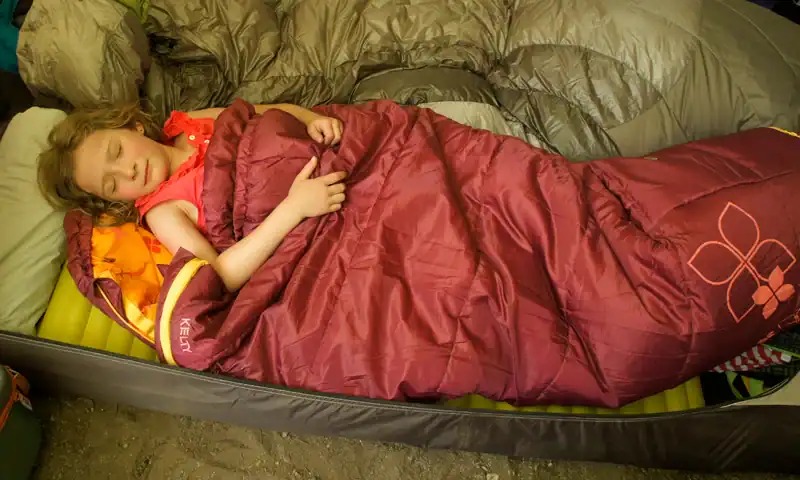
Buying an adult “short” bag to avoid replacing gear next year is the single most common mistake. Adult mummy bags run 190–210 cm long and 150–165 cm around the shoulders. A 10-year-old inside that shell faces 40–50% more dead air space — air their core simply cannot heat. Fit drives warmth more than fill weight when the body size mismatches the pattern.
Cheap youth bags make the problem worse. They simply shrink an adult pattern by roughly 15%, which puts the hood on the crown of the head and the draft tube pressing against the chin. A true youth pattern moves the shoulder baffle up by 8–10 cm and narrows the foot box by 4–6 cm. That’s pattern engineering, not a resize. It’s also why a properly cut 165 cm youth bag outperforms an adult 180 cm “short” bag at the same fill weight.
The 60-Second Field Test
Before buying or approving a sample, put your child in the bag and zip it to the chest. Bend their knees slightly — there should be slack, not tension. The hood should sit behind the head, not on top of it. Then check the chin area: any gap where the draft tube doesn’t seal is a heat leak. If you can slide an open hand between the chin and the tube, that bag fails below 10°C.
The thermal fit test is the one that matters at night. A youth mummy bag with 10 cm loft and a 165 cm length holds the line at 5°C comfort — the spec Kelyland’s sleeping bag production uses as its baseline. Factory partners in Zhenjiang, Jiangsu, run 1.5 million sleeping bags annually under ISO 9001:2015, and they measure shoulder girth and foot box width
Conclusion
A youth mummy bag at 165 cm with 10 cm of loft can hold 5°C comfort. An adult bag at 200 cm leaves 40-50% dead air, and a 10-year-old’s body mass can’t heat that space. Fit drives warmth more than fill weight, so the 10-15 cm rule for growing room is a ceiling, not a target.
-
- For a 10-year-old, choose 160-170 cm internal length, not an adult 190-210 cm bag.
- More than 30 cm of extra length creates a cold air pocket and cancels out fill quality.
- Youth shoulder girth should sit near 135-145 cm; adult bags run 150-165 cm.
- A true youth pattern moves the shoulder baffle up 8-10 cm and narrows the foot box 4-6 cm.
Before you sign off on a sample, put the numbers on paper: target length, shoulder girth, and comfort rating. For this age group, that means 160–170 cm length and 135–145 cm around the shoulders. Send those specs to Kelyland when you request a custom kids’ sleeping bag; the factory can adjust the pattern so the hood sits behind the head and the foot box doesn’t swallow a child’s feet.
Frequently Asked Questions
What size sleeping bag for a 10 year old?
A 10-year-old needs a youth sleeping bag with an internal length of 160–170 cm, not a standard adult bag at 190–210 cm. Fit drives warmth more than fill weight, so avoid oversized adult. Measure the child and confirm internal length before ordering.
Why do kids get cold in adult sleeping bags?
Adult sleeping bags leave 40–50% dead air around a child’s body, and a 10-year-old’s body mass can’t heat that extra volume. This can make the bag feel up to 5°C colder than its comfort. Use a youth-specific bag to keep warmth inside.
What makes a proper youth sleeping bag pattern?
A proper youth pattern moves the shoulder baffle up by 8–10 cm and narrows the footbox by 4–6 cm. Many budget bags just shrink adult patterns, which puts the hood. Ask suppliers whether they adjust youth patterns or only scale adult ones.
How much dead air do adult bags leave kids?
An adult 200 cm bag holds about 140 L and leaves 40%+ dead air for a 10-year-old, while a proper 165 cm youth bag holds about 95 L with near 8% dead space. Choose the bag by internal volume, not just length.
What size sleeping bag for ages 8-12?
A 160–170 cm internal-length youth bag is the practical benchmark for most 8–12 year olds, with 10-year-olds in the center of that range. Growth rates vary, so always compare internal length against the. Confirm internal length against the child’s height before committing.

 English
  Español
  Deutsch
  Français
  Português do Brasil
  Русский
  العربية
  한국어
한국어  日本語
日本語