 跳到内容
跳到内容 
1kg sleeping bag is the first checkpoint buyers should lock before they approve a supplier, budget, or production slot. A buyer’s checklist for a new sleeping bag line usually covers fill power, shell denier, and temperature rating. It looks solid on paper. But the one item nobody checks — the zipper weight and baffle construction — is what causes most post-delivery complaints about warmth. I’ve seen a $50K order come back because the pre-production sample felt fine in the showroom, but the mass production run swapped in a heavy #8 zipper and stitch-through baffles to hit the target price. The result was a 1kg sleeping bag that couldn’t hold its loft below 7°C.
The problem isn’t physics — a properly specified bag with a 10D shell, 350g of 700FP down, box-wall baffles, and a #5 coil zipper can deliver genuine 0°C comfort at exactly one kilogram. But most factories that quote “1kg” are allocating weight to the wrong places. They put grams into thick fabric and heavy hardware, then steal from the insulation budget to stay under the number. That trade-off turns a warm ultralight concept into a drafty shell that fails your brand’s comfort promise before it reaches retail.

What ‘1kg’ Actually Covers: Shell, Fill, and Hardware Budget
A 20D shell adds 80-100g and forces fill cuts.
A correctly specified 1kg mummy bag allocates roughly 250-300g for a 10D nylon shell, 350g for 700FP down, 100-120g for a YKK #5 coil zipper, 60g for a draft tube, and 30g for labels and trims. That leaves a small construction allowance for seams. Every gram is accounted for before production starts.
Why a 20D Shell Breaks the Budget
Switching the shell to 20D nylon adds 80-100g before insulation. A factory that still quotes ‘1kg’ must cut down fill to compensate. That lowers loft and pushes comfort rating down several degrees. The result: a bag that weighs the same on the scale but sleeps colder by a measurable margin.
Seam Allowance and Differential Cut
A differential cut uses a larger inner lining circumference than the outer shell, so the down has room to expand without straining the fabric. Combined with narrow seam allowances, this removes fabric volume without reducing insulation. Premium OEMs use this technique to save 150-200g versus a standard mummy pattern while keeping the 9-11cm loft needed for 0-5°C comfort.

Down vs Synthetic at 1kg: Two Very Different Bags
At 1kg, down delivers 0°C comfort; synthetic settles at 3-7°C.
A buyer who locks in a 1kg weight target and needs a specific comfort rating has to choose insulation first. Down wins on loft per gram. Synthetic wins when wet. The two paths lead to very different bags, and the wrong choice means either a cold customer or a return that eats your margin.
Down Wins on Loft per Gram
Down produces roughly 1.5x more loft per gram than hollow-fiber synthetic. That means 350g of 700FP down can hold 9-11cm of loft inside a box-wall baffle — enough for a 0°C comfort rating in a bag that stays under 1kg total. A synthetic bag needs 600-700g of fill to approach the same warmth, which pushes total weight above the target. For proof, look at the Rab Neutrino 400: it packs 400g of 800FP down into a sub-800g bag and hits -1°C comfort.
Synthetic Wins When Wet
Synthetic insulation retains more heat when wet and dries faster than down. It also costs less per bag — useful if your retail price point is tight. But on a strict 1kg budget, synthetic fill density forces the comfort rating up to 3-7°C. That’s fine for summer trips or damp climates, but it won’t cover the shoulder-season backpacker who expects warmth at freezing.
Which Is Better for a 1kg Target
Set the decision threshold before you spec anything else: if your KPI is a genuine 0-5°C comfort rating inside one kilogram, down is the only realistic insulation. If your buyer prioritizes wet-weather resilience and lower unit cost, accept that synthetic will land at least two degrees warmer and add roughly 200g to the pack weight.
Baffle Design and Temperature Rating: Loft Is King
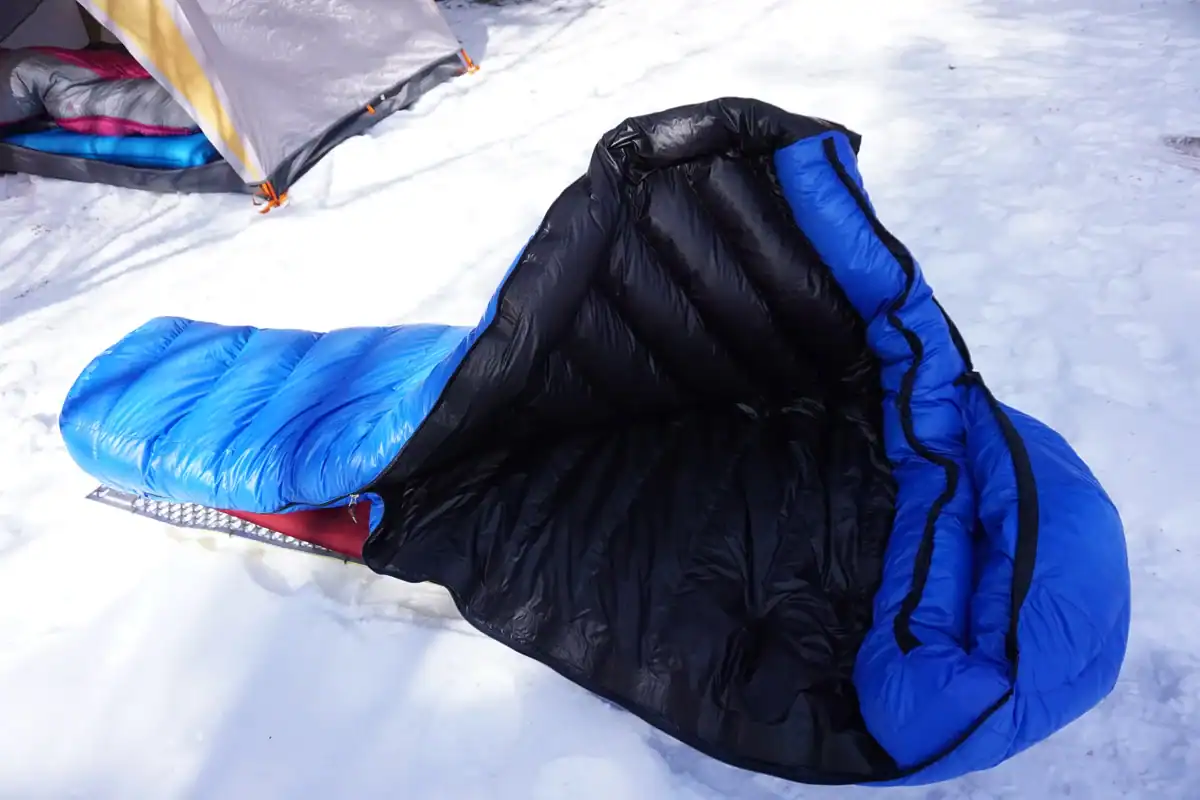
Two bags can both claim 1kg and 0°C, but field comfort can differ by 3-4°C depending on baffle construction.
Loft is the single most reliable predictor of warmth. A 2cm change in maximum loft shifts the comfort rating by 2-3°C. For a 1kg down bag, realistic loft is 9-11cm, which lands at 0-5°C comfort. Less loft means a colder bag, regardless of what the tag says.
Loft Drives Warmth
The insulation’s job is to trap still air. The thicker the air layer, the more heat stays inside. Down provides roughly 1.5x more loft per gram than hollow-fiber synthetic, so a 1kg down bag with 350g of 700FP fill can hold 9-11cm of loft. A synthetic bag at the same weight would have only 5-7cm and feel noticeably colder.
Stitch-Through vs Box-Wall vs Sewn-Through
-
- Stitch-Through (single-layer): Loft is 4-6cm. Every seam compresses the fill, creating strong cold lines. Suitable for summer bags only.
- Box-Wall Baffle: Loft reaches 9-11cm. Vertical fabric walls let the down fully expand. No cold lines. This is the standard for 0°C down bags.
- Sewn-Through: Loft is 5-7cm. Often used interchangeably with stitch-through in factory specs. Same problem: fill is compressed at every seam, causing thermal bridges.
Cold Lines and Heat Escape
Sewn-through seams steal up to 30% of total loft across the bag. That means a 1kg bag with stitch-through construction might deliver only 6-7cm of effective loft, pushing the comfort rating to 5-7°C instead of 0°C. Box-wall baffles eliminate this loss by keeping insulation fully expanded over the entire body.
Reading Temperature Ratings Correctly
Always ask for the comfort rating, not the limit rating. A bag marketed as -2°C with a limit of -8°C may catch attention, but on a 1kg budget the realistic comfort sweet spot is 0-5°C. The European EN 13537 standard separates comfort from limit for a reason. If a factory cannot provide both numbers on the spec sheet, walk away.
Our partner sleeping-bag factory in Zhenjiang, Jiangsu, produces 1,500,000 units annually under ISO 9001:2015. They can build box-wall baffles with 9-11cm loft using 700FP down and a 10D shell, hitting the 1kg target with a genuine 0°C comfort rating. Custom MOQs start at 50-100 pieces, with lead times of 30-45 days. That is the kind of component discipline that turns a weight claim into a real product.
Factory Checklist for Sourcing a Lightweight Sleeping Bag
A factory that cannot produce a component weight table is not controlling its material costs.
Before you approve a sample, request a written breakdown of every component’s weight. Shell fabric, fill mass, zipper, draft tube, trims — each line should show grams. If the supplier sends back a single number like ‘total: 1kg’, they are either hiding something or have no idea what goes into their own bag.
Demand a Written Component Weight Breakdown
A correctly spec’d 1kg mummy bag allocates roughly 250-300g for a 10D nylon shell, 350g for 700FP down, 100-120g for a #5 coil zipper, 60g for a draft tube, and about 30g for labels and seam tape. That leaves almost nothing for error. Ask the factory to put these numbers in writing before sampling begins.
-
- The ask: “Please provide a line-item weight budget showing shell g/m², total fill grams per size, zipper model and gram count, draft tube fabric weight, and trim/tape allowance.”.
- What to watch: If the factory quotes ‘1kg’ but allocates under 300g to down fill in a size regular, the bag will not reach 0°C comfort regardless of shell quality.
Specify Fill Power, Shell Denier, and Baffle Type
Put these three items into the written specification before any prototype work begins. Fill power determines loft per gram — use at least 700FP down for a sub-1kg target. Shell denier controls durability and weight; stick with 10D to 15D nylon on the inner and outer shells. Baffle type decides whether that loft actually insulates.
Conclusion
A quoted ‘1kg’ is just a budget, not a warmth guarantee. Without a component-level spec covering shell denier, fill power, zipper weight, and baffle construction, you risk ordering a bag that hits the weight target but misses the comfort rating by 3-4°C.
-
- A true 1kg bag needs at least 350g of 700FP down in a box-wall baffle.
- Switching from stitch-through to box-wall baffles recovers up to 30% of loft.
- Always request the all-in weight including stuff sack and trims.
If you skip this verification step and approve a sample based on a marketing number alone, the cost surfaces after your first retail season — when customer reviews mention cold nights at -2°C and you’re paying for returns or replacements on a batch of several hundred units. The reorder timeline alone can kill your Q4 sell-through window. Before committing to production, review current pricing and spec-matched options from Kelyland’s sleeping-bag line, where every gram is documented across ISO-certified factories with MOQs starting at just 50 pieces.
Frequently Asked Questions
Is a 1kg sleeping bag possible?
Yes, a 700FP down mummy bag with a 10D shell and 350g of fill can hit 1kg with 0°C comfort. The challenge is component discipline: a 20D shell adds 80-100g, forcing fill cuts. Specify 10D shell and 700FP down in your RFQ.
What temperature rating can a 1kg sleeping bag have?
Realistically 0°C to 5°C comfort for down; below zero requires higher-fill-power down or a lighter shell. At 1kg, synthetic bags settle at 3-7°C comfort. For sub-zero, expect a heavier bag or different fill.
Does a 1kg sleeping bag include the stuff sack?
Not always; many sellers quote bag-only weight, while the stuff sack, repair patch, and draft tube add 15-25g. Always ask for the all-in weight including packaging. Request all-in weight before comparing quotes.
Which is lighter: down or synthetic sleeping bag?
Down, at the same warmth level. For 0°C comfort, a down bag needs about 350g fill; a synthetic bag needs 600g of insulation. Down is lighter but more expensive and moisture-sensitive.
Can a 1kg sleeping bag work for winter camping?
Only down to its comfort rating of 0-5°C. A 1kg bag with 9-11cm loft covers 0-5°C; for true winter conditions below freezing, you need a heavier bag or layering. Use a 1kg bag for shoulder seasons, not deep winter.

 English
  Español
  Deutsch
  Français
  Português do Brasil
  Русский
  العربية
  한국어
한국어  日本語
日本語