 跳到内容
跳到内容 
The drop-stitch vs coil air beams decision rarely breaks the surface of a spec sheet. On a factory floor in Ningbo, the operator filling a drop-stitch beam watches the pressure needle hit 10 PSI in under two minutes and hears the high-volume pump labor against the thick TPU laminate. A few meters away, a different worker inflates a coil beam tent and runs a multi-chamber check—pressing each tube to verify a single puncture won’t collapse the structure. That split-second quality tolerance check never makes it into the sales call or the pre-production sample photos. A brand manager who got burned on a $50,000 order knows the gap firsthand: the sample approval unit was flawless, but the production run shipped with a revised weld schedule, and the seams started separating by the fifth pitch.
An e-commerce entrepreneur building a private-label listing doesn’t need to stand beside that operator. But they do need to buy like someone who knows what those operators measure. The professionals who win the category don’t stop at FOB pricing or a 2-minute setup video. They dig into packed size per unit, the real cubic-metre cost on a 500-piece sea freight load, and which beam technology turns a customer demo into a return request six months later. That last 10% isn’t in the manual—and it’s the only part that matters for margin.
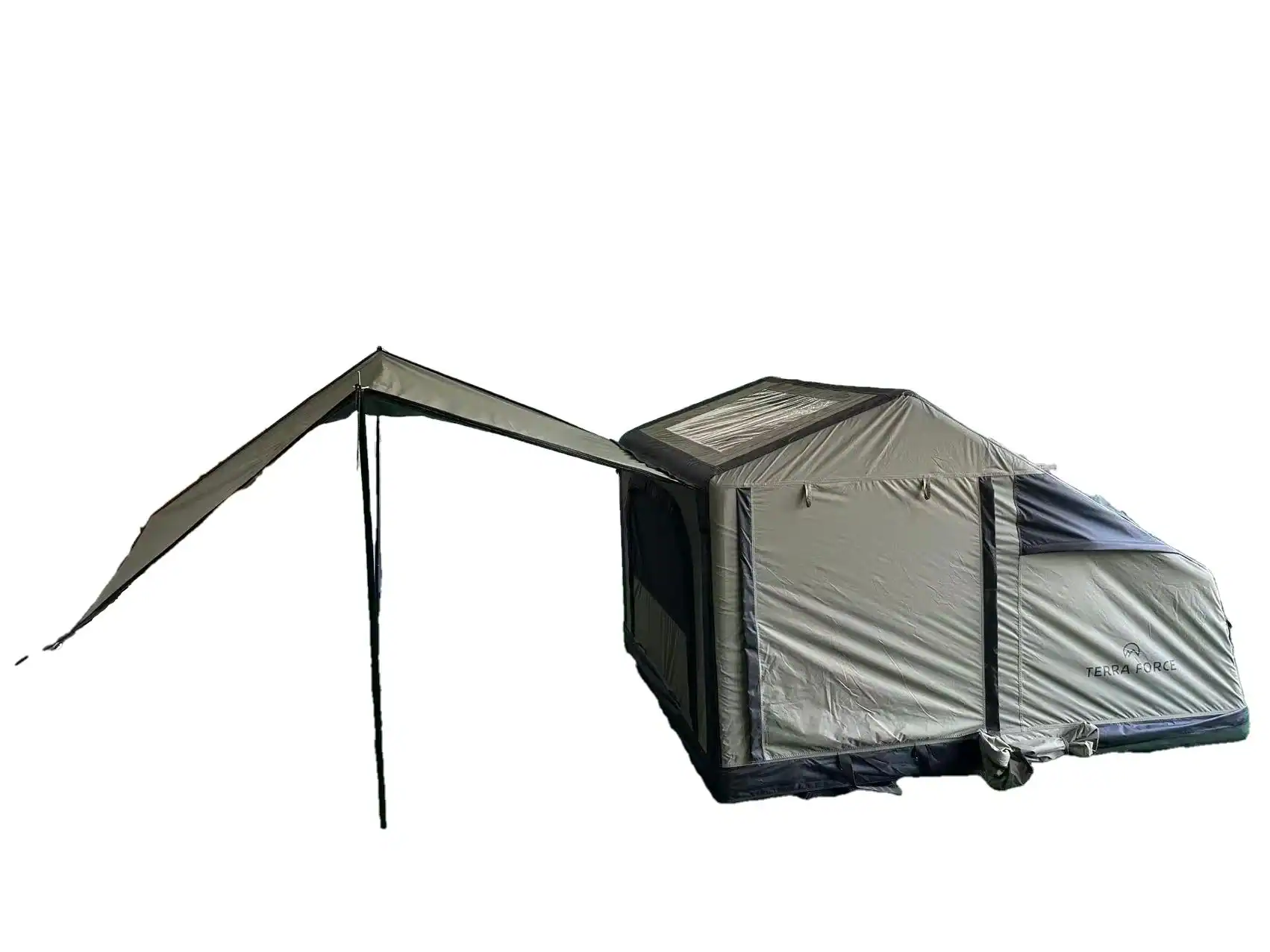
How Different Beam Technologies Affect Set‑Up Time
Drop‑stitch inflates in under 2 minutes; coil beam can take 5-7 minutes—the gap decides your conversion rate.
A buyer watching a product video doesn’t care about PSI ratings. They care about the gap between opening the carry bag and standing in a fully rigid tent. That gap is everything for an e-commerce listing. Get it wrong, and your return rate spikes before the camping season ends. The beam technology inside the tent walls dictates exactly how wide that gap is.
Drop-stitch construction changes the game entirely. Thousands of internal threads connect the top and bottom layers of the air beam fabric. When you pump air in at 10-15 PSI, those threads lock tight. The beam becomes rigid—almost like a solid pole. No bending. No sagging. Full structural integrity in under two minutes. The catch? You need a high-volume, high-pressure pump. Not the little foot pump that comes with a standard air mattress. A dedicated electric or double-action manual pump rated for the job.
Coil beam and I-beam structures work on a different principle. Inflate multiple interconnected chambers to 3-7 PSI. Lower pressure, simpler pump. Most family campers can handle the setup without reading instructions. But that lower pressure means the beams flex under wind load. The tent stays up, just less rigid. Setup takes longer—5 to 7 minutes from bag to pitched—because you’re waiting for several chambers to fill and stabilize. The real advantage shows when something goes wrong.
Why Setup Speed Matters for Amazon Listings
Video is the primary conversion driver for inflatable tents on Amazon. A listing video that shows a tent going from flat to fully pitched in 90 seconds communicates instant value. A video showing a buyer fumbling with a pump for 6 minutes communicates hassle. Budget for professional video content showing the rapid setup sequence. Internal data from successful e-commerce brands indicates that clear setup-time comparison videos can lift conversion rates substantially—in some cases exceeding 20%, especially when the drop-stitch advantage is visually undeniable.
Buyer perception hinges on the word ‘instant.’ No tent is truly instant. But drop-stitch gets close enough that the perceived effort is near zero. Coil beam tents require more patience. For a brand targeting families with young kids or first-time campers, the multi-chamber safety of coil beam may outweigh the speed loss. For a brand selling to solo adventurers or festival-goers who value rapid pitching, drop-stitch is the only answer that satisfies the ‘instant’ promise in the product title.
Three Questions to Pin Down Your Technology Choice
-
- Does your brand promise ‘instant setup’ or ‘family-safe simplicity’?: The answer pushes you toward drop-stitch or coil beam respectively. Don’t try to claim both in one product listing—buyers can smell the contradiction and will test your claims in review videos.
- Can your target price point absorb the pump cost?: Drop-stitch tents require a high-pressure pump included in the box. That adds to the unit cost and the package weight. If your target retail price forces a cheap pump, expect warranty claims and negative reviews when buyers can’t reach proper inflation pressure.
- What does your returns tolerance look like?: A buyer who can’t figure out a multi-chamber coil beam pump sequence will return the tent. A buyer who punctures a single large drop-stitch beam (no multi-chamber backup) will also return the tent. Match the failure mode to your customer support capacity.
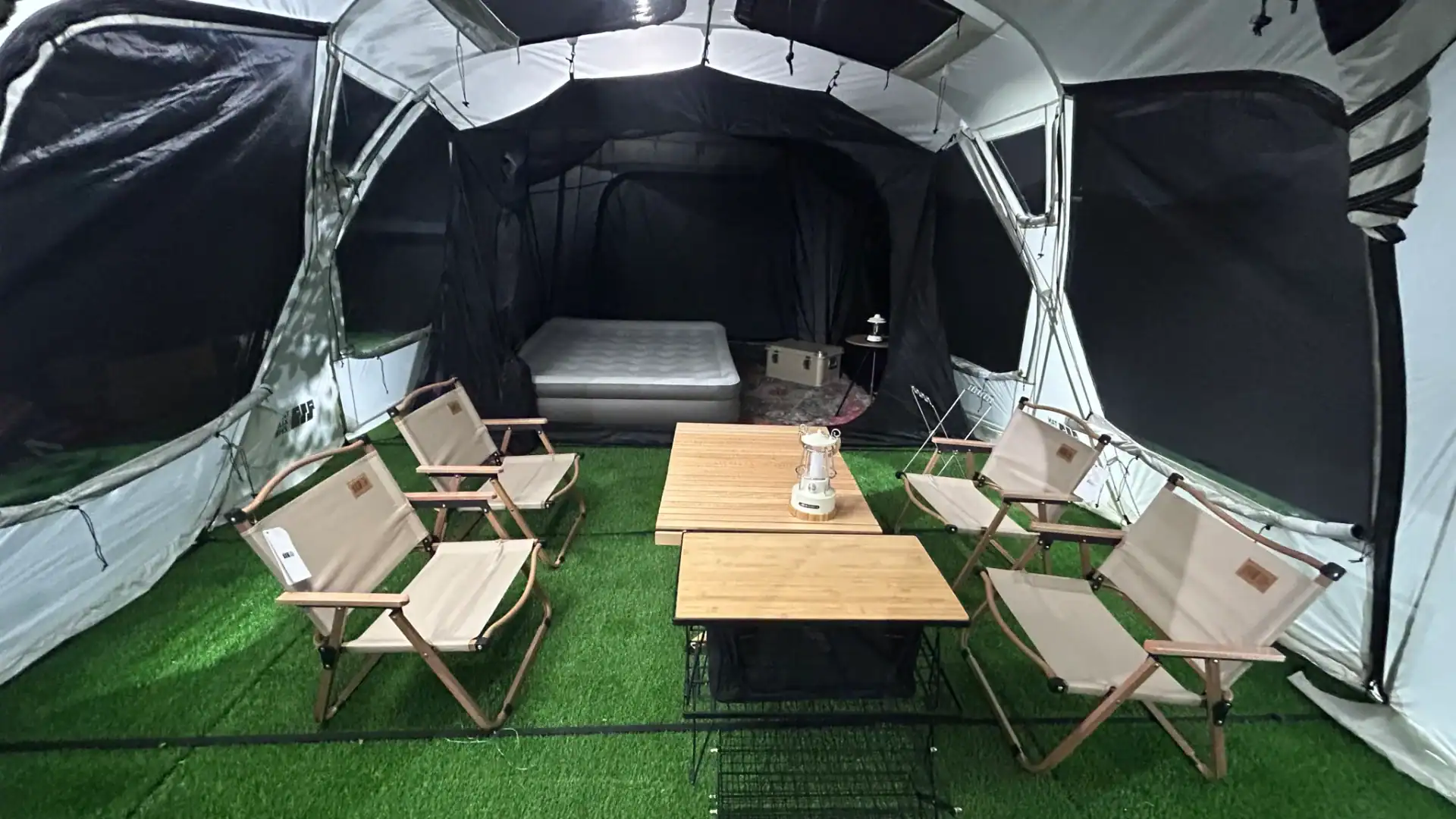
Drop‑Stitch: Rigid Inflatables & Ultra‑Fast Inflation
Two minutes at 10 PSI.
“Get three quotes and sample the cheapest one.” That advice has probably torched more e-commerce launches than any tariff hike. A buyer I know brought in $50K of inflatable tents — the pre-production sample hit 12 PSI in 90 seconds and held it for hours. The mass production run? Four minutes to limp to 8 PSI, then sagged within 20. Same factory. Same spec sheet. The difference came down to TPU laminate thickness nobody thought to lock in during sample approval. A 0.2mm variance in material gauge was all it took to turn a flagship product into a warehouse liability.
The 10 PSI Threshold Nobody Talks About
Drop-stitch construction runs thousands of internal polyester threads between two layers of fabric. Inflate to 10-15 PSI and those threads go taut. The panel becomes rigid. Not “air mattress firm” — more like a stand-up paddleboard. That rigidity means a 4-person drop-stitch tent can stand without pole sleeves, arch supports, or guy lines in moderate wind. But 10 PSI is non-negotiable. At 6-8 PSI, drop-stitch fabric feels solid to the hand but wobbles under structural load. The customer notices within one camping trip.
Getting to 10+ PSI fast demands a high-volume, high-pressure pump — not the 12V cigarette-lighter pump bundled with most air mattresses. Those units max out around 1-2 PSI. A drop-stitch pump pushes against 10-15 PSI of back pressure while moving enough air volume to fill the beams in under two minutes. This pump adds real cost to the bill of materials and real weight to the shipping carton. Skip it and your listing’s star rating absorbs the damage. Include a pump that meets ETL certification standards and the electrical safety compliance is already handled for North American listings. The air mattress production facility in Xiangyang, Hubei — producing 2.5 million units annually under ISO 9001:2015 — runs drop-stitch lines where pump pairing gets tested at full batch inspection, not spot-checked.
The Fabric Weight Penalty You Can’t Avoid
Drop-stitch beams use thicker TPU laminate than coil or I-beam air chambers. Where a standard coil-beam tent uses 0.4mm PVC or TPU-coated fabric, drop-stitch demands 0.6mm minimum — and premium builds push toward 0.8mm. Those extra 0.2-0.4mm add up across every panel in a tent with 6-8 structural beams. The result: a drop-stitch tent weighs 30-50% more than an equivalent coil-beam model with the same floor area. That weight sits squarely in your FOB pricing calculation, your freight quote, and your Amazon FBA fee tier.
Is the weight worth it? For a product listing anchored by a setup video showing a tent going from flat to rigid in 90 seconds — the math works. Buyers watch that clip and hit “Add to Cart” before reading the specifications. For a listing with static product photos and a bullet-point description, the weight penalty becomes a margin killer with no offsetting conversion lift. This is where the quality tolerance in the TPU spec matters. Specify 0.6mm ± 0.05mm in the production agreement. If the factory substitutes 0.45mm laminate to save cost and your inspection misses it, the tents will inflate but won’t hold structural rigidity long enough to survive a single windy night.
Three Questions to Ask Before Committing to Drop-Stitch.
-
- Can your target customer operate a high-pressure pump? If your buyer struggles with a manual bicycle pump, the electric high-pressure unit required for drop-stitch will generate returns. Ask your supplier for the exact pump model spec and operating instructions before approving the bundle.
- Does your shipping cost model absorb 3-5 extra kilograms per unit? Run the dimensional weight calculation with the actual packed box dimensions — not the sample unit — and compare FBA fee tiers. A $4 difference per unit on a 500-piece run eats $2,000 in margin before you sell a single tent.
- Will you produce a dedicated setup video within 30 days of inventory arrival? Drop-stitch’s entire value proposition is visual. A listing without a 60-second inflation video is a listing that paid the weight penalty for nothing. Budget for the content shoot before you budget for the inventory.
Coil & I‑Beam: The Traditional Choice
One puncture won’t ruin a coil-beam tent.
A customer camps for three nights. On night two, a sharp twig punctures one air beam. If your tent uses drop-stitch technology at 10+ PSI, the entire structure loses rigidity in seconds. The customer files a return, leaves a one-star review, and you eat the shipping cost back to Amazon. That scenario plays out differently with coil and I-beam construction.
Coil and I-beam air chambers operate as independent structural units. A 4-person inflatable tent built with this technology typically contains 4 to 6 separate air beams, each sealed at the factory with RF-welded seams running the full length of the channel. One beam loses pressure, the other three hold. The tent stays standing. Your customer patches the puncture or replaces the single beam tube, but the listing stays intact.
Why Multi-Chamber Design Reduces Return Rates
This is the operational advantage nobody talks about at the sourcing stage. Coil beam tents run at 2 to 5 PSI, not 10 to 15. Lower internal pressure means less stress on every seam, every valve, every weld point. The factory in Xiangyang producing 2.5 million air units annually validates this: seam failure rates on coil-beam structures run a fraction of what high-pressure TPU laminate systems see over identical production volumes.
E-commerce sellers selling into the family camping segment should pay attention. Family buyers camp with kids who drag chairs across tent floors, toss gear against walls, and generally treat equipment like rented furniture. A coil beam tent absorbs that abuse across multiple independent chambers. One chamber takes the hit while the others hold firm. The alternative, a single high-pressure drop-stitch bladder under the same conditions, becomes a single point of failure for the entire SKU.
Pump Simplicity and the Cost Stack
Coil and I-beam tents ship with basic dual-action hand pumps or low-pressure electric pumps that cost under $2 at factory pricing. Drop-stitch tents require high-volume, high-pressure pumps hitting 10+ PSI, which run $8 to $15 per unit at comparable volumes. At a 500-piece order, that’s a $3,000 to $6,500 difference in accessory cost alone, before you factor in the larger shipping box those heavy-duty pumps demand.
The 0.4mm to 0.6mm PVC or TPU material used in coil beam construction has been manufactured at scale for over a decade across the supplier network. It welds consistently, packs compactly, and survives standard shipping abuse without special handling. No exotic fabric laminates required. No steep learning curve for the production line. These factors compound into faster lead times, typically landing within the standard 30 to 45 days from order confirmation, which keeps your inventory planning predictable.
For an e-commerce brand deciding between technologies, frame it this way: coil and I-beam is the lower-margin-risk entry point. The per-unit cost sits 30% to 40% below equivalent drop-stitch models. The safety architecture protects your reviews. The pump cost keeps your landed COGS in check. If your listing targets families, casual campers, or festival-goers, this is the technology that matches how those customers actually use the product.
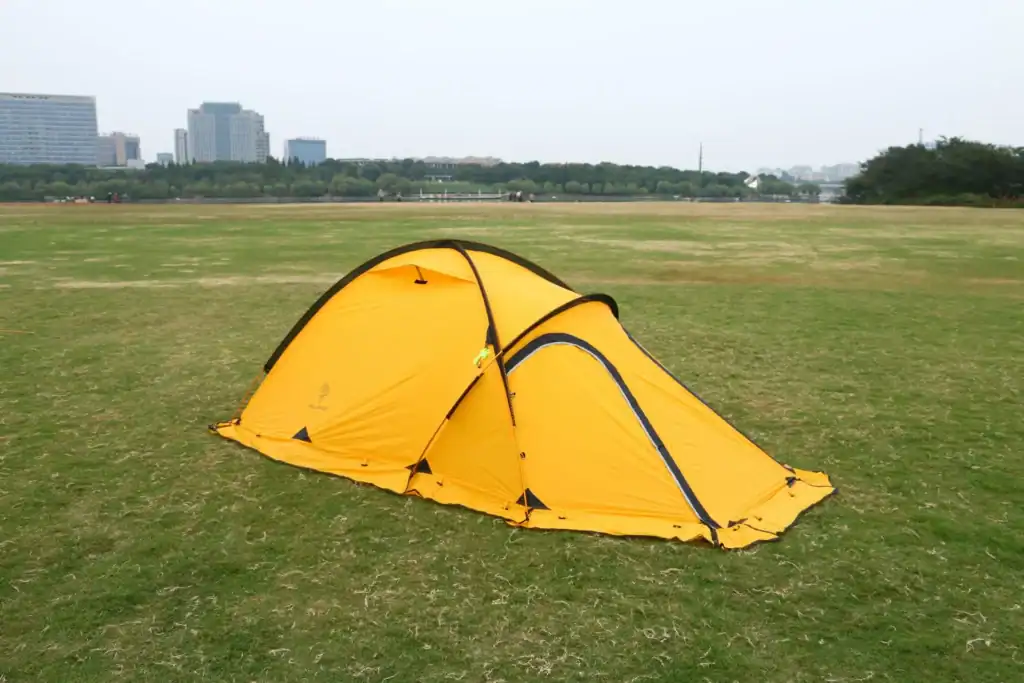
Packed Size & Shipping Considerations
Freight eats margin faster than any line item on your P&L.
Skip the cubic meter calculation once and you’ll blow $1.20 per unit on a shipment you priced at $0.45. That gap comes straight out of your net margin. For e-commerce sellers running on 35–40% gross, a 3% freight miscalculation wipes out a quarter of your profit on the first container. The beam technology you pick determines whether that number holds or bleeds.
Cubic Metre Per Unit: The Real Comparison
Drop-stitch tents pack into flat, rigid panels. A 4-person model ships in a box around 72cm × 48cm × 36cm — roughly 0.124 cubic metres. The thick TPU laminate fabric resists compression, so you cannot squeeze the carton down. A coil-beam tent with the same capacity folds into 58cm × 40cm × 30cm, landing at 0.070 cubic metres. That 0.054 cubic metre difference per unit looks trivial on a spec sheet. Multiply it by 500 units: 27 extra cubic metres. At current LCL rates out of Ningbo to Long Beach, that single decision adds roughly $1,800 to the freight invoice. Per container.
Why Freight Cost Per Cubic Metre Hits Margins Twice
Most buyers budget freight as a flat percentage of FOB pricing. That approach ignores the structural reality of air beam tents. Drop-stitch models demand thicker carton walls because the folded panels resist compaction — 5-ply cardboard becomes the floor, not 3-ply. Heavier boxes trigger dimensional weight charges on the carrier side. A shipment that scales into volumetric weight pricing adds a second cost layer: the carrier bills for the space the carton occupies, not the physical weight on the scale. Coil-beam tents, with their multi-chamber deflation, compress into softer bundles and ship in lighter, thinner cartons. The freight bill drops proportionally.
Amazon FBA Fees: Why Box Dimensions Dictate Your Referral Cost
Amazon’s fulfillment fee tiers punish oversize dimensions. A standard large item in the US marketplace caps at 45.7cm on the longest side before it slides into the oversize category. That one classification jump adds $3–$6 in FBA fees per unit, depending on the dimensional weight calculation. Drop-stitch tent cartons routinely break the 50cm threshold on the longest edge. Coil-beam tents, with their softer pack-down profile, stay under 45cm on at least two dimensions. For a 300-unit launch on Amazon.com, that dimension control saves between $900 and $1,800 in fulfillment fees before the listing even goes live. Sellers who skip prototype carton measurement pay the oversize tax for the entire production run.
-
- Carton dimension verification during sample approval: Request a measured carton sample before finalizing the order. The Kelyland quality control step includes pre-shipment inspection that cross-checks carton dimensions against the FBA size tier chart. If the drop-stitch model exceeds 45.7cm on any side, trigger a carton redesign.
- Dimensional weight calculation for LCL shipments: Shipments from the Ningbo tent factory move through consolidated containers where volumetric weight trumps physical weight. Ask the freight forwarder to run the DIM calculation on both the drop-stitch and coil-beam carton specs before issuing the booking. The coil-beam option consistently produces a lower chargeable weight.
- FBA label placement and carton integrity: Drop-stitch cartons require stiffer walls to protect the rigid folded fabric. That stiffness means fewer cartons per pallet and higher inbound placement fees at Amazon’s fulfillment centers. The coil-beam alternative stacks tighter and ships with standard-gauge cartons, reducing both material and inbound costs.
| Technology | Typical Packed Volume (m³) | Approx. Box Dimensions (cm) | Sea Freight Cost Impact | Amazon FBA Fee Tier |
|---|---|---|---|---|
| Drop‑Stitch | 0.10–0.12 | 55 × 40 × 45 | Higher – dense TPU laminate adds weight, freight billed per kg/m³ | Oversize (medium) – length+girth triggers tier; fees moderate |
| Coil / I‑Beam | 0.14–0.16 | 60 × 45 × 50 | Lower weight but larger volume – often billed on volumetric weight | Oversize (medium) – slightly larger dimensions push handling costs up |
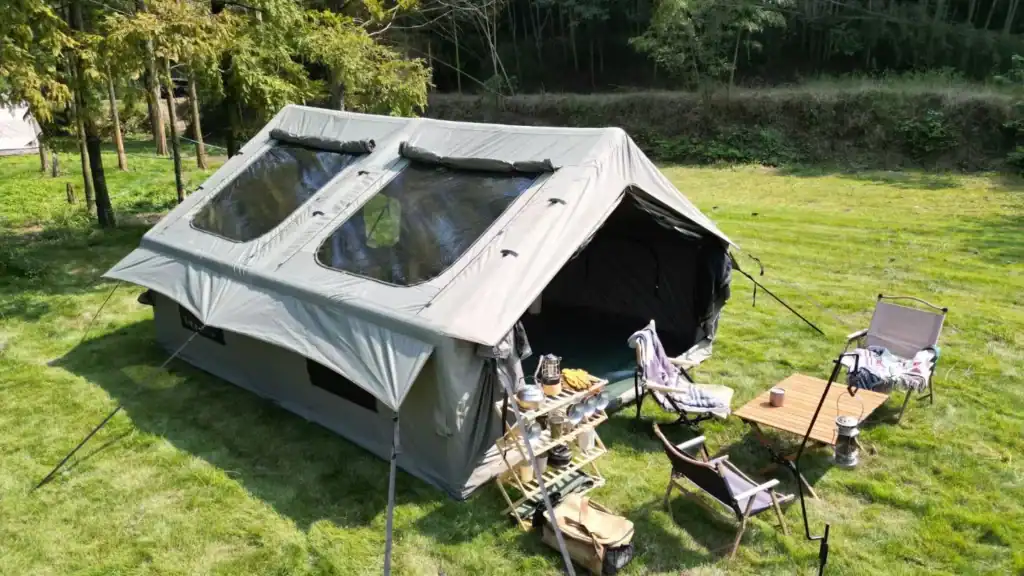
Pricing & MOQs for Each Technology
The 30% price gap between coil-beam and drop-stitch tents isn’t about materials—it’s about the pump, the factory’s learning curve, and the MOQ.
Put a 4-person coil-beam inflatable tent next to a drop-stitch model of the same footprint. The coil-beam unit lands at roughly $65-85 FOB at 500 pieces. The drop-stitch version pushes past $110 FOB at the same quantity. Same size tent. Same number of doors. The 30-40% delta comes from three places: the high-pressure pump that ships with every unit, the thicker TPU laminate the drop-stitch beams demand, and the slower sewing cycle on the production floor.
Unit Cost Breakdown at 100 vs 500 Pieces
At 100 pieces, the gap widens further. Coil-beam tents run on simpler beam-sealing lines. The fabric cutting and welding process tolerates smaller batch runs without retooling the jigs. Drop-stitch production uses specialized TPU-coated fabric rolls that carry a higher minimum purchase from the textile mill. A factory can’t buy 200 meters of drop-stitch fabric at a competitive price—the mill floor is typically 1,000 meters. That raw material constraint means a 100-piece drop-stitch order carries a surcharge that gets absorbed at 500 pieces.
-
- Coil Beam (100 pcs): FOB roughly $75-95 per unit. Simple pump included. Fabric waste under 8% on small runs. Most tent factories can run this without dedicated tooling.
- Drop-Stitch (100 pcs): FOB typically $125-145 per unit. High-volume pump mandatory. Fabric minimums from the mill push per-unit material cost 18-22% higher than at 500-piece volumes.
- Coil Beam (500 pcs): FOB drops to approximately $65-85. Material efficiency hits 92%+. Pump cost amortizes across the volume.
- Drop-Stitch (500 pcs): FOB lands around $110-130. Mill minimums met, labor efficiency improves, and the pump supplier offers volume pricing.
Kelyland’s Drop-Stitch MOQ: Lower Than Industry Standard
Most drop-stitch inflatable factories in the Zhejiang and Hubei clusters set a hard floor of 500 units. The reasoning is genuine—the TPU laminate supply chain doesn’t flex easily below that threshold. Kelyland’s air mattress production hub in Xiangyang, however, runs a 2.5-million-unit annual capacity with CE and ETL-certified lines that already produce drop-stitch air beds. That existing material pipeline means the team can accept drop-stitch tent orders starting at 50-100 pieces for first-run trial batches. The catch: at that volume, expect a 15-25% unit cost premium over the 500-piece rate, and lead times stay at the standard 30-45 days since the line still sequences among larger production blocks.
Coil-beam models carry no such constraint. The beam-sealing and fabric-cutting workflow handles 100-piece orders without a cost penalty. For an e-commerce seller testing a first-season listing, coil-beam lets you validate the market at roughly half the upfront inventory cost of an equivalent drop-stitch SKU.
The Benchmark to Write Down
On your next supplier call, ask for the FOB quote at exactly 120 units. If the drop-stitch quote exceeds $140 per unit, the factory is pricing in fabric minimums inefficiently. If it lands at $125 or below, you’re dealing with a sourcing partner that already runs drop-stitch production at scale and isn’t passing along startup waste to small-batch buyers. Write that number down: $125 FOB at 120 units. It’s the line between a factory that actually wants your drop-stitch business and one that’s quoting to make you go away.
Conclusion
The choice between drop-stitch and coil air beams runs deeper than inflation speed. Drop-stitch tents hit full rigidity in under two minutes at 10+ PSI, but the thick TPU laminate fabric and high-volume pump add noticeable weight and packed volume. Coil and I-beam designs trade that instant pitch for multi-chamber safety—one puncture won’t collapse the tent—and a smaller, lighter pack that keeps shipping costs in check. Both technologies shape the customer’s first five minutes with the product, which is exactly where the listing conversion battle is won or lost.
-
- Drop-stitch setup time: under 2 minutes, but heavier TPU fabric and a high-output pump are mandatory.
- Coil beam safety: independent air chambers keep the tent standing even if one tube gets punctured.
- Shipping math: a drop-stitch tent’s larger packed cube often pushes the box into a higher FBA fee tier, raising per-unit fulfillment cost.
- The demo video edge: a crisp 90-second inflation clip can lift conversion by 20% or more on a crowded listings page.
Professionals don’t stop at comparing beam specs. They budget for a product demo video that shows the tent going from flat to fully pitched before the customer’s coffee finishes brewing. That asset turns a technical speed advantage into a buyer’s emotional conviction, directly lifting the conversion rate that makes or breaks a private-label launch. Amateurs skip this cost; those who are serious factor it into the sourcing plan from day one. Visit the air mattress page to examine the beam construction that underpins these inflatable tents, then request a sample to shoot your own setup video and validate packed dimensions before locking in the production order.
Frequently Asked Questions
Which inflates faster, drop-stitch or coil beams?
Drop-stitch air beams inflate in under 2 minutes, while coil beams typically take 5-7 minutes with a standard pump. This speed gap becomes critical when marketing your tent as “instant setup.”. Request a timed inflation comparison video from your supplier.
What is the MOQ for custom drop-stitch tents at Kelyland?
Kelyland’s flexible MOQ for drop-stitch inflatable tents can start as low as 50-100 pieces for select models, depending on fabric and component complexity. This is significantly lower than the typical 300-500. Confirm exact MOQ after your design and material requirements are final.
Which beam technology is safer if one chamber leaks?
Coil and I-beam tents use multiple independent air chambers; if one leaks, the structure stays standing temporarily. Drop-stitch tents often rely on fewer high-pressure chambers, so a puncture can deflate the. Consider coil-beam if you sell to families camping in rough terrain.
How does the packed size affect shipping costs?
Drop-stitch tents pack down smaller because the fabric is more flexible when deflated, reducing the box dimensions that drive Amazon FBA fees and container density per unit. Coil beam tents are. Always compare the cubic metre data before finalizing your freight quote.
What is the typical unit cost difference between drop-stitch and coil?
Drop-stitch tents often carry a premium of 30-50% over coil-beam models at similar volumes, mainly due to the specialized TPU fabric and high-pressure valve systems. The gap narrows at. Get quotes for both technologies at your planned order quantity for accurate budgeting.

 English
  Español
  Deutsch
  Français
  Português do Brasil
  Русский
  العربية
  한국어
한국어  日本語
日本語