 跳到内容
跳到内容 
The inflatable tent CE certification check starts on the factory floor, where operators weld seams and glue valve bases, not in the email thread with the attached PDF. The operator running the high-frequency welding press checks each seam twice; the certificate sitting in the front office might cover only the electric pump. That gap is how a buyer got burned on a $50,000 order last season — the pre-production sample passed inspection, then the mass production run arrived with a mark that had nothing to do with the tent structure.
Certificate validity comes down to two checks. The Notified Body number printed beside the CE logo has to match an entry in the NANDO database; if it doesn’t, the document is invalid even when it looks official. The Declaration of Conformity must name the exact product model, cite EN 14960 or the relevant EU directive, and carry a dated signature. With the General Product Safety Regulation now shaping EU market access, an email attachment that simply says ‘CE certified’ is a sales prop, not a compliance document.
Kelyland Outdoors pre-vets its core factories on exactly this distinction. When the certificate scope already matches the inflatable structure, the welded seams, and the finished model number, an inflatable tent CE certification check becomes a thirty-minute document review instead of a three-week validation. That’s how compliance should work: the standard gets fixed at sample approval, and the quality tolerance agreed then holds through container loading.
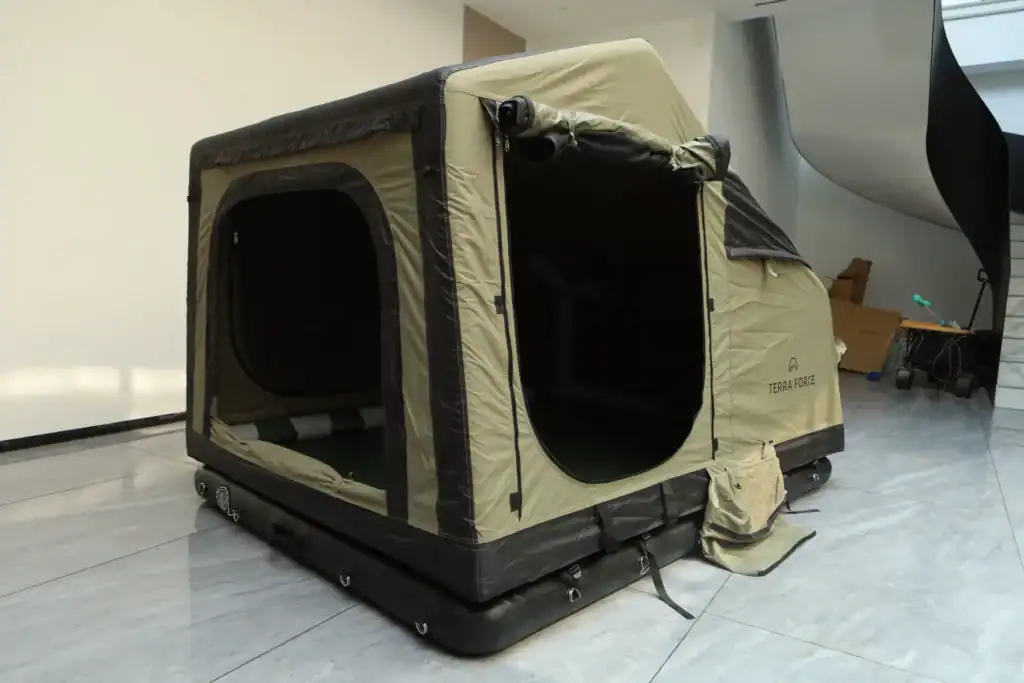
Understanding CE Requirements for Inflatable Tents
A CE mark on the pump doesn’t certify the tent.
CE marking on an inflatable tent is not a single certificate. It’s a stack of requirements covering the air structure, the pump, and any electrical components. Most Chinese suppliers know this. The problem is they don’t always tell you which part of the product their CE file actually covers — and customs won’t sort it out for you.
Which directives apply
Inflatable camping tents fall under the General Product Safety Regulation (GPSR 2023/988), which replaced the old GPSD in December 2026. Because no dedicated harmonized standard exists for air-frame camping tents, EU market surveillance bodies reference EN 14960 — the standard for inflatable play equipment — to evaluate structural integrity, air pressure retention, and anchoring. Your supplier’s test report should name EN 14960 and the GPSR explicitly.
The connection between EN 14960 and camping tents is simple: both products fail the same way. A ruptured air beam or a leaking weld seam collapses the structure, and someone inside gets hurt. So the standard’s pressure decay limits and seam strength requirements get applied to tunnel tents, glamping domes, and inflatable awnings even though EN 14960 was written with bouncy castles in mind.
Notified Bodies and the NANDO database
A Notified Body is an organization the European Commission authorizes to assess products against specific directives. Each one receives a four-digit identification number. That number is traceable in the NANDO database — the official EU registry of every active Notified Body. If the number on a supplier’s certificate doesn’t appear in NANDO, the certificate was not issued by an authorized body. Treat it as invalid.
The most common trap in China sourcing: a factory presents a CE certificate for the electric air pump, then ships an inflatable tent that was never tested as a complete structure. The pump passes the Low Voltage Directive. The tent passes nothing. Import authorities catch the mismatch, and you’re left with a container held at port and a retail launch window gone.
-
- NANDO verification: Look up the four-digit Notified Body number in the NANDO database. Confirm it’s active and authorized for the directive in question. Mismatched scope = invalid certificate.
- Declaration of Conformity: The DoC must name the exact product model, the directive, and the standard used. Match it against the sample approval you signed off on. Generic wording with no model reference is not valid.
- Scope check: Confirm the certificate covers the tent structure and its air beams, not just the pump, LED strips, or other electrical accessories shipped in the same carton.
Kelyland’s partner factories for tents in Ningbo and Shaoxing hold CE and ISO 9001 certifications, and their inflatable tent lines use PVC and TPU air tubes. That factory-level certification is a starting point, not a substitute. The product-level CE file — with the DoC matched to your SKU and model number — is what protects your shipment at the EU border.
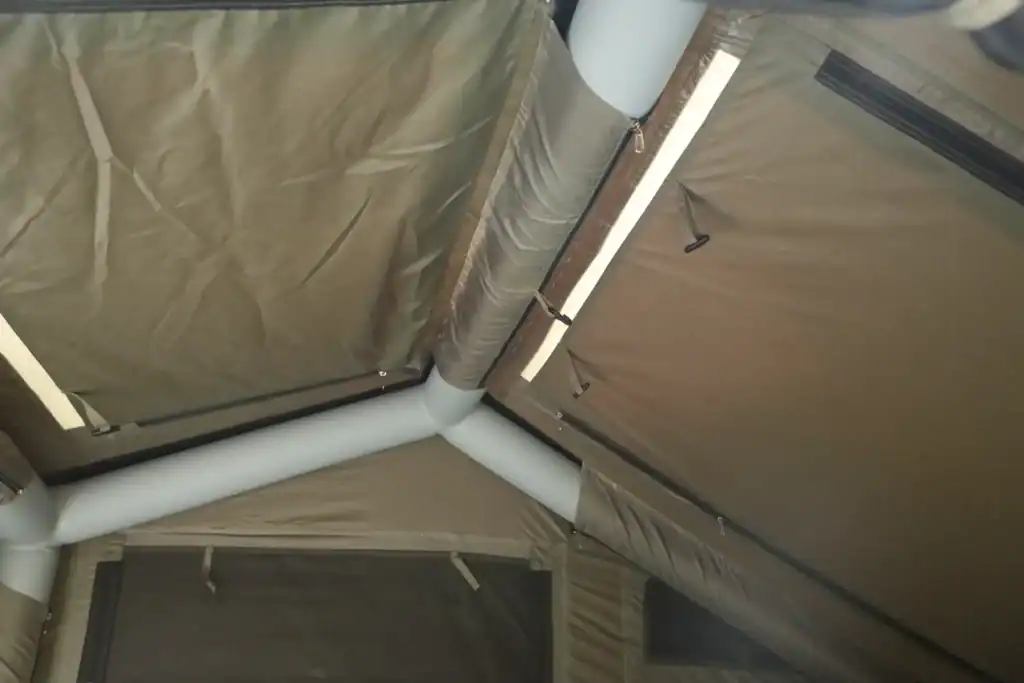
Requesting and Verifying Proof of Certification
A CE mark is only as valid as the document trail behind it — verify model, standard, and Notified Body first.
Ask any inflatable tent supplier for three documents before you talk pricing: the Declaration of Conformity, the third-party test report, and the certificate itself. The DoC should name your exact model number, the directive it falls under, and the EN standard used. If it just says ‘CE certified’ without those details, treat it as a warning — a genuine DoC is a technical document, not a marketing line.
Documents that actually prove CE compliance
-
- Declaration of Conformity: Must state the exact product model, the applicable directive (for most camping gear in 2026, the General Product Safety Regulation (EU) 2023/988), and the EN standard applied, such as EN 14960 for inflatable structures. No model reference means the document covers a different product, not yours.
- Third-party test report: Confirm the lab tested the inflatable structure itself: beam pressure, fabric strength, valve integrity. A report that covers only the pump motor or battery pack leaves the tent structure unverified at customs.
- Notified Body certificate: If the supplier presents a numbered certificate, type that number into the NANDO database. If the number doesn’t exist, or the body’s scope excludes inflatable structures, the certificate carries no legal weight.
This is where the fake CE certificate issue appears in practice. Many Chinese factories display a certificate that covers only electrical components — the pump, the charger, the LED strip — then claim the entire tent is CE certified. Customs sees through it quickly. A container gets flagged, held at port, and a standard 30–45 day production lead time turns into a 60-day shipping problem.
Cross-checking certificate validity on EU databases
The NANDO database is the EU’s official registry of Notified Bodies. Search the four-digit number from the certificate and confirm the body is listed for the relevant legislation. A certificate issued by a non-notified body is invalid, meaning your product has no CE marking at all, no matter what the label claims.
Run the same check on the test report. A legitimate lab issues a reference number the supplier can verify online — ask them to share the query link or copy the issuing body on an email. And check dates. Reports issued before December 2026 should be re-confirmed against the current GPSR compliance window. Outdated certificates show up in audits more often than most buyers expect.
Kelyland runs this verification before sample approval, not after. The camping tent and tarp partner factory in Ningbo operates with CE, BSCI, and ISO 9001:2015 certifications, and the 10-step sourcing process includes a pre-shipment inspection where the certificate, test report, and labels are re-checked against the final order. If a supplier hesitates to share documentation at the quotation stage, that hesitation is the answer.

Spotting Fake or Obsolete CE Marks
Most fake CE marks on inflatable tents cover the pump, not the structure.
The most common fake CE mark in the inflatable tent category is the pump-only certificate. A factory shows a CE certificate for the electric air pump, and the product page reads ‘CE certified.’ The tent structure itself carries no certification. Buyers miss the gap until customs stops the container.
The pump-only certificate trap
EU customs treats a tent and its pump as separate items. The pump falls under the Low Voltage Directive and the EMC Directive. The tent structure falls under the General Product Safety Regulation (GPSR). A certificate that names only the pump proves nothing about the tent. That mismatch is how a 40-foot container ends up sitting at port waiting on paperwork.
Independent verification, not trust
Every legitimate CE certificate for a directive that requires third-party assessment carries a four-digit Notified Body number. Cross-check that number against the European Commission’s NANDO database. If the body is not listed for the relevant directive, the certificate is invalid. Not close — invalid. The same test applies to certificates issued by bodies whose notification scope doesn’t include outdoor equipment.
-
- NANDO database check: Search the four-digit Notified Body number on the European Commission’s NANDO database and confirm the body is notified for the exact directive on the certificate.
- Declaration of Conformity: The DoC must name the precise product model, the applicable directives, and the standards used. ‘CE certified’ alone is not a Declaration.
- Scope line: A certificate covering ‘electric pump’ or ‘inflatable play equipment’ does not cover an inflatable camping tent. The scope must match the product.
- Standard edition: Certificates referencing superseded versions of standards — or old directive numbers — should be treated as obsolete, not grandfathered.
Why the scope of the directive matters
Scope is where outdated certificates creep in. Some suppliers cite EN 14960, the standard for inflatable play equipment, as if it covers camping tents. It doesn’t. Others hand over a certificate issued for a different model in their catalog. The test is simple: the Declaration of Conformity must name the exact model you’re ordering, under the directive that applies to that product’s actual use.
This is why Kelyland pre-vets factory certifications before showing a supplier to a buyer. The camping tent and tarp factory in Ningbo holds CE, BSCI, and ISO 9001 — but the compliance review goes further, matching the certificate scope to the specific tent model and checking the GPSR technical file. A logo on a website is not a compliance document.

On-Site Factory Audit Checklist
Certificates satisfy customs, but weld lines survive campsites — audit the production line, not just the file.
A CE certificate tells customs the product passed a standard. It doesn’t tell you whether the factory can hit that standard on every run. That distinction matters when you’re committing to a 1,000-unit order with a seasonal sell-through window. If the inflatable structure fails in the field, the return rate lands on your margin, not the supplier’s.
Key Inspection Points for Inflatable Structure Safety
-
-
- Weld seam strength: Inflatable tents depend on RF-welded or heat-sealed PVC/TPU air tubes, not stitching. Ask the QC manager to demo a peel test on a finished tube. A weld that separates under hand pressure will fail at the worst moment: during a storm, with guests inside.
- Material thickness disclosure: The factory’s air mattress line uses puncture-resistant PVC/TPU at 0.4mm-0.6mm thickness. Request the same spec disclosure for tent air tubes. If the supplier can’t produce a material spec sheet, you are buying an unknown structure with a CE sticker.
- Valve cycle testing: One-way valves fail from repeated insertion, not from static pressure. Ask for the QC cycle log. A factory that can’t show a documented inflation-deflation test is guessing on the component most likely to generate customer complaints.
- Stress-point reinforcement: Where webbing straps meet air tubes, bar-tack stitching should reinforce the join. Standard straight stitching tears under wind load. Check the guy-line anchor points on the physical sample, not just in product photos.
-
These checks take about 90 minutes on the factory floor. Skipping them converts an audit trip into a paperwork exercise. The tent that looks fine in the showroom is not the tent that survives a weekend of repeated setup, takedown, and pack-down by retail customers who don’t read instructions.
How Kelyland Pre-Vets Factories Before You Commit
Kelyland operates with 17 core strategic factories and over 200 manufacturing partners, most ISO 9001:2015 certified. Each factory is qualified before it takes a client order. The core camping tent and tarp partner in Ningbo, Zhejiang, holds CE, BSCI, and ISO 9001 certifications with an 800,000-unit annual production capacity.
-
- Stage-by-stage inspection: The Kelyland process monitors manufacturing at every phase, with regular checks on stitching, mechanisms, and compliance. Inspection reports are available upon request, not after a problem surfaces at the pre-shipment gate.
- Pre-shipment gate: No order ships without a final quality check. If a batch misses the spec, it gets held before customs clearance becomes your problem. That is the difference between a trading company and a supplier with a QC commitment.
Skip the audit and the failure surfaces after the season, when inventory has already moved through the channel and the liability claim lands on your desk. Ask any supplier for their inspection report cadence and material spec disclosure. If they hesitate on either, move to the next candidate before you commit a deposit.
Conclusion
Valid CE marking on an inflatable tent is not a logo—it is a documented chain linking the product model, the EN 14960 test report, and a Notified Body number that actually exists in the NANDO database. The directive scope matters: a certificate covering only the pump or electrical components will not protect your shipment at EU customs. Verify these documents before committing to a production run, not after the container has left Ningbo.
-
- Ask for a Declaration of Conformity that names the exact tent model and relevant directive.
- Check the Notified Body number in the NANDO database before trusting a CE mark.
- Confirm EN 14960 coverage for the inflatable structure, not just the electric pump.
- Treat a certificate with no product model or directive reference as a red flag.
Before you approve the next quotation, put the supplier’s CE documentation through the same checks outlined above. If the certificate scope feels narrow or the Notified Body number does not appear in NANDO, request a corrected document set or move to a factory that pre-vets compliance. A sourcing partner that coordinates with CE-certified production lines—like the tent and air mattress facilities behind Kelyland’s product range—makes this verification step part of the standard process. Browse the inflatable tent and air mattress lineup to compare which product specs come with the full compliance file attached.
Frequently Asked Questions
How do I verify CE marking on inflatable tents?
Ask for the Declaration of Conformity and test report for the exact tent model, not just a photo of the CE mark. Verify the listed standards and cross-check the Notified. Only accept the mark if the document trail matches your exact model.
Does CE mark on pump certify the tent?
No, a CE mark on the pump only covers the pump itself, not the inflatable tent structure. The tent needs its own conformity assessment and supporting documentation. Confirm the tent structure is covered separately on the certificate.
What documents prove CE certification for tents?
Request the Declaration of Conformity, the test report, and the CE certificate that names the exact model. The standards and Notified Body number must match the product you are importing. Check model numbers carefully before placing a bulk order.
What are red flags for fake CE marks?
Fake CE marks often appear only on the pump or come with vague statements and obsolete standards. Be suspicious if the certificate does not clearly identify the tent model and the issuing. Reject any certificate that does not match the exact product.
What should a factory audit check for inflatable tents?
Inspect seam welding, valve base attachment, and material strength on the production line. Confirm the manufacturing process matches the certified sample and that QC records are traceable. Audit the line before production, not just after samples arrive.

 English
  Español
  Deutsch
  Français
  Português do Brasil
  Русский
  العربية
  한국어
한국어  日本語
日本語