 跳到内容
跳到内容 
folding wagon weight capacity testing is the first checkpoint buyers should lock before they approve a supplier, budget, or production slot. Day 1 the order is placed for a folding wagon with a stated capacity of 150kg. Day 14 the pre-production sample arrives and passes visual inspection — frame looks solid, fabric feels right. Day 45 the container lands at your warehouse, and by week three on the sales floor, you get the first return: a customer says the axle bent after rolling over a parking lot curb with two cases of soda inside. That $50K order just turned into a warranty liability problem because nobody ran a folding wagon weight capacity test on the actual production units.
The gap between what factories quote in spec sheets and what happens under real-world use is wider than most buyers realize. Most suppliers list static load — meaning the wagon can sit still holding that weight without collapsing. The dynamic load, when you actually pull it across gravel or drop off a curb, can be 40% lower. A wagon rated for 100kg static might fail at 60kg in motion. That distinction matters less if you are selling to suburban parents who roll it across flat grass once a season. It matters a lot if your retail customers are hauling camping gear over uneven terrain or loading it with firewood.
Before you commit to an MOQ, ask your supplier three yes/no questions that will tell you more than any brochure. One: Is your stated capacity based on static or dynamic testing? Two: Are your axles at least 16mm hardened steel with sealed bearings for models above 100kg? Three: Is your double-layer Oxford fabric cross-stitched every two inches, or just glued? If they hesitate on any of these, you already know where the failure point will show up six months from now.

Why Weight Capacity Claims Vary Between Factories
Static load ratings can be 40% higher than what the wagon survives rolling over a curb.
Two folding wagons land on your desk with identical spec sheets. Both claim 150 kg capacity. One costs $28 FOB, the other $39. The difference isn’t margin — it’s testing methodology. Most Chinese factories list static weight capacity, meaning the wagon can hold that mass while parked on a level floor. That test tells you nothing about what happens when a customer loads 120 kg of gear and rolls it over a gravel path or drops off a curb.
Common inflation tactics in supplier spec sheets
-
- Static-only rating: The factory loads the wagon bed with sandbags and reads the scale while the wagon sits still. No rolling, no turning, no uneven surface. This number is often 30-40% higher than what the frame and axle survive in motion.
- Best-point sampling: The factory tests only one unit from a production batch — usually the one with the thickest weld bead or tightest rivet. The other 999 units in the container may have inconsistent welding penetration or loose axle mounts.
- Material grade substitution: “Aluminum frame” sounds premium until you learn it’s 6063-T5 alloy instead of 6061-T6. The yield strength drops by nearly half. Same for “steel frame” — Q195 mild steel vs Q235 structural steel makes a measurable difference in deflection under load.
Static load vs dynamic rolling load
“Double-layer Oxford fabric” is another spec that needs scrutiny. Two layers glued together delaminate under heavy use — cross-stitching every 2 inches is what actually adds strength. The internal production standard at Kelyland Outdoors uses cross-stitched double-layer Oxford from 600D to 900D, paired with powder-coated carbon steel frames rated for dynamic loads through our ISO 9001:2015 partner factory in Jinhua, Zhejiang.

Equipment Needed to Run Your Own Load Tests
A digital hanging scale with 300kg capacity is the minimum for testing any wagon rated over 100kg.
You don’t need a certified lab to verify a folding wagon’s load rating. But you do need the right tools. Most buyers skip this step and rely on factory spec sheets alone — then wonder why return rates hit double digits in the first season. The equipment list is short, but each piece has specific requirements that matter.
Digital Hanging Scale Requirements
Get a digital hanging scale with a minimum 300 kg capacity. That covers standard wagons (rated 50-150 kg) and heavy-duty models up to 200 kg. The scale must read in 0.1 kg increments — not 0.5 kg — because the difference between passing at 100% load and failing at 110% can be just a few kilograms on a welded joint. Look for models with an auto-hold function so you can lift the loaded wagon, wait three seconds, and record a stable reading without guessing.
Test Weights and Distribution Method
Use sandbags or water containers as test weights. They conform to the wagon cavity and distribute load evenly across the fabric floor, which is critical for realistic results. Avoid stacking hard objects like steel plates — they concentrate weight on small areas and will puncture Oxford fabric before you reach the rated load. For a wagon rated at 150 kg, prepare three sets: one at 120 kg (80%), one at 150 kg (100%), and one at 180 kg (120%). This lets you measure deflection progression rather than just pass/fail.
Step 1: Frame Stress Point Inspection
Most frame failures happen at the weld joint, not the tube itself.
The welding bead tells you more about a folding wagon’s real lifespan than any spec sheet number. On steel frames, look for continuous MIG welds with no pitting or cold laps. Aluminum frames require TIG welding — if you see MIG on aluminum, the heat-affected zone will crack within six months of retail use. A good weld shows uniform penetration on both sides of the joint. A bad weld looks like stacked dimes that never fully fused.

Deflection Testing Protocol
Set up the wagon on a level surface with the wheels locked. Apply load in three stages using sandbags or water jugs distributed evenly across the floor panel — not concentrated in one spot. Measure vertical deflection at the center crossbar using a tape measure or dial indicator.
-
- 80% of rated load: Maximum allowable deflection is 15mm. If the crossbar drops more than that, the frame tube wall thickness is likely under 1.0mm, which won’t survive repeated loading cycles.
- 100% of rated load: Deflection should not exceed 25mm. Watch for any creaking sounds from welded joints — audible stress indicates incomplete fusion that will propagate into cracks.
- 120% of rated load (overload test): The frame must hold this load for 60 seconds without permanent deformation. After removing weight, check for residual bend greater than 3mm — that signals the material has yielded and future loads will cause faster fatigue.
Kelyland Outdoors’ strategic folding wagon factory in Jinhua uses powder-coated carbon steel frames with minimum 1.2mm wall thickness on all models rated above 100kg. During pre-shipment inspection, every production batch is sampled at 120% rated load to verify zero plastic deformation before shipment approval.
Step 2: Fabric Seam and Handle Tensile Test
A glued double-layer seam fails at 40% of the load a cross-stitched seam handles.
The fabric basket and the handle assembly are the two most common failure points on a folding wagon under load. A buyer who only checks the frame is missing half the risk. The test here is straightforward: you need to confirm that the Oxford fabric seam can hold its rated tension and that the rivets anchoring the handle to the frame won’t shear off when a customer yanks it over a curb.
Oxford Fabric Seam Pull Strength Test
Take a 50mm-wide strip cut from the side panel seam — ideally where the floor joins the wall, because that’s where cargo weight concentrates. Clamp one end in a vise and attach a digital hanging scale to the other. Pull steadily until the seam separates. For wagons using 600D double-layer Oxford fabric — which is what Kelyland Outdoors specifies for its standard models — a properly cross-stitched seam should hold at least 80 kg before tearing.
Here’s where many factories cut corners. They claim “double-layer Oxford” but simply glue two thin layers together with hot-melt adhesive instead of cross-stitching every 2 inches (50mm). A glued assembly will delaminate at roughly 30-40 kg under continuous tension. That’s fine for light grocery runs but fails fast once loaded with camping gear — coolers, chairs, tents — on uneven ground.
Handle Rivet Shear Force Thresholds

Step 3: Wheel and Axle Durability Under Load
Dynamic load testing reveals failure points that static spec sheets never show.
Most factory spec sheets list weight capacity based on a static test: the wagon sits parked with the load distributed evenly. That number looks good on paper but tells you nothing about what happens when a buyer rolls that wagon over a gravel path or drops it off a curb. The real failure point is dynamic capacity — and it’s often 40% lower than the advertised static rating.
Simulating Rough Terrain (Curb Drops, Gravel Paths)
Set up a test course with a standard curb height (15 cm) and a 10-meter gravel section. Load the wagon to its rated capacity. Roll it off the curb three times in succession, then inspect the axle for bending and the wheel hub for cracks. In a standard durability test, a wagon with a 13mm axle may begin to show deformation under a 100kg dynamic load — especially if the axle is mild steel rather than hardened. For wagons rated above 100kg, specify minimum 16mm hardened steel axles with sealed bearings. Without that spec, expect warranty claims within six months on any model sold through retail channels.
Bearing Wear After 500 Meters at Full Load
Run the loaded wagon over a mixed surface (pavement, grass, gravel) for 500 meters total. Stop every 100 meters and spin each wheel by hand. Listen for grinding noise and feel for resistance. Sealed bearings should spin freely with no audible grit after this distance. Open bearings will collect debris quickly — you’ll hear the difference by meter 200. This test separates wagons that survive a season from those that get returned after three trips to the beach.
-
- Axle spec minimum:: 13mm hardened steel for loads up to 100kg . 16mm sealed-bearing axles required above 100kg . Confirm material grade with your supplier before sample approval.
- Wheel type impact:: PVC wheels crack under repeated curb drops at full load. PU or TPE wheels absorb impact better — specify these for any wagon marketed as heavy-duty.
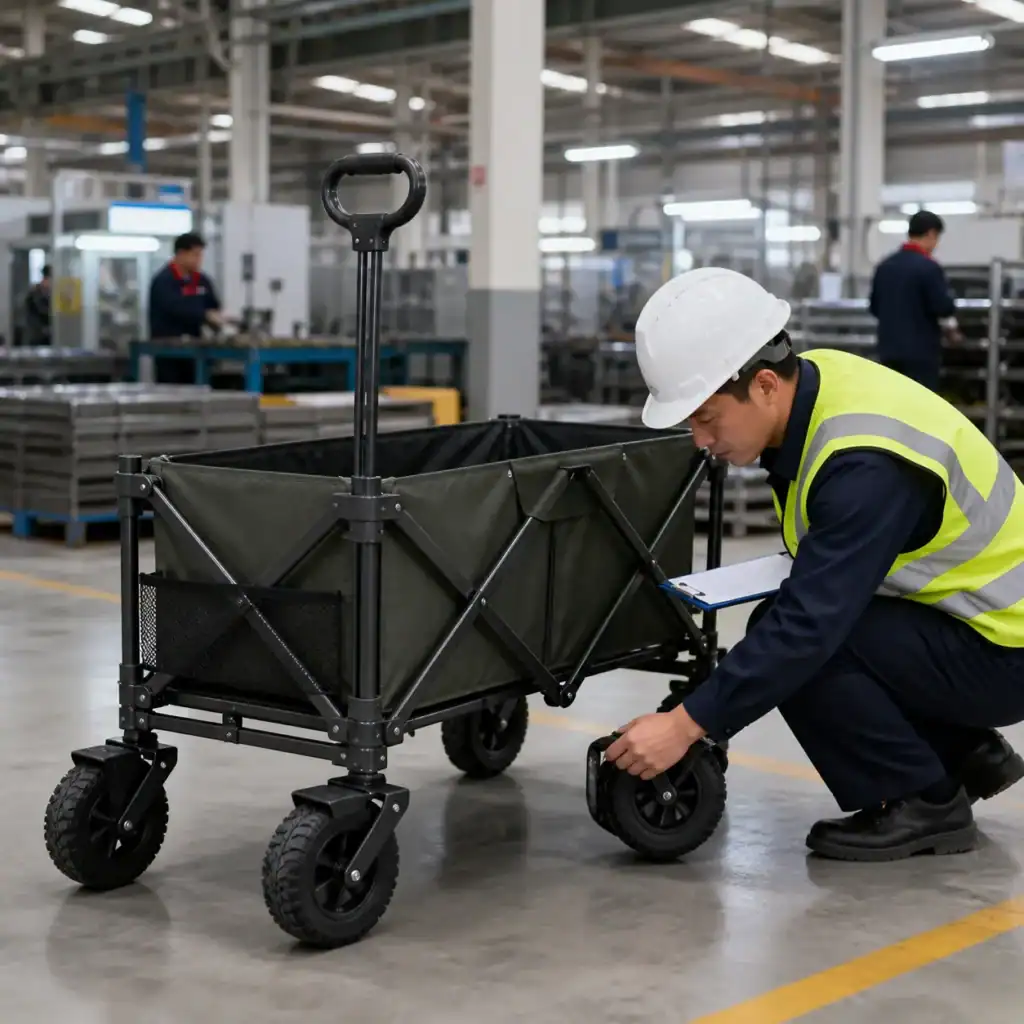
Interpreting Results: Pass/Fail Criteria for US and EU Markets
A wagon that passes static load at 100kg can fail at 60kg when rolled over a curb.
The gap between a factory spec sheet and what lands on your retail floor is often a single number: the load rating. But that number means almost nothing unless you know how it was measured. Most Chinese factories list static weight capacity—the load the wagon can hold while parked. The real failure point is dynamic capacity, which drops by roughly 40% once you start rolling over curbs or gravel. A buyer who skips this distinction will see warranty claims pile up within the first season.
Minimum Standards for US Retail Returns Reduction
For US market resale, aim for a dynamic pass threshold at 80% of the rated static load. That means if the spec says 100kg, your test sample must carry 80kg while being pulled across a standard curb (10cm height) without frame deformation exceeding 5mm or any weld cracking. EU buyers typically enforce a tighter tolerance: dynamic load at 70% of rated capacity, with zero visible deflection on aluminum frames after three consecutive curb drops.
-
- US Market Pass Criteria: Dynamic load test at 80% of rated capacity over three curb cycles. Frame deflection under 5mm. No weld separation. Fabric seams must hold without tearing.
- EU Market Pass Criteria: Dynamic load test at 70% of rated capacity over five curb cycles. Zero permanent deflection on aluminum frames. Axle bearings must rotate freely after test.
- “13mm” Axle Warning: ’13mm’ axle diameter works for loads up to 100kg static. For any wagon rated above that, demand minimum 16mm hardened steel axles with sealed bearings—or expect warranty claims within six months.
‘Double-layer Oxford fabric’ is another spec that needs verification. The layers only add real strength if they are cross-stitched every two inches. Many factories simply glue two thin layers together, which delaminate under heavy use and cause the cargo bed to sag or tear mid-season.

How Kelyland Outdoors Can Pre-Test Samples Before You Commit to MOQ
Most sourcing guides tell you to order a sample before committing to MOQ. That advice is incomplete. The real question isn’t whether you get a sample — it’s whether the sample actually represents what your bulk shipment will look like. A pre-production sample that passes a static load test in a showroom tells you nothing about how the wagon performs after 500 meters over gravel with 80 kg inside. Kelyland Outdoors addresses this through a structured sample approval process that goes beyond checking color and logo placement.
How the Sample Approval Process Works
Kelyland’s 10-step service process includes a dedicated Sample Approval stage (step 3) before mass production begins. This isn’t a single photo sent via WeChat. The team produces an actual prototype based on your approved design, then runs through a review loop with you covering dimensions, materials, stitching patterns, and hardware function. For folding wagons specifically, the sample is built using the same material grades and frame specifications that will go into your full run — 600D-900D double-layer Oxford fabric, powder-coated carbon steel or aluminum frames, and PP or MDF baseboards as specified.
Testing Beyond the Visual Check
A visual inspection catches logo alignment and fabric color. It doesn’t catch structural failure points. Kelyland coordinates with its ISO 9001:2015 certified partner factories to run functional tests on pre-production samples when requested. For wagons rated at 150 kg, the factory can perform a static load test at 100% rated capacity plus an overload test at 120%. They also check wheel axle durability — something most buyers never ask for until warranty claims start coming in six months later.
Sample Costs and Commercial Terms
Kelyland charges for samples upfront, but those fees are refundable when you confirm a bulk order. For lower-cost items, samples may be free if you cover shipping. This removes the financial friction of verifying quality before committing to MOQ quantities that start as low as 50-100 pieces for certain models. The standard production lead time of 30-45 days applies after sample approval — so getting the sample right early directly affects your go-to-market timeline.

Conclusion
A folding wagon that fails at 60% of its rated dynamic load isn’t a sourcing mistake — it’s a ticking warranty liability. The three tests outlined here — frame deflection, seam pull strength, and axle durability — separate factory fiction from field reality before you commit to a container.
-
- Dynamic rolling capacity is often 40% lower than static ratings.
- Cross-stitched double-layer Oxford fabric prevents seam delamination.
- Axles under 16mm on heavy-duty models trigger warranty claims within six months.
The cost of skipping these checks shows up in your return rate by month seven — typically around $12–$18 per unit in freight and processing alone for a failed wagon. Before you sign off on sample approval for your next folding wagon order, run the deflection test at 120% rated load and inspect the axle spec yourself. If your supplier can’t produce a pre-shipment inspection report covering these three stress points, that’s your signal to request a more rigorous QC protocol or compare quotes from factories that build to ISO-certified tolerances.
Frequently Asked Questions
How to get a quote for How to Test Folding Wagon Weight Capacity for Resale?
The exact answer depends on the product specification, quantity, and order setup. The safest approach is to confirm the commercial terms only after the final requirement sheet is locked. Always verify compliance against the exact model and the target market requirement.
Can I request samples first?
The exact answer depends on the product specification, quantity, and order setup. The safest approach is to confirm the commercial terms only after the final requirement sheet is locked. Sample availability should be confirmed against the current stock and shipping plan.

 English
  Español
  Deutsch
  Français
  Português do Brasil
  Русский
  العربية
  한국어
한국어  日本語
日本語