 跳到内容
跳到内容 
Most sourcing camping gear China checklists look airtight on paper: FOB pricing verified, minimum order quantities agreed, sample approval documented, lead time confirmed at 30–45 days. The one line nobody checks is the material match between the approved sample and the actual production run. That gap causes more post-delivery complaints than any other issue in this category.
A $50K order can fall apart on exactly that gap. The buyer approved the pre-production sample, confirmed the specification, then watched the bulk shipment arrive with thinner fabric and cheaper hardware than the prototype. Every checklist item was complete. The mismatch still shipped.
Sample approval only means something when it’s anchored to approved material swatches and a documented production baseline. A factory-side sourcing team closes the loop by verifying material certificates, mold files, and production photos at source — skipping the middlemen who never visit the line. Quality tolerance gets set on the production floor, and the mass run either matches the baseline or it doesn’t ship.
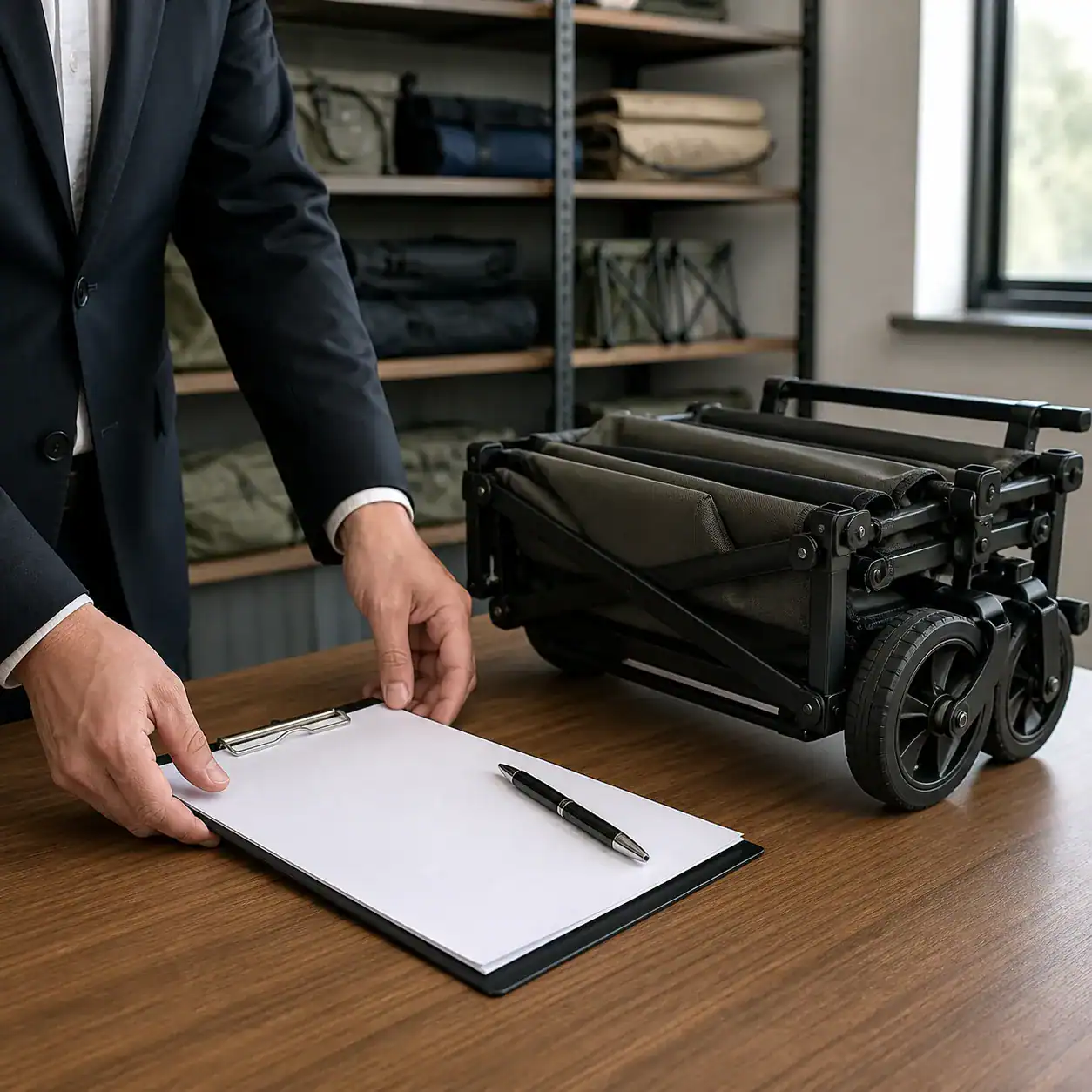
Why Most China Sourcing Fails: 5 Hidden Risks
A $50K order failed because the pre-production sample didn’t match the mass run.

Real Cost Breakdown of Sourcing Gear in 2026
Sample fees, MOQ, deposits, and Incoterms decide your real unit cost — not the quote.
The real cost of sourcing camping gear from China is not the unit price on the quotation. It is the sum of four decisions: the MOQ threshold, the deposit structure, the freight terms, and the customs classification. Miss any one of these and the landed cost per unit can exceed the wholesale price you planned to sell at. A 2026 sourcing plan should treat these as line items, not as facts to discover after the order ships.
MOQ & Tooling Costs
MOQ is the first cost gate. On select camping gear, small-batch test orders start at 50–100 pieces. Standard models fall in the 300–1,000 piece range, depending on the factory and the level of customization. The gap matters because the lower end of that range lets you validate product-market fit without tying up capital in inventory that may not move. It also forces the supplier to keep the production line set up for your spec, which reduces the risk of batch-to-batch drift.
-
-
- Test-order path: A 50–100 piece MOQ on select gear allows a low-risk pilot run before committing to full container volumes.
- Tooling check: Confirm whether the product uses existing molds or new tooling. New molds raise complexity and push lead time toward the upper end of the standard 30–45 day window.
-
Deposit & Payment Protection
The deposit structure is the second gate. For new clients or orders above $3,000, the standard term is 30% deposit and 70% before shipment. That balance payment lands after pre-shipment inspection, which is the point where you still have negotiating power. Repeat buyers often negotiate softer terms, but the 30/70 split exists for a reason: it keeps the factory invested in completing your order while protecting you from paying the full amount before a single container is ready.
-
-
- Sample refund: Paid samples are refundable against a confirmed bulk order; low-cost samples may be free if the buyer covers courier fees.
- Swatch gate: Release the deposit only after approving the pre-production sample paired with material swatches. Brokers often upgrade a cheap prototype and swap in cost-down materials during bulk production.
-
Freight & Customs Cost Levers
Freight and customs are where hidden costs appear. A supplier should issue a commercial invoice, packing list, and HS code so your forwarder can estimate landed cost before the order ships. FOB is the standard first-order choice because you control the freight quote and see the export documents before releasing the balance. DDP removes the logistics work but bundles the risk and margin into the unit price — fine for a one-off test, expensive at scale.
-
- Customs factors: Import duties are calculated from the HS code, declared value, and destination country rules. Get the HS code wrong and the customs hold can cost more than the products.
- Incoterm alignment: Agree on FOB or DDP in writing before payment. A vague Incoterm is how freight becomes the largest line item on your invoice.
| Cost Factor | Typical Range / Rule | Kelyland Benchmark |
|---|---|---|
| MOQ | 50–100 pieces for select gear; 300–1,000 for standard models | Test order path from 50–100 pieces |
| Lead Time | 30–45 days standard, subject to complexity and quantity | 30–45 days with stage updates and buffer planning |
| Deposit / Payment | 30% deposit / 70% before shipment for orders over US$3,000 | Negotiable terms for repeat clients |
| Sample Fee | Paid samples, often refundable on bulk confirmation | Low-cost samples may be free; buyer covers courier |
| Quality Control | ISO 9001:2015 factories; AQL 2.5 bulk inspection standard | Stage-by-stage inspections with reports on request |
| Material Cost Verification | Swatches and certificates verified before mass production | Pre-production swatches matched to approved sample |
| Freight & Customs | FOB common for first orders; DDP available at higher cost | Export paperwork and customs guidance included |
| Total Landed Cost Control | Hidden fees from middlemen can add 10–20% | Direct factory network removes two middleman layers |

Factory Direct vs Trading Companies: Which Wins?
Trading companies relay quotes.
Most buyers think they are purchasing factory-direct when they contact a supplier on a sourcing platform. In reality, many of those listings are front-end trading companies. The red flag appears when you ask for a production photo of your actual order and the broker has to request it from the line. Direct communication with a factory-side sourcing team changes that. Material certificates, mold files, and production photos are verified at the source.
Direct Factory Access
A true factory-direct operation has physical control over the production process, not just the sales channel. Kelyland Outdoors operates through 17 core strategic factories and over 200 stable manufacturing partners, covering everything from camping tents to trekking poles. That is what lets a buyer confirm a 0.4–0.6 mm puncture-resistant PVC thickness on an air mattress before mass production begins, instead of trusting a PDF spec sheet from someone who has never walked the workshop floor.
A broker can sell you the same product from the same factory, but the broker adds markup and delay without adding production control. If a material shortage means a substitution mid-run, the factory-side team catches it during the production stage and reports it before the shipment leaves. A trading company may only find out when the buyer files a claim.
ODM/OEM Pricing Control
Pricing control matters most when you are doing private label work, not buying a generic off-the-shelf camping cot. A factory-side sourcing team negotiates against actual material and labor costs — fabric dyeing, frame powder coating, custom-molded parts. A trading company negotiates against its markup. That difference matters in product development where the buyer funds molds, sampling, and revisions. The party with direct line access can price the real cost of changes.
-
- Material verification: Swatches and production-stage inspection reports confirmed at the source, not relayed through a broker.
- Pricing transparency: Factory-direct quotes tie to material and labor costs rather than a middleman’s markup.
- Change control: A revision on a tent pole or sleeping bag fill lands directly with the production team.
Response Time Impact
The hidden cost of a trading company is time. Standard production lead time for camping gear runs 30–45 days. If a design question takes days to relay through an intermediary, the entire seasonal launch window shifts. A factory-side team answers with the production manager’s actual constraint and can adjust material orders or line schedules the same day.
For an e-commerce operator testing a new product or a supply chain manager planning a bulk tent order, those response cycles are the difference between hitting the spring buying season and holding inventory in a warehouse. Factory-direct is not always cheaper than a broker, but it is predictably faster and more controllable.

How to Vet Camping Gear Factories Fast
Check the certificate scope annex, not just the PDF.
Most buyers start the vetting process with one question: “Are you ISO certified?” That is the wrong question. ISO 9001:2015 audits the quality management system, not the product range. A factory can hold a valid certificate for plastic injection molding while the tents it assembles come from a different line with no audit coverage. The only way to confirm the match is to read the certificate annex, which lists the exact scope of activities covered by the audit.
Certificate Scope Check
Ask for the full certificate PDF, then zoom into the scope section. It should name the specific production category — for example, “manufacturing of camping tents and outdoor equipment” — not just “manufacturing.” If the supplier sends a blurry one-page certificate with no annex, treat it as a red flag. Legitimate audits include a scope statement, an audit date, and an expiry date. Cross-check those dates against the supplier’s claim of being “long-term certified.”.
-
- Verify location and product-line match: Confirm the factory address on the certificate matches the address on the supplier’s contract and website. If the factory is in Ningbo but the certificate shows a different city, the supplier may be a trading company with no direct production.
- Request the audit report: The certificate proves a system exists. The audit report shows findings, corrective actions, and any non-conformities flagged during the last assessment. A supplier that hesitates to share it likely has something to hide.
- Ask which product line was audited: A factory that produces both camping chairs and air mattresses may only have ISO 9001:2015 coverage for one line. If you are sourcing a camping cot, confirm the cot production line is inside the certified scope.
Pre-Production Sample Rules
Sample approval is where most sourcing projects quietly fail. The pre-production sample looks perfect. The bulk shipment arrives with lighter fabric, thinner coating, and a different zipper brand. This is not an accident — it is a commercial decision made when the factory sees the order margin shrinking. The fix is to pair sample approval with pre-production material swatches and a signed quality tolerance sheet.
The swatch rule matters. A photo of a sample proves nothing about the material weight, coating density, or stitch count. Insist on physical swatches cut from the actual production roll, not from a sample book. For air mattresses, check the PVC thickness against the agreed specification of 0.4 mm to 0.6 mm. For camping cots, verify the frame grade and surface fabric before releasing the deposit. A pre-production sample should always be approved after the material swatch, not before.
Production Audit Triggers
Not every order needs a full factory audit, but three triggers should push you to schedule one: first orders above $10,000, any supplier located through a trading company referral, and any order with custom ODM requirements such as proprietary molds or specialized coatings. A mid-production audit catches drift before it becomes a chargeback. The audit should check stitching density, material specifications, and whether the factory is actually running your order on the certified line.
The fastest way to trigger an audit is to request production stage photos with a dated newspaper or a unique mark. If the supplier refuses or sends generic photos from a previous order, escalate immediately. Direct factory communication — the kind that skips two layers of middlemen — is what makes this verification possible. A trading company will often relay photos without knowing whether they match the actual production batch.

How to Source Without Getting Scammed
Most sourcing disputes are contract gaps, not fraud — close the payment and inspection gates.
The word “scam” implies elaborate fraud — fake factories, stolen deposits, disappeared contacts. In practice, most China sourcing losses come from three contract gaps: no AQL standard written into the agreement, no inspection gate before the final payment, and murky Incoterms that leave freight risk undefined. Each one is preventable, but only if it’s in the contract before the deposit leaves your account. A supplier with a real production line will accept these terms. One without a line to protect will not.
Contract & AQL Kickers
AQL 2.5 is the most common bulk inspection standard for camping gear. For each lot, an inspector pulls a random sample and the batch passes with up to 2.5% major defects — and zero critical defects. A critical defect is a safety issue: a torn seam on a load-bearing cot strap, a leaking air mattress valve, a tent pole that snaps during setup. Write AQL 2.5 / 0 critical into the contract so the supplier knows you’ll measure the batch against a published standard, not a subjective opinion.
- Certificate scope check: ISO 9001:2015 certificates cover specific product lines, not entire factories. Ask for the certificate annex and audit report — not just the PDF — to confirm the camping gear category you’re ordering is actually within scope.
Payment Milestone Structure
The standard payment structure for a first order is 30% deposit and 70% before shipment. That 70% is the only leverage you hold once the container is loaded. Tie it to the pre-shipment inspection report and dated photos of the actual production run — not to a status update from the sales rep. Repeat clients can negotiate better terms, but a first order should keep the balance payment gated until the inspection passes. If the supplier asks for 50% or full payment upfront, treat it as a red flag.

Shipment Inspection Gate
Pre-shipment inspection is the last checkpoint before the container ships. The Kelyland 10-step process includes this as a formal gate: a final quality check on stitching, mechanisms, and compliance before shipment approval, with reports available on request. Require dated photos of the mass-production items — not the pre-production sample. Verify the details that matter for your product: for air mattresses, the 0.4–0.6mm puncture-resistant PVC; for camping cots, the frame welds and fabric attachment points across the 120–250kg load range. If the inspection fails, the rework cycle starts — and it only works because the balance payment is still on your side.
- Incoterms: Align Incoterms before payment. FOB is common for first orders because the buyer controls freight and sees export documents before paying the balance. DDP simplifies door-to-door import but raises supplier freight responsibility and cost.
Conclusion
Doing nothing after reading this is the most expensive option. A $50,000 order with an unverified factory or a sample-to-mass material swap will burn 30-45 days in rework and land you on the wrong side of your defect-rate KPI. The five control points in this guide — certificate scope, swatch approval, AQL 2.5 inspection, clear Incoterms, and staged payment — exist to stop that loss before the container leaves the factory.
-
- Request the ISO certificate annex and audit report, not just the PDF, to confirm the product line is covered.
- Lock AQL 2.5 with zero critical defects into the contract before releasing the 30% deposit.
- A paid sample gate with approved material swatches prevents sample-to-mass swaps on a $50K order.
- Minimum order quantities from 50-100 pieces and 30-45 day lead times allow a structured test run.
Match the ISO 9001:2015 certificate scope to your exact product line, request pre-production samples with material swatches, and define the Incoterm before you sign anything. Browse the product and sourcing pages at Kelyland Outdoors to compare camping gear that fits a 50-100 piece test order, then confirm minimum order quantities and the 30-45 day lead time before you release the deposit.
Frequently Asked Questions
What is AQL 2.5 inspection for camping gear?
AQL 2.5 is a bulk QC standard where a random sample is inspected and up to 2.5% critical or major defects are accepted. It is the most common final inspection level. Use AQL 2.5 as your baseline sampling plan for bulk orders.
Can I get free samples before bulk purchase?
Low-cost samples may be free if you cover shipping, while paid samples are usually refundable after a confirmed bulk order. Sample fees depend on product complexity and customization, so confirm the. Ask for the sample policy and keep the terms in writing.
How are import duties and taxes calculated on camping gear from China?
Duties and taxes are based on the HS code, declared value, and destination country import rules. Your supplier or freight forwarder should provide export guidance and customs paperwork, but final. Verify the HS code with a customs broker before finalizing your order.
What happens if production is late by 20-30 days?
Late delivery triggers whatever penalty or re-planning terms you put in the production agreement, so define them upfront. A reliable supplier with a 30-45 day standard lead time should flag delays early and. Build late-delivery penalties into the agreement before mass production.
Which Incoterm is best for a first camping gear order?
FOB is typically best for a first order because you control freight and see export documents before paying the balance. EXW leaves logistics completely in your hands, so FOB is safer. Confirm FOB port and document requirements with the supplier in writing.

 English
  Español
  Deutsch
  Français
  Português do Brasil
  Русский
  العربية
  한국어
한국어  日本語
日本語