 跳到内容
跳到内容 
A $50,000 private-label order is where most air tent failures begin—not in the field, but in the gap between the pre-production sample and the mass production run. Your sample approval probably checked the printed flysheet and the carry bag logo. Most quality tolerance conversations stop at fabric denier and never reach the two places that actually fail: the valve stem weld and the seam where the beam joins the floor. FOB pricing pressure then pushes the factory to shave the one spec that protects you—TPU film thickness at the weld zone.
The physical mechanism is simple and worth putting in front of your QC team. Air inside a beam expands roughly 1 PSI for every 10°C temperature rise. Inflate to 12 PSI at 20°C, leave the tent in direct sun at 40°C, and you are sitting at 16 PSI—without a single extra pump. That extra pressure concentrates at the valve stem, the stiffest point in the beam, and the weld starts to peel. Factories that skip a pressure-relief valve or use 0.4mm film at that joint are shipping a predictable warranty claim.
Set your spec before you talk price. On the next supplier call, ask for 0.6mm TPU at the valve weld, a pressure-relief valve calibrated below the beam’s burst rating, and a temperature-cycle test from 20°C to 40°C with no seam failure. That is the benchmark that separates a tent that survives the second season from one that comes back in pieces.
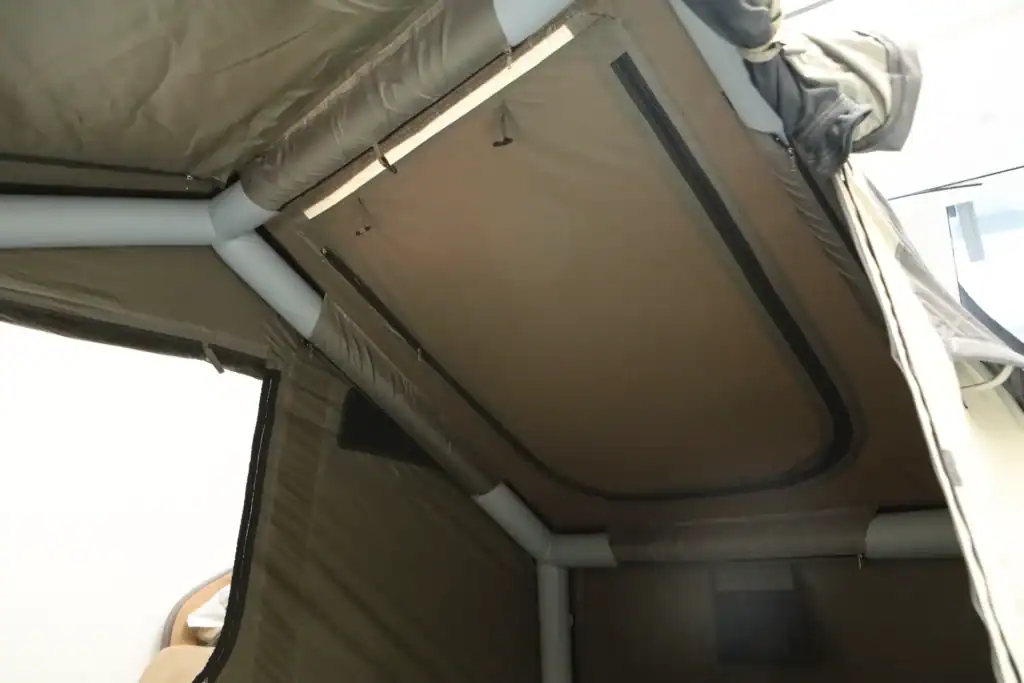
Failure #1: Valve Stem Separation
Over-pumping a cool-morning air beam can push pressure past 16 PSI — enough to tear the valve stem out of the weld.
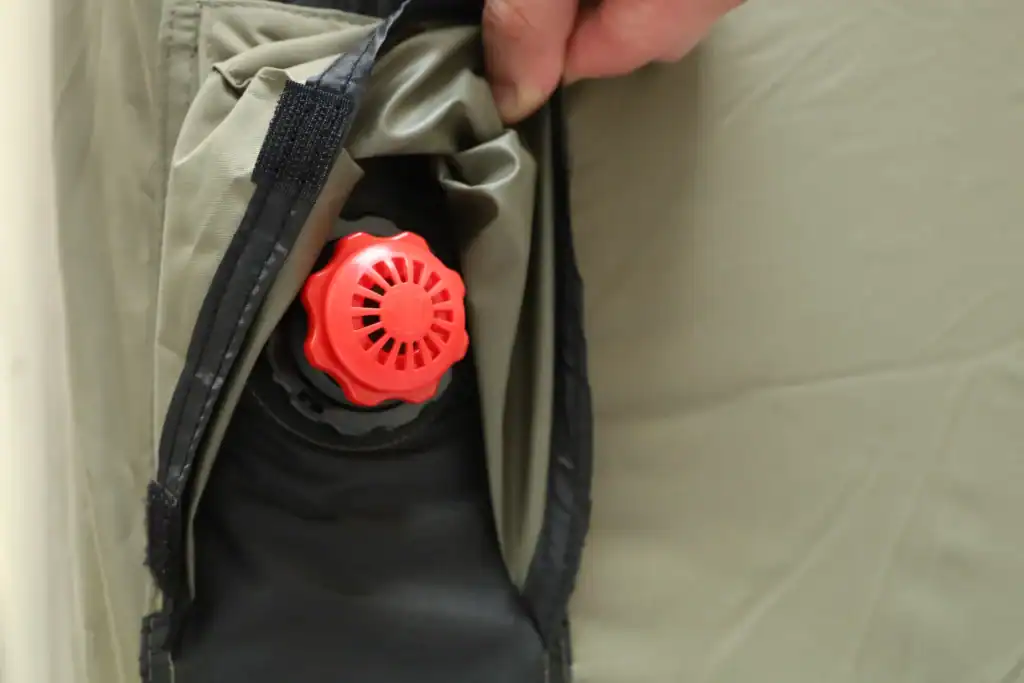
The valve stem is the weakest structural point on an inflatable tent. The plastic stem is welded into the beam wall, and that weld has to hold 8–15 PSI of operating pressure, repeated setup and teardown, and daytime-to-nighttime temperature swings. Most “leaks” in returned tents trace back to this valve base, not to a puncture in the beam fabric. Once the weld starts lifting, no patch kit fixes it.
Why over-pumping pulls the stem loose
Manual pumps do not have an automatic shut-off calibrated to ambient temperature. A user on a cool morning feels a soft beam, adds more air, and stops by hand feel rather than by pressure. PVC-coated polyester beams also stiffen below -10°C, which makes the beam feel even more underinflated in cold weather. Then the sun hits the tent, and the air inside expands by roughly 1 PSI per 10°C. A beam set to 12 PSI at 20°C can climb past 16 PSI at 40°C — and the excess load concentrates at the valve weld.
That pressure spike does the damage over time. The stem does not usually pop on first inflation. It fatigues after repeated over-pumping, the weld edge lifts, and on the next setup the stem tears away from the beam wall under a load it was never rated to take. This is the mechanism behind most air tent valve problems in the field.
Spec the fix at the factory
-
- Material choice: TPU film holds up better than PVC-coated polyester at the valve zone because it stays flexible at low temperatures and handles repeated flexing. If a supplier quotes 0.4mm TPU across the beam, ask for 0.6mm at the valve reinforcement.
- Valve style: Boston valves sit flush on the beam and offer a wide weld footprint. Leaf valves are simpler and cheaper, but the smaller contact area makes them more likely to tear loose under pressure spikes.
- Weld method: High-frequency welding gives a more consistent seal on TPU than hot air welding when the material is handled correctly. Weld width and temperature settings should be part of the QC spec, not left to the machine operator.
- Pressure relief: A pressure-relief valve vents excess PSI before the weld or stem reaches its limit. With the 6 PSI swing between a cool morning and a hot afternoon, this is low-cost insurance against the most common warranty claim in the category.
Kelyland’s inflatable tent partner factory in Jinhua, Zhejiang, produces 500,000 units per year under ISO 9001 and CE. That production volume means valve weld parameters and material thickness have to be locked into the QC inspection sheet before the first unit runs. For a private-label program, put the same specs in writing: valve style, TPU thickness at the weld zone, weld method, and pressure relief.
Failure #2: Welded Seam Splitting
Welded seam failure is pressure-driven, not a random puncture.
The beam holds. The fabric is intact. The split runs along the weld line a few centimetres from the valve, and the tent sags within twenty minutes of pitching. Most field reports call this a puncture. It isn’t. It’s a pressure-driven seam failure, and it repeats across brands because the engineering mistake happens before the tent is boxed.
Air beams run at 8-15 PSI at normal operating temperature. But air inside a sealed beam expands roughly 1 PSI per 10°C rise. A tent inflated to 12 PSI at 20°C can pass 16 PSI at 40°C. That over-stresses the weld zone, particularly where the valve stem joins the beam wall.
Why Welded Seams Split Before the Base Fabric
Air beam seams are made by high-frequency welding or hot air welding. RF welding fuses thermoplastic films molecularly; hot air welding relies on controlled temperature and roller speed. When those parameters drift on a long production run, the weld looks fine in the sample but fails under pressure cycling. The failure mode is predictable: peel stress at the weld edge.
The 0.6mm Weld Zone Spec
Beam film is usually TPU from 0.4mm to 0.9mm thick. The main seam area and valve base should be bumped to at least 0.6mm TPU, with a pressure-relief valve on each independent beam. Without one, an over-eager pump combined with daytime heat turns a 12 PSI tent into a 16 PSI liability.
-
- Spec: Use high-frequency welding for main longitudinal seams and valve-base reinforcement. RF fusion gives peel strength that hot-air lines can’t match when process drift is present.
- Risk: Air beam pressure increases close to 1 PSI per 10°C rise. A 20°C inflation at 12 PSI passes 16 PSI at 40°C. That’s the split near the valve.
- Factory check: Ask for weld-peel test records and pressure-relief valve presence on each beam. Kelyland’s inflatable tent partner factory in Jinhua, Zhejiang, builds 500,000 units annually on ISO 9001 and CE-certified lines.
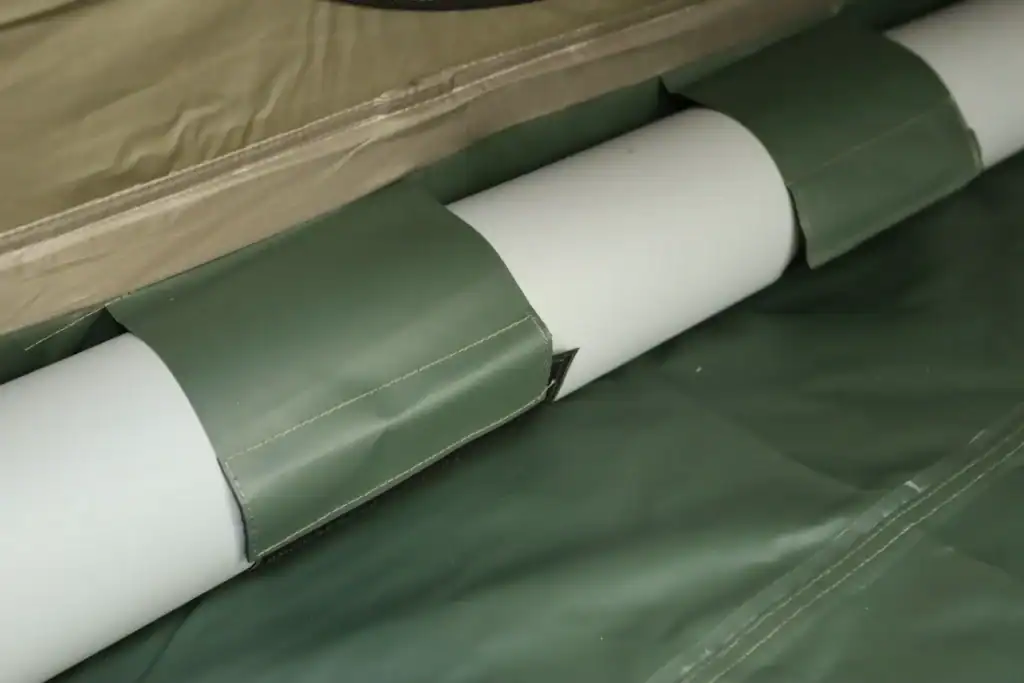
Failure #3: Beam Material Selection and Delamination
Standard PVC beams fail at the weld.
Most air tent failures trace back to the beam material before any customer touches the product. The two common choices are PVC-coated polyester and TPU film. That single decision drives delamination, cold-weather cracking, and seam creep. Buyers rarely spec it because suppliers quote “air beam tent” as if every beam is the same.
Why Standard PVC Becomes a Warranty Claim
PVC-coated polyester is cheap, welds quickly, and passes a static factory inflation test. But PVC stiffens below -10°C. In winter conditions, every fold and flex point concentrates stress on the welded seam. The coating separates from the polyester scrim, the beam develops a slow leak, and the tent sags within 20 minutes of pitching.
-
- Delamination pattern: The PVC coating lifts from the polyester base along high-frequency welded seams, usually near the valve stem or at fold creases. You can feel the layers separate before the leak becomes visible.
- Cold-weather failure: PVC loses flexibility below -10°C. TPU stays flexible to -30°C. That 20°C operating margin is exactly what prevents inflatable tent cold-weather cracking.
- Pressure stress: Air beams run at 8–15 PSI. Add pressure creep from daytime heat, and the delaminated seam near the valve is the first place to fail. That is why returned tents usually leak at the valve base, not in the middle of the beam.
Spec the TPU Upgrade Before Sample Approval
Specify TPU film at 0.4mm–0.9mm thickness, with 0.6mm minimum at weld zones. Standard PVC may cut the factory cost by $8–$15 per unit, but one returned tent destroys that saving in freight, restocking, and chargebacks. The upgrade is warranty insurance, not a premium feature.
Kelyland’s inflatable tent partner factory in Jinhua, Zhejiang, produces 500,000 units annually under ISO 9001 and CE certification. Their material sourcing step verifies outdoor-grade durability before sample approval. Ask your supplier for the beam material spec sheet in writing. If the answer is only “PVC,” you are approving a predictable failure mode.
| Failure Mode | Root Cause | Material / Spec Data | Prevention / Spec Fix |
|---|---|---|---|
| PVC Coating Delamination from Base Fabric | PVC-coated polyester beams stiffen below -10°C; repeated flexing in cold weather breaks the bond between coating and fabric, causing visible peeling and air migration through the fabric matrix. | PVC-coated polyester (typical 0.4mm-0.9mm total film); TPU film (0.4mm-0.9mm) remains flexible to -30°C; coating adhesion differs by welding process used. | Specify TPU film for cold-weather markets; require 180° peel test on coated fabric before production; set minimum adhesion force in your QC checklist (ISO 9001 factory audits). |
| High-Frequency Weld Separation at Beam Ends | High-frequency welding (RF welding) creates a strong molecular bond only when material chemistry is identical; mismatched PVC/TPU layers or incorrect dwell time create weak fusion lines that delaminate under pressure spikes. | RF welding standard for PVC; hot air welding often used for TPU; operating pressure typically 8-15 PSI; pressure creep adds roughly 1 PSI per 10°C temperature rise. | Require weld-seam peel testing on every batch; specify single-material beams (all-TPU or all-PVC); insist on hot air welding with calibrated temperature and pressure settings for TPU. |
| Temperature-Driven Delamination Near Valve Zone | A tent inflated to 12 PSI at 20°C can exceed 16 PSI at 40°C; the welded zone around the valve is the highest-stress region and delaminates first when pressure exceeds bond strength. | Typical operating pressure 8-15 PSI; pressure spike of +1 PSI per 10°C; valve-stem weld area experiences concentrated cyclic loading every inflation/deflation cycle. | Upgrade to thicker TPU (0.6mm+) at weld zones; install pressure relief valves; run batch pressure-test at 1.5x rated pressure for 24 hours before shipment. |
| Plasticizer Migration & Layer Cracking in Cold Weather | PVC relies on plasticizers for flexibility; below -10°C plasticizers become rigid, and flexing causes micro-cracks that grow into full-beam delamination and leaks. | TPU operates down to -30°C without plasticizer migration; PVC stiffens below -10°C; field exposure on winter trips or alpine overnight sites triggers failure. | For EU/APAC winter-season SKUs, require TPU beams as standard; if PVC is mandatory for cost, add cold-flex test at -15°C to your QC and marketing compliance specs. |
| Inconsistent Batch Quality Between Material Suppliers | Beam material sourced from different suppliers with similar grades can have different laminate thickness and adhesion; delamination appears only after several inflation cycles in the field, not during factory spot checks. | Kelyland’s inflatable tent partner factory in Jinhua produces 500,000 units annually under ISO 9001 and CE; certified factories must document material lot traceability. | Mandate mill certificates for every TPU/PVC lot; require incoming-material adhesion testing; use a single approved supplier list (AVL) in your OEM contract to eliminate variance. |
Failure #4: Beam Burst from Over-Pumping and Thermal Expansion
A 1 PSI climb per 10°C means a 12 PSI morning inflation becomes a 16 PSI afternoon overload.
The claim that air beams cannot be over-inflated is false. The gas physics behind the air beam pressure temperature change are straightforward: sealed air expands as it heats. A tent pumped to 12 PSI at 20°C can exceed 16 PSI when the canopy hits 40°C in direct sun. That is not a marginal difference — it is the delta that tears the welded seam.
This type of failure is not a random puncture in the beam fabric. Returned tents come back with the valve stem torn away from the beam wall. Over-pumping initiates the damage; the pressure spike finishes the job. That pattern repeats across climates and user types.
Why the Valve Stem Fails First
The valve base sits at the interface between rigid plastic and flexible coated fabric. That area takes concentrated stress from the beam’s internal pressure. When the beam wall is 0.4mm PVC, expansion has little room to absorb. It tears. TPU at 0.6mm or above flexes measurably more and delays the tear. PVC also stiffens below -10°C, while TPU stays flexible to -30°C, so cold weather makes the problem worse, not better.
Pressure Control Starts at the Factory
Kelyland’s inflatable tent partner factory in Jinhua, Zhejiang produces 500,000 units a year with ISO 9001 and CE certification. There, pressure relief valves and thicker TPU at the weld zones are standard structural specs, not add-ons. A buyer who skips them is not cutting cost; they are accepting a warranty claim rate as overhead.
-
- Operating pressure: Typically set at 8-15 PSI by the factory against a 20°C baseline. When the user is the one deciding the limit, the spec is already broken.
- Pressure relief valve: A calibrated vent that releases air before the seam reaches failure stress. Without it, daytime heat turns a proper morning inflation into an afternoon overload.
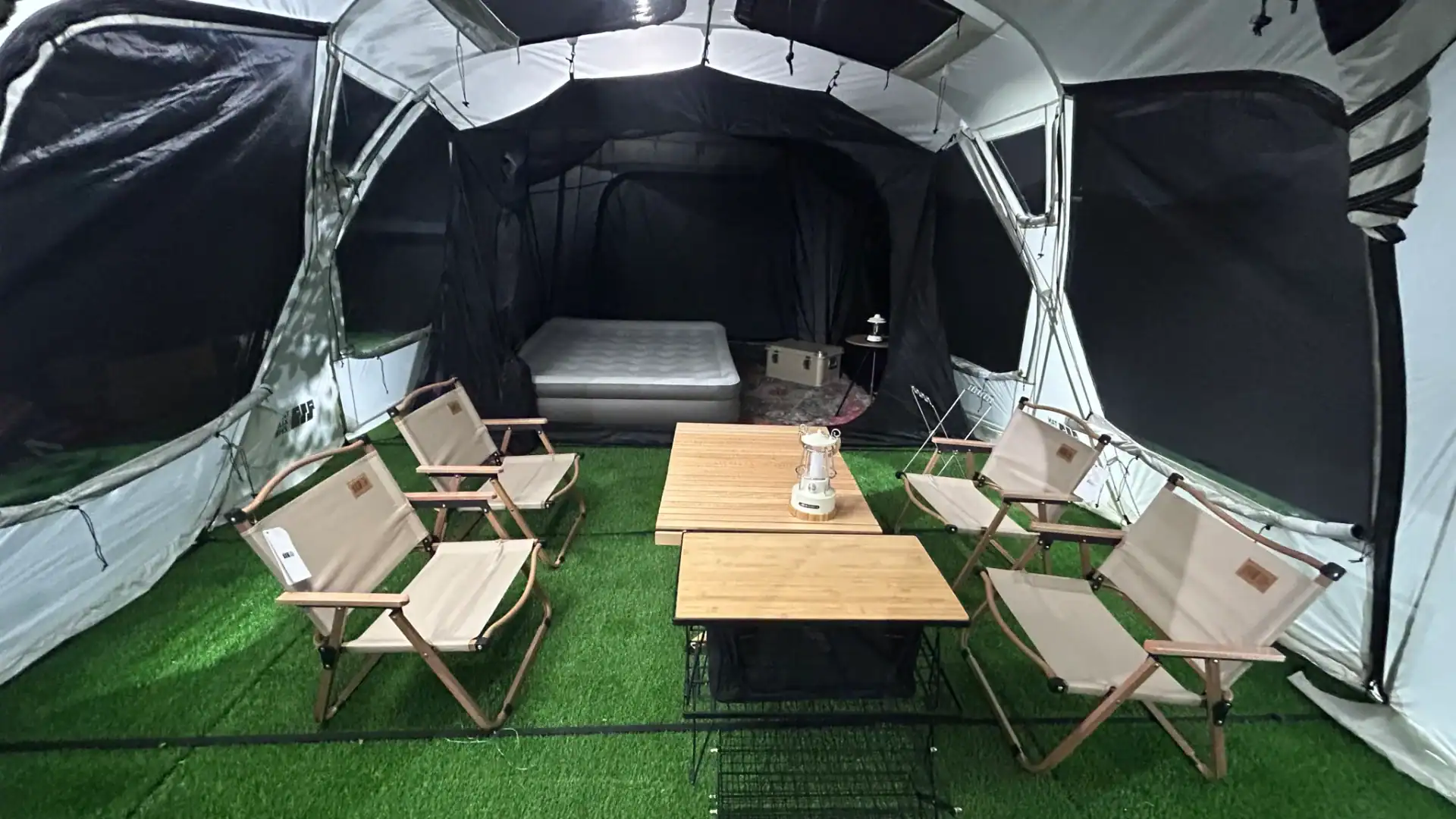
What to Spec in Your Next OEM/ODM Order
Spec reinforced TPU, pressure-relief valves, and field-condition testing, or the warranty returns are yours.
Most air tent failures trace back to three things buyers never put in writing: beam material, valve assembly, and test protocol. A pre-production sample approved in a 22°C showroom tells you nothing about a 40°C beach or a freezing mountain morning. Here is what to spec before mass production.
Beam Material: TPU vs. PVC
PVC-coated polyester is cheaper and welds easily, but it stiffens below -10°C. That is why inflatable tent cold weather cracking shows up in winter orders. TPU film stays flexible down to -30°C, resists hydrolysis, and survives repeated folding. Specify reinforced TPU at 0.4-0.9mm, and upgrade to 0.6mm+ at weld zones where stress concentrates.
-
- PVC: Lowest material cost, fast high-frequency welding; stiffens below -10°C and becomes a top reason for inflatable tent seam failure causes in cold climates.
- TPU: Flexible to -30°C, better hydrolysis resistance; use 0.4-0.9mm film with 0.6mm+ reinforcement at valve pockets and welded joints.
Valve Assemblies and Pressure Creep
Most returned air tents don’t have punctured beams. They have valve stems torn away from the beam wall after repeated over-pumping. Air beam pressure temperature change makes this worse: pressure rises roughly 1 PSI per 10°C. Inflate to 12 PSI at 20°C and the beam can exceed 16 PSI at 40°C. That spike overstresses the weld around the valve.
Spec an integrated pressure-relief valve plus a reinforced valve patch. Boston valves handle high-volume pumps; leaf valves are simpler. Either style works if the base flange is welded to a TPU patch and positioned away from high-flex zones.
Test Conditions Must Match the Campsite
A controlled lab at constant 20°C with a regulated pump won’t catch what users do. Require tests that replicate field abuse: inflate to operating pressure (8-15 PSI), cycle temperature from -10°C to 40°C, and measure pressure decay over 12 hours. Also test the valve after 100 inflation cycles and with sand or grit on the opening.
Kelyland’s inflatable tent partner factory in Jinhua, Zhejiang—500,000 units per year, ISO 9001 and CE certified—builds these tests into the production timeline. That’s the standard to put in your B2B inflatable tent quality specs.
Conclusion
Most air tent failures follow predictable patterns: valve stems tearing under over-pumping, welded seams overstressed by temperature-driven pressure creep, and materials that stiffen or crack outside their rated range. Buyers who catch these risks at the specification stage avoid the return-logistics bill and preserve category margin. The fix lives on the spec sheet, not in the field.
The last 10% that separates professionals from amateurs is simply asking the supplier to prove weld-zone thickness and confirm the working pressure range on paper. Review your next inflatable tent sourcing brief with these five failure modes in hand — and talk to Kelyland’s engineers about TPU vs PVC beam construction, valve placement, and pressure relief before the prototype stage. They can deliver a sample in 30-45 days, with the QC documentation you need to justify vendor selection.
Frequently Asked Questions
What causes air tent valve stem failure?
The valve stem usually tears loose because over-pumping pushes internal pressure past the beam’s safe limit, especially on a cool morning. Daytime-to-night temperature swings can then add expansion stress and pull the. Spec a pressure limit and test valve welding before production.
Why do air tent welded seams split?
Welded seam splitting is pressure-driven, not a random puncture or a fabric defect. The seam is the weakest point when the beam is over-inflated or exposed to wide temperature swings. Require weld strength tests before mass production.
Which material fails most in air beams?
Standard PVC is the usual problem material because it fails at the weld under pressure and temperature stress. Reinforced TPU is the common upgrade, though it adds about $8 to $15 per unit at. Balance material choice against your target return rate.
What does an air tent failure cost a retailer?
A single failed batch can cost $50,000 or more in return logistics, replacement shipping, and chargebacks. Reinforced TPU is cheaper than that risk at roughly $8 to $15 per unit. Treat the material upgrade as return-loss protection.
How can buyers prevent air tent failures in private label?
Prevent failures by specifying reinforced TPU beams, pressure-rated valves, and weld inspection in your order. A factory QC step and pre-shipment inspection are where these issues are actually caught. Add failure-mode checks to your sample approval.

 English
  Español
  Deutsch
  Français
  Português do Brasil
  Русский
  العربية
  한국어
한국어  日本語
日本語