 跳到内容
跳到内容 
Every air tent valve leak repair guide you will find online tells you to check for a puncture first. That advice is dead wrong for about 40% of the returns flagged across supplier audits in a dozen countries. The real failure mode is a weld peel at the valve-base tab that is invisible when the beam is at rest, and it only shows up under load. A buyer burned through a $50K order because the pre-production sample held pressure fine, but the mass production run had a 2 mm separation at the same joint that opened up after three inflation cycles.
The fix is not complicated, but it requires changing how you test. Standard soapy water spraying catches nothing if you spray a static beam. You need to press and flex the beam while spraying at around 8 psi working pressure. Bubbles that appear only under that flexing motion point straight to the weld split. A fifty-cent TPU patch with polyurethane adhesive applied over that spot can extend the beam life for another season and save you a $30 freight return plus the customer relationship damage.
The Valve Weld Is the Weak Point, Not the Valve Core
Most valve leaks start at the weld seam, not the core.
A customer says the tent lost pressure overnight. Most inspection guides send you to the valve core first. That instinct is wrong more often than right. In failures that actually reach a repair bench, the split sits in the high-frequency weld around the valve base tab. The core is rarely the culprit. This is the first thing to check when a private-label air tent comes back with a leak complaint.
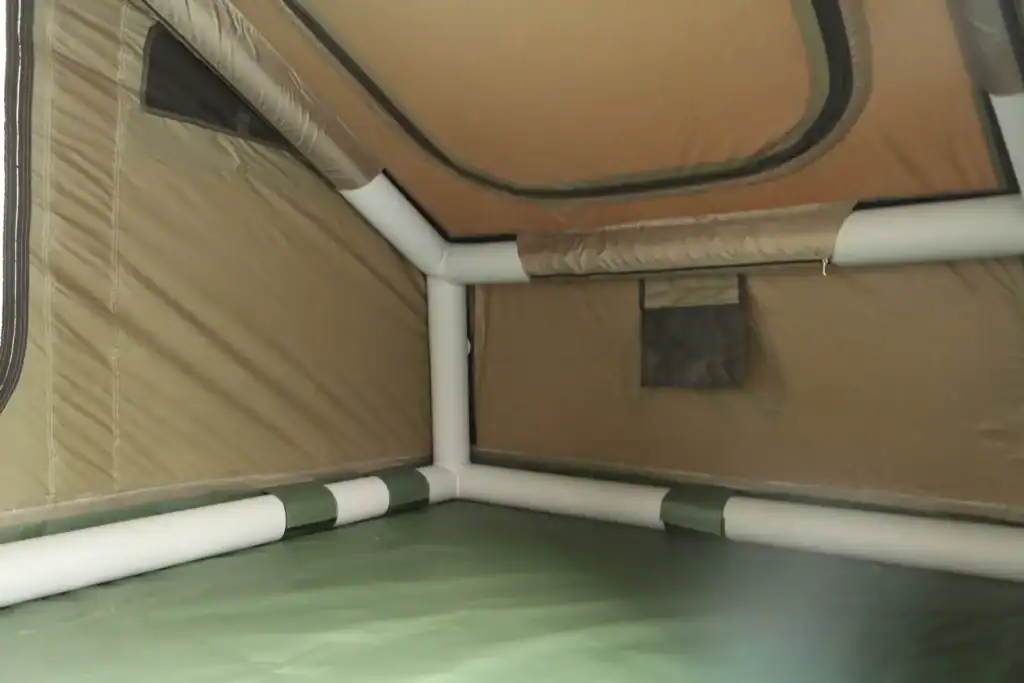
The valve assembly is compact: a valve core, a rubber gasket, an HDPE wing nut, and a TPU-base tab that is HF-welded to the beam fabric. That welded seam is the load-bearing joint. Every hose connection and disconnection applies leverage to one corner of the round weld. The weld width decides how much abuse that corner can take before TPU starts to peel off the beam wall.
Anatomy of an Air Tent Valve Assembly
-
- Valve core and rubber gasket: The core seals the air path. The gasket sits between the wing nut and fabric. These fail from debris or wear, causing a slow hiss, but they are not the main source of overnight pressure loss.
- HDPE wing nut: Tightened by hand. Over-torquing with pliers distorts the gasket and lifts the TPU tab, pushing stress directly into the weld seam.
- TPU-base tab with HF weld: Budget-grade tents often use a 6 mm weld width. The recommended minimum for a valve base on a load-bearing air beam is 12 mm. The wider weld doubles the peel-resistance path and gives a split much farther to travel before it becomes a leak.
A weld that narrow fails the same way every time. Under peel stress, the TPU separates layer by layer. The industry reference threshold for this kind of bond is roughly 5 kg per 20 mm of weld width. Below that, a sharp pull from an inflation hose can start a hairline crack at the seam edge. The crack stays closed when the beam is static, which is exactly why a flat soapy water test will not reveal it.
Why Pull Stress Opens the Weld Corner
The lever action is mechanical. A hose attached at an angle pulls the valve base sideways, concentrating force on a single point of the round weld seam. Over-inflation above 10 psi raises the internal pressure on that same point. When both happen together, a micro-crack that began at 2 mm opens into a visible leak path after a few inflate-and-deflate cycles. The tent works in the shop and fails on the third night at a campsite.
That is why the test procedure matters. The standard flat soapy water check misses the failure. Instead, inflate the beam to 8 psi and press inward along the top ridge while spraying the seam. Bubbles that appear only under flex point to a weld peel. That simple step should be part of any pre-shipment inspection for air beam tents. Kelyland’s partner factory in Ningbo handles air tent production under ISO 9001:2015 and CE quality systems; when a buyer specifies a flex-probe leak test, the inspection report follows the shipment.
5 Beam Seal Fixes You Can Apply in the Field
A $0.50 patch and 20 minutes of labor can stop a $30 freight return if you find the split before the customer.
Most valve leaks don’t come from the valve core itself. The weak point is the high-frequency weld that attaches the valve base to the TPU beam fabric. A 2 mm peel at that weld edge — invisible when the beam is at rest — opens under inflation pressure and causes overnight sag. The fixes below are ordered from simplest to most involved. Start with Fix #1 and only escalate if pressure loss persists.
Fix #1 – Re-Seat or Tighten Valve Gasket
This is the fix most people skip because they assume a leak must be a puncture. Remove the wing nut by hand or with light pliers. Inspect the rubber gasket underneath for debris, flattening, or deformation. A gasket that has taken a set after repeated hose insertions will not seal evenly against the valve seat.
Clean both surfaces with isopropyl alcohol on a lint-free cloth. Reinstall the gasket, then tighten the wing nut to hand-tight plus one quarter-turn using pliers if needed. If threads feel worn, wrap one layer of PTFE tape around them before reinstalling. This resolves roughly 15–20% of reported slow-leak complaints without any patching.
Fix #2 – Soapy Water With Active Flex Probe
The standard soapy water test fails because people spray and look — but they don’t flex. Inflate the beam to working pressure (8 psi). Mix a solution of dish soap and water in a spray bottle (roughly 1:5 ratio). Spray generously along the entire seam where the valve base meets the beam fabric, including around the gasket base.
Conclusion
The difference between a $0.50 field patch and a $30 freight return often comes down to knowing where to look. Over half of warranty leaks start as a sub-2mm weld peel at the valve-base tab, not a puncture in the beam body. That peel only reveals itself when you flex the beam under pressure during a soapy water test.
-
- Test at 8 psi with soapy water while pressing and flexing the beam.
- A loss over 2 psi in eight hours means a real leak path exists.
- The ISO weld peel threshold for air beams is ≥5 kg per 20 mm.
Before your next production run, send that weld peel test spec to your sourcing team and request a sample air tent with the reinforced valve base. Kelyland Outdoors works with ISO-certified factories that can match that standard from prototype through mass production, with MOQs starting at 50-100 pieces and lead times of 30-45 days. Review the OEM spec sheet on their inflatable tent page to confirm your quality tolerance before you commit to a full order.
Frequently Asked Questions
How to get a quote for Air Tent Valve Leak? 5 Beam Seal Fixes?
The exact answer depends on the product specification, quantity, and order setup. The safest approach is to confirm the commercial terms only after the final requirement sheet is locked. Final terms should be confirmed against the exact product specification and order conditions.
Can I request samples first?
The exact answer depends on the product specification, quantity, and order setup. The safest approach is to confirm the commercial terms only after the final requirement sheet is locked. Sample availability should be confirmed against the current stock and shipping plan.

 English
  Español
  Deutsch
  Français
  Português do Brasil
  Русский
  العربية
  한국어
한국어  日本語
日本語