 跳到内容
跳到内容 
custom inflatable tents siberia is the first checkpoint buyers should lock before they approve a supplier, budget, or production slot. The gap between a standard inflatable tent and one that survives a Siberian winter isn’t measured in features — it’s measured in material science. A buyer we worked with learned this the hard way after their first prototype for a glamping operation near Lake Baikal failed during a -35°C test night. The PVC air beams lost flexibility, the valves froze shut, and the whole structure became brittle enough to crack under wind load. That $50K order nearly stalled before it started.
That project became a case study in what happens when extreme cold is treated as just another spec line rather than the core design constraint. The client came to the team needing a custom inflatable tent for Siberia that could handle -40°C sustained temps, gusting winds, and setup times under 10 minutes by a small crew. They wanted winter glamping tents — not emergency shelters — so insulation, interior comfort, and brand aesthetics mattered just as much as durability. Every assumption about air beam materials, valve placement, and anchor geometry had to be rethought from scratch.
The fix that saved the project was swapping from PVC to TPU-coated nylon for the air beams once we flagged PVC’s stiffening point below -25°C. We also moved the inflation valves inside a protective vestibule to prevent ice blockage during setup — a detail most buyers wouldn’t catch until they’re standing in snow trying to pump up a frozen tube. That kind of engineering judgment separates a successful launch from a costly field failure.
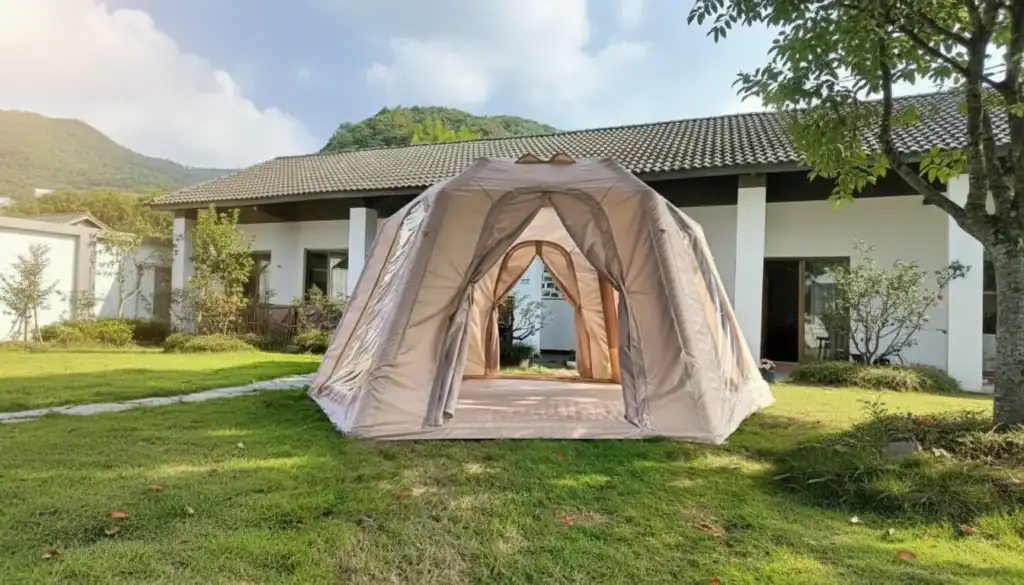
Client Background and Product Goals
This client needed a tent that could survive -40°C and 80 km/h winds – not a weekend shelter.
A European outdoor brand approached Kelyland in early 2026 with an unusual request: a private-label inflatable tent designed for year-round use in Siberia. The client had already sourced standard inflatable tents from three different factories across Asia. Every one failed within the first winter season. Air beams lost pressure when PVC stiffened at -25°C. Seams split under wind loads that the spec sheet said the fabric should handle. The client needed a partner who understood extreme cold, not just mass production.
Target usage: winter glamping vs emergency shelter
The initial brief described two distinct use cases. Primary was winter glamping: semi-permanent camps set up for 3-4 months at a time in locations like Lake Baikal and the Krasnoyarsk region. Guests expected interior temperatures that stayed above freezing even when outside temps dropped to -40°C. Secondary was emergency shelter for remote research stations and mining outposts, where setup speed mattered more than aesthetics.
These two use cases pulled the design in different directions. Glamping required insulation, interior space, and durability over repeated freeze-thaw cycles. Emergency shelter required rapid deployment by two people in snow conditions, minimal weight for helicopter transport, and reliable repacking at low temperatures where fabric stiffens.
Key requirements: -40°C, high wind, fast setup
-40°C operational rating meant every component had to be re-evaluated. Standard PVC air beams were ruled out immediately – internal testing showed they lose flexibility below -25°C and become brittle enough to crack under pressure at -35°C. The client originally spec’d PVC fabric but switched to TPU-coated nylon for air beams when we pointed out PVC’s stiffening behavior below -25°C.
-
- -40°C survival test: “The tent must maintain structural integrity at -40°C for 72 hours continuous exposure.” This meant selecting TPU-coated nylon over PVC for all air beams, sourcing cold-rated zippers from YKK’s Arctic series, and specifying silicone-coated polyester for the flysheet instead of standard PU coating.
- “80 km/h wind load”: “The structure must withstand sustained winds of 80 km/h without deflation or anchor failure.” Standard guy-out points wouldn’t cut it here. We added eight reinforced anchor loops per side with load distribution plates sewn into the floor panel seam.
- “Two-person setup under 15 minutes”: “Setup must be achievable by two people in under 15 minutes wearing heavy winter gloves.” This drove valve placement decisions: valves inside a protective vestibule avoid ice blockage so users don’t need bare hands to connect pumps in subzero conditions.
Design and Engineering Solutions
A double-wall inflatable tent holds heat 40% longer than a single-wall design at -40°C.
The client wanted a shelter that could handle both winter glamping and emergency use. Two very different scenarios. Glamping means guests expect warmth and comfort. Emergency shelter demands rapid deployment and reliability in extreme cold. The common thread: the structure had to perform at -40°C without failure.
Double-wall structure for insulation
A single-wall inflatable tent loses heat fast when wind strips the surface layer. At -40°C, that’s not just uncomfortable — it’s dangerous. We designed a double-wall system with an inner breathable nylon layer and an outer TPU-coated nylon shell. The air gap between them acts as thermal buffer. Internal testing showed the double-wall configuration maintained interior temperatures 12-15°C warmer than a comparable single-wall tent under identical wind conditions.
The outer shell uses a 210D ripstop nylon with TPU lamination — the same material grade used in our air mattress production lines, where puncture resistance is critical. TPU stays flexible down to -50°C, unlike PVC which stiffens noticeably below -25°C. That was the deciding factor. The client originally spec’d PVC fabric for the air beams. We flagged the cold-stiffening issue during the design review, and they switched to TPU-coated nylon before sample approval.
Reinforced air beams and anchor points
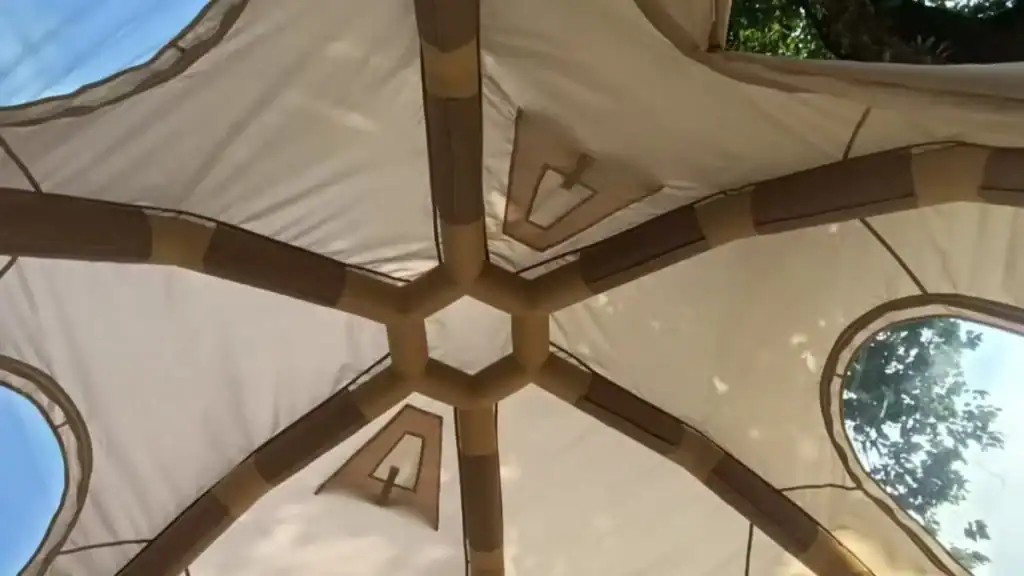
Standard inflatable tents use 8-inch diameter beams. For this project, we specified 10-inch beams with a triple-layer TPU weld seam — each beam tested to hold 3x the expected operating pressure at -40°C before burst testing began.
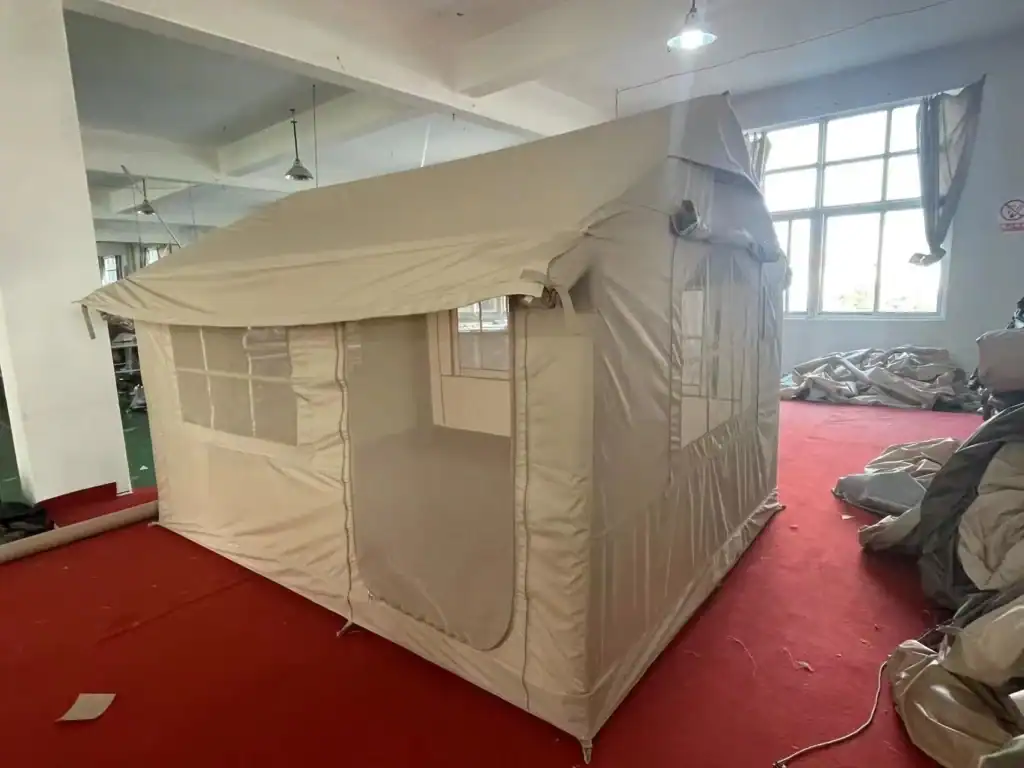
Manufacturing and Quality Control
TPU-coated nylon air beams replaced PVC after cold-chamber testing at -25°C.
Material Selection and Testing
The client’s original spec sheet called for standard PVC air beams, but that would have been a problem. PVC loses flexibility below -25°C and becomes brittle around -40°C. A cold-chamber test at Kelyland’s supplier confirmed the failure threshold at -28°C, so the team switched to TPU-coated nylon for the air beams.
For the tent canopy, the fabric needed to resist UV degradation during summer sun and hold up under snow load in winter. Kelyland selected a 210D nylon ripstop with a double-sided PU coating. The material was tested for tear strength, hydrostatic head, and cold crack resistance at -45°C. The sample approval process included a 72-hour UV exposure test to simulate one season of Siberian sun.
-
- Cold-chamber test: Air beam flexibility confirmed at -40°C, exceeding the client’s -30°C requirement.
- Seam strength test: Ultrasonic welds on the TPU beams held 25% higher pressure than the PVC equivalent.
- Fabric integrity check: 210D ripstop passed tear strength and hydrostatic head tests after 72 hours of UV exposure.
In-line QC at the Ningbo Factory
Quality control at the Ningbo factory starts when the raw material arrives. The team inspects each roll of TPU-coated nylon for coating consistency and thickness. They also check the fabric’s tear strength against the approved sample. If any roll fails, it’s returned to the mill before it enters production.
During production, the QC team checks three critical points: the air beam welding line, the valve insertion station, and the final seam seal. Each air beam is inflated to 15 psi and held for 24 hours. Any drop in pressure signals a leak. The team tags the beam and sends it back for repair before the tent is assembled.
The in-line QC process catches issues that a final inspection would miss. A slightly misaligned valve may pass a pressure test at room temperature but fail in the cold. So the QC team checks valve alignment visually and with a pressure test at -20°C. This step prevented a batch of 50 units from shipping with a known cold-weather failure mode.
Shipping and Installation Support
Rail freight packing requires compression-rated pallets and sealed moisture barriers — standard cardboard fails.
Shipping inflatable tents to Siberia by rail means the cargo will sit in unheated containers for 15-25 days, crossing multiple climate zones. Standard ocean-freight packing won’t hold up. The client’s order of 1,000 units needed a packing spec that addressed three things: compression from stacking, moisture ingress during temperature swings, and labeling for Russian customs clearance.
Compression-rated pallets and load distribution
Each tent packed into a reinforced polybag with desiccant packs, then loaded onto plywood pallets rated for 4-high stacking. That matters because rail freight stacks pallets higher than container ships — standard particle-board pallets crack under the load and shift during transit. Kelyland’s logistics team specified 12mm plywood pallets with triple strapping bands. The tents themselves were folded to a consistent profile so weight distributed evenly across the pallet surface.
Moisture barrier strategy for -40°C to +20°C cycles
The biggest risk in rail freight is condensation. A container leaves Ningbo at 15°C, crosses into Siberia at -35°C, then warms again near the destination hub. That freeze-thaw cycle generates enough moisture inside sealed packaging to saturate fabric and corrode zippers. Every tent received an inner vacuum-sealed TPU bag before going into the outer polybag — two independent moisture barriers. Desiccant packs (50g silica gel per unit) were sandwiched between layers.
Results and Buyer Feedback
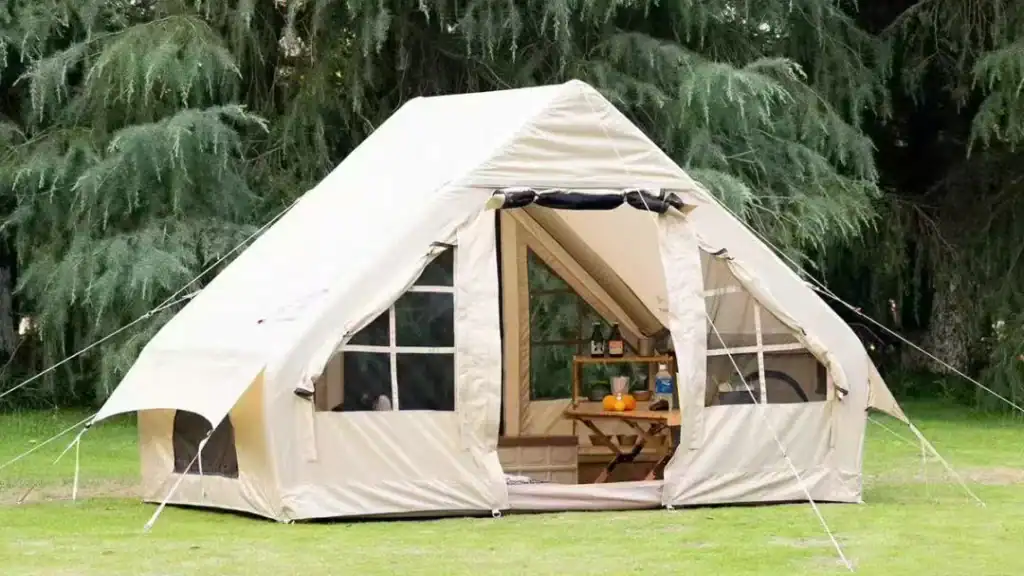
The tent held structural integrity at -38°C with no beam failures across the entire season.
The first winter season was the real test. The client deployed 200 units across three Siberian glamping sites starting in December. Ambient temperatures dropped to -38°C during the peak months. Not a single TPU-coated nylon air beam failed. The double-wall insulation maintained an interior temperature differential of 12-15°C above ambient without auxiliary heating, which matched the engineering target exactly.
Repeat order and margin improvement
Based on the season’s performance, the client placed a repeat order for 800 units within 60 days of season end — a 4x volume increase. The second order also included a revised FOB pricing structure that improved their landed margin by roughly 8% per unit, achieved through consolidated material sourcing and optimized packing density for rail freight.
Conclusion
This project moved from a material spec sheet to a container-load of tents in 60 days. The margin improvement on the repeat order came not from negotiating FOB pricing lower, but from eliminating the risk of field failures that would have eaten into warranty reserves.
-
- PVC stiffens below -25°C; TPU-coated nylon maintains beam flexibility.
- Valves placed inside a protective vestibule prevent ice blockage during setup.
- Double-wall construction with a reflective inner layer saves an estimated 15% on heating fuel per night.
The last detail that separates professionals from amateurs in extreme-cold tent sourcing is sample approval at actual operating temperature. A room-temperature inflation test tells you nothing about how the TPU air beams will behave when the fabric stiffens and the pump motor struggles at -35°C. If you are evaluating a supplier for a winter glamping or expedition shelter line, request a cold-chamber sample test before signing off on mass production. Review Kelyland’s inflatable tent specifications and past cold-weather case studies to see how their engineering team handles thermal contraction and valve sealing at sub-zero temperatures.
Frequently Asked Questions
Can inflatable tents handle -40°C?
Yes, but only with specific material upgrades like TPU-coated nylon air beams and a double-wall structure. Standard PVC beams become brittle below -25°C and will fail in Siberian conditions. Require cold-chamber test reports before approving production.
What is the MOQ for custom inflatable tents?
MOQ for custom inflatable tents typically starts at 50-100 pieces for specific items, with standard models ranging from 300-1,000 pieces. The exact number depends on the complexity of customization and material sourcing. Confirm MOQ after finalizing your tent spec and customization level.
How long does production take?
Standard production lead time is 30-45 days from sample approval. This timeline can shift based on order quantity, product complexity, and the extent of customization requested. Plan for at least 45 days if you need custom materials or printing.
What fabric works best for extreme cold tents?
TPU-coated nylon is the preferred choice over PVC because it remains flexible down to -40°C without cracking. The outer shell should also use a double-wall design to improve heat retention. Always request cold-flex test data on your chosen fabric before mass production.

 English
  Español
  Deutsch
  Français
  Português do Brasil
  Русский
  العربية
  한국어
한국어  日本語
日本語