 跳到内容
跳到内容 
A $50,000 order went sideways because the pre-production sample passed while the mass production run didn’t — and that’s when a folding wagon cost breakdown starts making sense. The approved sample had a 1.0mm steel frame and smooth-rolling wheels; the shipped units had 0.8mm tubing, plastic hub centers, and axle pins that snapped on a gravel path.
For resellers comparing cheap vs expensive folding wagon options, the first trap is reading FOB pricing as total cost. A $0 promotional wagon or a $15 FOB China quote looks attractive until returns and chargebacks arrive. Budget wagons in the $15–25 FOB range commonly add $6–10 per unit in QC failures — torn fabric, broken welds, wobbly wheels — which can push effective unit cost up by 40% before freight even enters the picture.
The other cost driver sits inside the folding mechanism. Moving from a basic flat-fold to a gather-up/compact storage design adds $8–12 in materials and assembly, but it can cut LCL shipping volume by up to 25%. The sample approval process should verify that mechanism under load, not just the printed logo — because quality tolerance on hinges and axles varies more between factories than any other component.

The Price Floor
A sub-$15 FOB quote means the supplier cut the frame, fabric, or wheels.
The cheapest folding wagon on any sourcing platform is a marketing artifact, not a product. That $0 promo unit built for a supermarket campaign has one job: look convincing in a giveaway photo. The steel tube, fabric, and wheel hubs carry a near-zero material budget. It falls apart on the first real load.
Why the $15 FOB floor exists
In 2026, the manufacturing cost reality in Zhejiang is traceable line by line: tube steel, Oxford fabric, wheel assemblies, hardware, assembly labor, packaging. A standard model built on Q195 steel at 0.8mm wall thickness with 300D single-layer Oxford can touch $12–14 FOB. That spec does not survive a full season. Move to Q235 steel at 1.0mm, 600D–900D double-layer fabric, and a reinforced axle, and the materials alone push the quote into the high teens.
-
- Frame steel: Budget builds specify Q195 steel at roughly 0.8mm wall thickness. It flexes and bends on uneven ground. The Q235 / 1.0mm upgrade is where folding wagon wholesale pricing tiers start to separate.
- Fabric: 300D Oxford with no coating tears at the crease after repeated folding. Functional resale stock uses 600D–900D double-layer Oxford with a PU or PVC coat — the same spec you verify during sample approval.
- Wheels and axles: PVC wheels with plastic hubs crack under lateral load. Larger PU or TPE tires with ball bearings and a thicker axle pin add $1–2 at the factory and remove the most common failure in cheap vs expensive folding wagon comparisons.
The hidden cost trap lands after the quote. Budget wagons in the $15–25 FOB band show up in pre-shipment inspection with broken frames, torn floor fabric, and collapsed hubs. That $6–10 per-unit rework and return cost raises the effective unit price by up to 40%. Every failure also carries a chargeback that lands on the reseller’s P&L, not the factory’s.
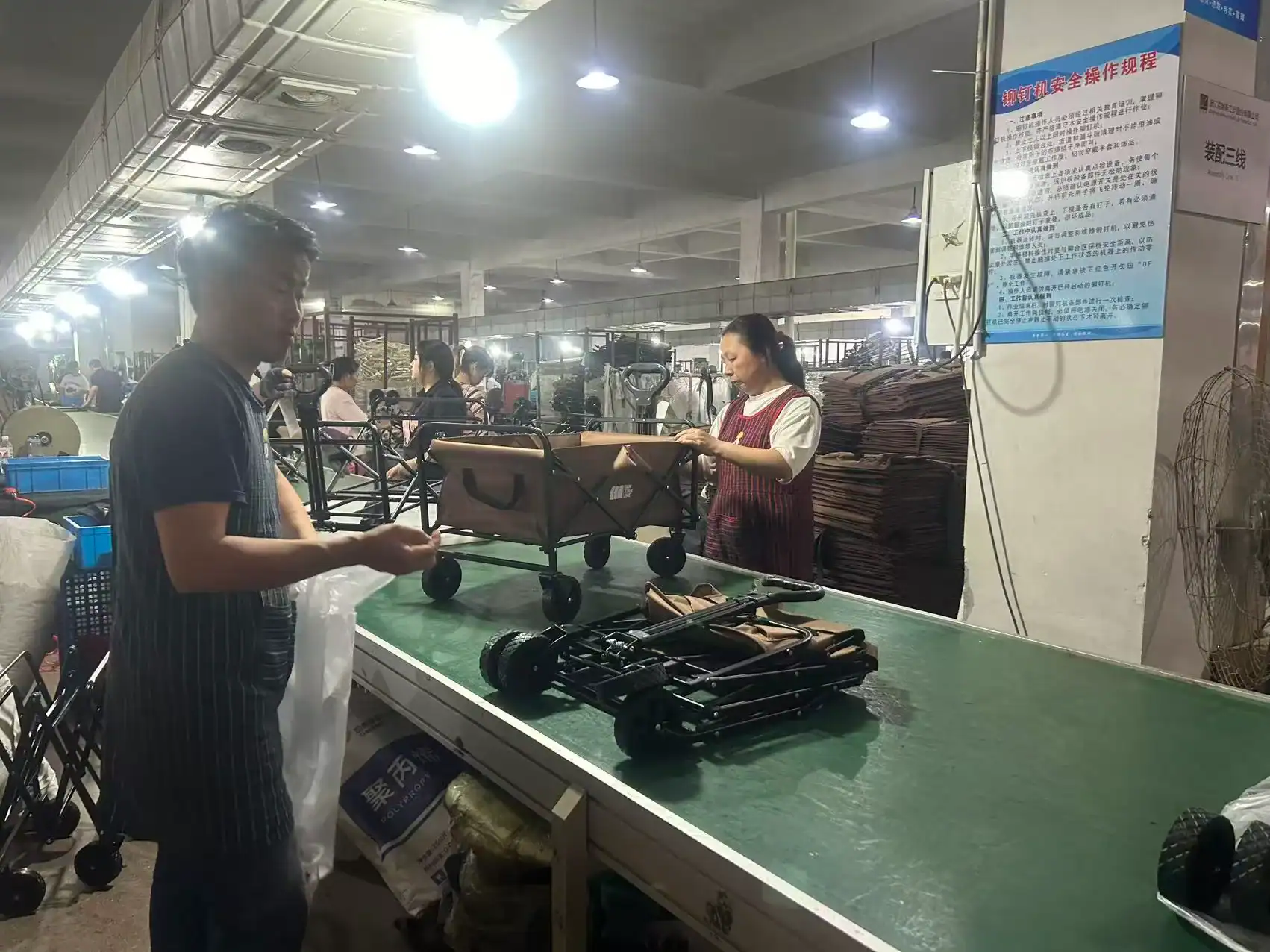
The $15 floor is not an arbitrary number. Kelyland Outdoors sources folding wagons through a Jinhua, Zhejiang factory certified to CE and ISO 9001, producing around 1,000,000 units annually. The approved build uses 600D–900D double-layer Oxford, powder-coated carbon steel or aluminum frames, and 360° rotating wheels with brakes. This is the engineering baseline that defines what a reseller-grade wagon costs. Building below it means shifting the failure point onto the customer.
The $0 promotional wagon disappears after first use because it was designed to. It is a loss leader priced to sit in a marketing budget, never in resale inventory. Treat it as a sourcing benchmark and you are building a returns desk, not a product line.
| Feature | $0 Promo Wagon | $15 Price Floor | Reseller Cost Impact |
|---|---|---|---|
| Frame Steel Grade | Q195 / 0.6mm wall | Q235 / 0.8-1.0mm wall | Thin steel snaps on gravel paths; Q235 prevents structural collapse and costly returns |
| Fabric Spec | 300D Oxford, no coating | 600D Oxford with PU coating | Uncoated fabric splits after 2-3 uses; PU-coated 600D survives repeated outdoor abuse |
| Wheel & Hub Assembly | All-plastic hub, solid PVC tire | Ball-bearing hub, PU tire | Plastic hubs crack under load; ball bearings extend wheel life and reduce warranty claims |
| Axle Pin & Hardware | Undersized axle pin, minimal rivets | Reinforced axle pins, welded joints | Axle pins bend and lock wheels; reinforced hardware is the true reliability floor |
| QC & Inspection | None / random batch check | Basic inline inspection per ISO 9001 | Without QC, hidden failures add $6-10 per unit in chargebacks and return shipping |
| Effective Unit Cost | $12-18 after QC failures | $15-18 stable and predictable | The ‘cheap’ wagon has no real price advantage once failure rates are priced in |
Hidden Cost Trap
The $15 wagon isn’t cheap once you count QC failures.
First-time resellers see a $15–25 FOB quote for a folding wagon and lock it in. The real cost shows up later: broken frames on gravel paths, fabric splitting after three trips, wheel hubs cracking in the parking lot. Each failure adds $6–10 in returns and handling. On a $20 wagon, that’s a 40% increase in effective unit cost before you spend a dollar on marketing.
Where Budget Wagons Cut Corners
-
- Frame Steel: Budget wagons commonly use Q195 steel with thin walls. Under load, the tube bends at the hinge, and a bent hinge makes the wagon unusable. Q235 steel with thicker walls holds up to repeated folding and heavier loads.
- Fabric Density: 300D Oxford without coating tears at stress points within weeks. The internal standard for a wagon meant to survive a second season is 600D–900D double-layer Oxford fabric — the difference between a $0.40 and a $0.90 per-meter material cost.
- Wheel Assembly: Small PVC wheels with plastic hub centers crack on uneven terrain. The extra $1–2 for PU wheels with ball bearings removes the most common return reason. Skipping that upgrade saves pennies but costs the entire margin when a hub shatters mid-use.
QC standards separate the $20 wagon from the $45 wagon before the container ships. The folding wagon factory in this supply network runs CE and ISO 9001 certified lines in Jinhua, Zhejiang, with mid-production stitching inspections and a pre-shipment check on frame alignment and wheel torque. That checks-and-balances layer is the $6–10 per unit most budget quotes simply omit.
Skip that layer and the failure moves downstream. The customer doesn’t complain to the factory — they file a return against your brand. A single bad batch can wipe out the margin on an entire season. The $15 wagon and the $45 wagon are not competing on price. They are competing on how many units you replace before the customer walks away.
| Hidden Cost Trap | Budget Wagon ($15-25 FOB) | Premium Wagon ($45+ FOB) | Margin Impact |
|---|---|---|---|
| QC Failure Rate | 8-12% defect rate (broken frame, torn fabric) | 1-2% defect rate with multi-stage inspection | Adds $6-10 per unit; up to 40% effective cost increase |
| Frame Material & Gauge | Q195 steel / 0.8mm wall, snaps on gravel paths | Q235 steel / 1.0mm+ or aluminum alloy | Warranty claims and replacement costs |
| Fabric Durability | 300D Oxford, no coating, splits after 3 uses | 600D-900D Oxford with PU/PVC coating | Return rate spikes in first 30 days |
| Wheel & Axle Assembly | Small PVC wheels, plastic hub, undersized axle pins | PU wheels with ball bearings, reinforced axle | Field failures trigger negative reviews |
| Shipping Volume Efficiency | Flat-fold only, bulky LCL footprint | Gather-up/compact fold cuts volume up to 25% | Lower freight cost per unit |
| Chargebacks & Brand Risk | Single bad batch wipes out seasonal margin | Reliable quality protects brand equity | Chargebacks and refunds erode net revenue |

Engineering Gap
The $8 to $12 frame upcharge cuts LCL shipping volume by up to 25%.
Basic flat-fold wagons use one pivot set and an X-frame collapse. Gather-up designs add sliding tracks, locking collars, and a second hinge group. That mechanical upgrade costs $8 to $12 more per unit before fabric or wheels change.
Flat-Fold vs. Gather-Up Frames
In Jinhua, the Kelyland partner factory has built folding wagons under CE and ISO 9001 approval since 2017. The fabric and frame materials remain 600D to 900D Oxford and powder-coated carbon steel. The moving parts are where the money goes. Sliding tracks need tighter tolerances. Locking collars add assembly minutes. Together, those minutes and tolerances make the $8 to $12 jump.
The assembly difference shows up on the line. A flat-fold frame gets its pivots welded, then the fabric slips over the frame and the wheels snap on. A gather-up frame requires rail alignment and a locking collar test at the end of the line. That test adds a few seconds per unit, but it catches the failures that create chargebacks later.
-
- Load capacity: Gather-up frames still need to hold the same 50 to 200 kg rating as flat-fold frames. The locking mechanism carries the load, so the steel grade or aluminum wall thickness cannot drop even though the collapsed size shrinks.
- Tolerance risk: A factory that saves money on the sliding track wall thickness will see early failures at the locking collar. Ask for caliper verification photos of the rail profile before mass production. Pre-shipment inspection should cover lock snap force on every batch.
- Transit damage: Gather-up frames tuck the moving hardware inside the fabric pocket. Flat-fold frames leave exposed tube ends that bend during LCL loading. The gather-up design cuts damage claims and replacement freight.
Shipping Volume Impact
LCL freight is billed by cubic volume, not by weight. A gather-up wagon collapses into a shorter, tighter package than a flat-fold. That reduces the shipping volume per unit by up to 25%. For a container that mixes folding tables, chairs, and wagons, the space saving can offset a significant share of the mechanism upcharge.
On a 500-unit order, the $8 to $12 upcharge equals $4,000 to $6,000. A 25% shipping volume cut trims the freight line by one quarter. The same cube saving shows up later in warehouse density. A flat-fold wagon order of the same quantity takes more pallet spaces. Buyers should compare freight and storage savings against the mechanism cost for their specific lane.
Why Most “Cheap” Wagons Fail: The Hidden Risks
The cheapest wagon you can import is often the most expensive one you can sell.
First-time resellers chase the $9 wagon on Alibaba. They also snap up pallets from Amazon liquidation sales. The unit cost looks unbeatable. Then the steel tube bends on a gravel path. Or the fabric splits after three trips to the beach. That is where the cheap price ends.
For a private label, the invoice is only the opening number. Return shipping, refunds, and chargebacks stack up fast. A single bad batch can consume an entire season’s margin. Chargebacks turn a healthy margin into a loss.
What breaks first in a sub-$15 wagon
-
- Frame steel: Budget wagons often spec Q195 steel. This low-cost carbon grade has lower yield strength than Q235. Pair it with a 0.8mm wall thickness and the frame bends under a normal family load. A bent frame ends the wagon.
- Powder coating: The coating on a cheap wagon is thin. It chips when the wagon hits a curb. Exposed steel rusts. Rusted joints stick, then snap.
- Axle pins: Undersized pins shear on uneven terrain. When the wheel folds under, the customer photographs it, posts it, and asks for a refund.
The folding wagon line Kelyland works with in Jinhua uses 600D to 900D double-layer Oxford fabric and powder-coated carbon steel frames. The factory holds ISO 9001:2015 and runs inspections at every production stage. Those checks add cost at the factory. They remove cost from your return rate.
How a low quote becomes a high loss
Between the $15 FOB price and a stockable wagon sits the failure rate. A weak wagon often adds $6 to $10 per unit in returns and replacement work. That lifts the effective unit cost by up to 40%. At that point, the premium wagon is the cheap one.
To hit a $15 FOB number, a factory skips the second layer of Oxford, drops the steel wall thickness, and uses a thinner powder coat. Ask for the exact steel grade, wall thickness, and coating spec. A supplier with a real QC process will answer. A supplier selling on price alone will deflect.

Real Cost Breakdown of Folding Wagons in 2026
Steel grade, fabric denier, wheel hub, and fold geometry quietly create a $30 landed-cost gap.
The gap between a $15 FOB wagon and a $45 FOB wagon is rarely the logo. It is a chain of specifications: tube steel grade, wall thickness, fabric denier and coating, wheel hub and axle connection, folding geometry, hardware finish, and the QC tolerance behind each batch. A supplier quoting one number without breaking these out is asking you to buy blind.
Seven layers inside a folding wagon quote
-
- Frame material and wall thickness: Budget builds spec Q195 at 0.8mm; mid-range jumps to Q235 at 1.0mm; premium uses aluminum or thick-walled steel. Under 1.0mm, a steel wagon folds under load.
- Fabric denier and coating: The entry tier uses 300D Oxford with no coating. Mid-range uses 600D with PU; the heavy tier uses 900D double-layer Oxford with PVC.
- Wheel assembly and axle connection: Small PVC wheels with plastic hub centers fail on gravel. Larger PU wheels with ball bearings and foot brakes survive; a reinforced axle pin adds roughly $1-2 per unit.
- Hardware finish quality: Zinc-plated hardware, consistent welds, and rivets that seat flush cost more in labor but prevent callbacks.
- Folding mechanism: Flat-fold is cheaper to assemble. Gather-up frames use more linkages and labor, adding $8-12 FOB per wagon.
- LCL freight volume: Gather-up boxes pack smaller, cutting shipping volume by up to 25%. Heavier budget steel adds freight weight instead.
- Customs brokerage and handling: LCL consolidation, customs brokerage, and port fees add a hidden per-unit expense that never appears on the factory quote.
Most buyers compare FOB prices as if steel and fabric were commodities. They are not. Two quotes can both say 600D Oxford and Q235 steel, but one uses a thinner coating and a lower wall thickness at the low end of the tolerance. Loose quality tolerance becomes your problem when the frame kinks in the field.
That is why the sample approval step matters. A pre-production sample confirms the frame grade, wheel hub, and fabric construction before money moves into mass production. A mid-production inspection catches the drift between sample and batch. Skip either, and a wagon that saves $10 at the factory can cost $6-10 more in QC failures, returns, and freight exceptions — pushing effective unit cost up by 40% before it reaches a warehouse.
A sourcing partner who wants a long-term reseller relationship gives you a component-level quote. In the Kelyland network, the folding wagon factory in Jinhua, Zhejiang runs a million units a year under CE and ISO 9001. Its standard specification starts with 600D-900D double-layer Oxford, powder-coated carbon steel or aluminum frames, rotating wheels with foot brakes, and detachable components. That floor removes the $15 failure tier before you ever compare prices.
| Cost Component | Budget Tier ($15 FOB) | Mid-Range Tier ($30 FOB) | Premium Tier ($45+ FOB) | Margin Risk / Insight |
|---|---|---|---|---|
| Frame Material | Q195 steel / 0.8mm wall | Q235 steel / 1.0mm wall | Aluminum alloy or 1.2mm Q235 steel | Cheap vs expensive folding wagon: thin tubes bend permanently on curbs, causing up to 8% structural returns. |
| Fabric & Coating | 300D Oxford / no coating | 600D Oxford / PU coat | 900D Oxford double-layer / PVC backing | Uncoated fabric tears after ~15 uses; warranty replacements add $8-12 per unit to folding wagon manufacturing cost. |
| Wheel Assembly | Small PVC wheels / plastic hub | Larger PU wheels / ball bearings | 360° PU/TPE wheels / foot brakes | Plastic hub fracture on gravel costs $4-6 per wheel; upgrading axle thickness is only +$1-2 at factory. |
| Folding Mechanism | Basic flat-fold | Flat-fold with locking braces | Gather-up / compact storage | Gather-up adds +$8-12 between folding wagon wholesale pricing tiers and shifts b2b folding wagon price analysis — while cutting LCL volume by 25%. |
| Hardware & Finish | Standard rivets / thin powder coat | Reinforced rivets / powder-coated frame | CNC-machined joints / anodized finish | Rust within 3-6 months triggers $20-30 per unit retailer chargebacks — a hidden cost of folding wagon import. |
| Quality Control | Visual inspection only | Inline checks / sample load testing | ISO 9001:2015 certified / pre-shipment inspection | QC failures add $6-10/unit — up to 40% margin erosion — the biggest swing factor in reseller folding wagon china price. |
| Freight & Logistics | Heavy / bulky dimensional weight | Balanced volume-to-weight ratio | Compact fold / 25% less LCL volume | Budget wagons cost $4-7 more per unit in freight; heavy duty folding wagon bulk cost must include customs and warehousing. |
Conclusion
Choosing a folding wagon on the FOB line item alone is how resellers erase a season’s margin. A $16 budget wagon that fails in testing becomes a $24 unit after return shipping, restocking, and chargebacks. Skip the spec review and that math repeats with every batch.
-
- The price floor for a resellable wagon is $15 FOB; below that, frame and fabric quality collapse.
- QC failures on sub-$25 wagons add $6–10 per unit, raising effective cost by up to 40%.
- Gather-up folding adds $8–12 per unit but cuts LCL shipping volume by up to 25%.
- A 500-unit budget order can cost $4,000+ in hidden replacements within one season.
Before you commit to your next container, compare supplier quotes against the specs that actually drive durability: frame steel grade, wall thickness, fabric denier, and wheel hub construction. Request a material spec sheet and a pre-shipment inspection report before signing off. To see how the folding wagon category stacks up across those specs, review the product range at Kelyland Outdoors.
Frequently Asked Questions
What is the real minimum cost for a folding wagon?
A durable folding wagon for retail resale can’t be sourced under $15 FOB China for standard models. Anything below that usually means the supplier cut frame, fabric, or wheel quality to. Use $15 FOB as your floor and verify materials before ordering.
Why are $15 folding wagons risky for resellers?
Sub-$15 wagons fail QC because budget suppliers cut frame or fabric quality. Those failures can add $6–10 per unit in returns and chargebacks, effectively raising your cost by up to 40%. Budget for QC checks before locking in a cheap quote.
How much does compact folding add to cost?
Upgrading from flat-fold to gather-up or compact storage adds roughly $8–12 per unit in materials and assembly. It can cut LCL shipping volume by up to 25%, so the higher unit cost is often offset. Compare landed cost, not just FOB price.
Besides the FOB price, resellers should include QC failures, returns, shipping volume, and customization setup costs. A $15 wagon can become a $21 unit once failure-related costs are loaded. Price your landed cost after all failure buffers.

 English
  Español
  Deutsch
  Français
  Português do Brasil
  Русский
  العربية
  한국어
한국어  日本語
日本語