 跳到内容
跳到内容 
“The sample approval went through, but the mass production run fails my load test. Shouldn’t this have been caught?” — “Your folding wagon specifications list didn’t state whether the load rating was static or dynamic. That’s the gap.” A $50,000 order ended up in dispute because the buyer assumed the factory would fill in the unspoken details.
The factory quotes to the spec sheet, not to your intent. When the sheet omits the nuances — wheel track width, tube wall thickness, quality tolerance limits — the production line makes its own decisions. Those decisions surface after the FOB pricing is locked, and you’re negotiating from a weak position.
The fix is to treat the RFQ as the quality document it is. A complete folding wagon specifications list forces the factory to price the same wagon you will later approve in pre-production. The twelve points below exist to close those gaps before you pay a deposit.

Why Sending an Incomplete Spec Sheet Delays Your Quote
A vague RFQ always carries a risk premium.
Price quotes are only as accurate as the spec sheet behind them. When a factory receives a request for a “150 kg camping wagon” with no other details, the person quoting has to guess at frame tube wall thickness, fabric denier, wheel size, baseboard material, and fold type. Every guess gets padded with a safety margin. That padding becomes the price.
What a Factory Needs to Quote Accurately
A complete folding wagon specifications list for importers includes load capacity, interior volume, folded dimensions, frame material, fabric weight, wheel diameter, and packaging. Add the target retail price and required compliance certifications, and the supplier can engineer to the margin instead of hedging against unknowns.
-
- Load capacity and wheel spec: Static and dynamic load ratings are not interchangeable. Dynamic load is typically 30-50% lower than static load. If the marketing claim is 150 kg, write “150 kg dynamic” or the factory will design a heavier, more expensive frame than needed.
- Wheel track width: Track width determines whether the wagon fits through standard gates and how stable it feels on slopes. A 2 cm change can eliminate an entire wheel mold and save $0.50-$1.50 per unit.
- Material grades: Frame steel grade and tube wall thickness, 600D vs 900D Oxford fabric, baseboard material (PP, MDF, or aluminum), and tire compound all shift the cost structure. Without these, the quote is a guess with a risk premium.
How Ambiguous Specs Inflate Your Price
When specs are vague, factories cannot compete on efficiency. They compete on worst-case assumptions. One supplier quotes using 900D Oxford and a heavier frame; another uses 600D fabric and a lighter tube. Both think they met the brief. The higher quote looks inflated until the cheaper sample fails the load test.
The other inflation driver is a missing retail price target. A factory that does not know whether the wagon will sit at an entry-level price point or a premium one will over-engineer components to avoid rejected samples. This is where a sourcing partner with a network of 17 core factories and ISO 9001-certified production earns its role: aligning material selection, packaging, and logistics so the custom folding wagon quote requirements match the commercial target.
The fix is not harder work from the factory. It is a written spec sheet with numbers. When tube wall thickness, fabric denier, wheel diameter, and load rating are on the page, the quote cycle stays short and the price reflects the actual product. Leave them blank, and the cost of clarity comes back as a higher quote.

The 12 Folding Wagon Specifications Every Buyer Must Provide
Dynamic load ratings run 30-50% lower than static.
A folding wagon quote depends on whether you specify the load as static or moving. The dynamic rating on the same frame runs 30-50% lower. If your product page says 150 kg, write “dynamic 150 kg” in the RFQ. Otherwise the factory will design a heavier frame to protect its warranty, and your margin disappears.
Structural Specs That Set the Base Cost
-
-
- Intended load capacity: Give both display rating and structural test weight. A 150 kg static rating is cheaper to build than a 150 kg dynamic rating. Confirm in kg or lbs so the factory can spec tube wall and wheel bearings accordingly.
- Volume and interior dimensions: State usable interior length x width x depth in cm, plus volume in liters. A 90L wagon and a 200L wagon need different panels, baseboards, and cross-bracing. Miss this and the quoted unit price has no anchor.
- Folded size and fold type: Flat fold produces a thin stack; gathered fold compresses smaller in one dimension but is harder to re-pack. Choose the fold type based on how customers store it and what carton size your retail shelf accepts.
- Frame material and tube wall thickness: Powder-coated carbon steel is the most common frame for 50-200 kg wagons; aluminum is lighter and costs more. Specify tube diameter and wall thickness in mm. Set a quality tolerance on weld joints and powder-coating adhesion before production.
-
Materials That Affect Durability and Returns
-
-
- Fabric, denier, and coating: Most wagon bodies use 600D-900D double-layer Oxford fabric. Lower denier works for flat beach use; higher denier handles multi-terrain loads. State whether you need PVC or PU water-resistant coating and whether stitching needs reinforcement at stress points.
- Wheel size, tire material, brake, and track width: List wheel diameter, tire compound (PVC, PU, EVA, TPE), and foot brake requirement. Add wheel track width: a 2 cm change can eliminate a whole wheel mold and save $0.50-$1.50 per unit, while still fitting standard gate widths.
- Handle length and locking mechanism: Specify extended and collapsed handle length, plus the lock style: button, twist, or spring pin. The handle system determines pull comfort and is a common source of retail returns when it collapses under load.
- Baseboard material: PP boards are low-cost and flexible; MDF is rigid but heavier; aluminum is lighter and more premium. Match the base to the terrain you advertise. A wagon marketed for tailgating and one marketed for beach use should not have the same baseboard.
-
Commercial and Compliance Details
-
- Custom branding and logo placement: Identify which components carry branding: side fabric, wheel caps, handle grip, or carry bag. Fabric dyeing, printing, custom injection molding for plastic parts, and custom frame powder coating each have separate tooling costs and lead times.
- Packaging and retail display: Share carton size, whether you need retail-ready packaging, hang tags, or instruction sheets. Packed size drives ocean freight. A display carton that fits your planogram is different from a plain brown box for online orders.
- Target retail price and market region: State the target retail price and, if possible, an FOB range. That lets the factory spec to your margin instead of adding safety factors you didn’t ask for. Vague requests like “cheaper than the competitor” always carry a higher risk premium.
- Compliance and testing certifications: The folding wagon production line in Jinhua holds CE and ISO 9001 certifications. If your market requires additional testing, list it at RFQ stage. Stipulate sample approval and third-party test reports before mass production, and account for the standard 30-45-day lead time.
| Feature | Specification | Why It Matters |
|---|---|---|
| Intended Load Capacity | Specify dynamic rating in kg/lbs (e.g., 150 kg dynamic); dynamic is 30-50% lower than static | Prevents an over-engineered, heavier frame and reduces material cost |
| Wagon Volume & Interior Dimensions | Provide interior L x W x H and target volume (industry range: 90L to 200L+) | Determines packing capacity, carton size, and your retail dimension claims |
| Folded Size & Fold Type | Flat fold vs gathered fold; specify collapsed L x W x H | Affects shelf footprint, shelf-ready packaging, and shipping container utilization |
| Frame Material & Tube Wall Thickness | Powder-coated carbon steel or 6061 aluminum; steel tube 0.6-1.2mm wall | Balances frame weight, load stability, and cost per unit |
| Fabric Material, Denier & Coating | 600D-900D double-layer Oxford with PU coating; specify color and dyeing | Drives tear strength, water resistance, and perceived quality at retail |
| Wheel Size, Tire Material & Brakes | 7-10″ 360° rotating wheels; PVC, PU, EVA, or TPE tires; foot brakes; include wheel track width | A 2cm track width change can eliminate a wheel mold and save $0.50-$1.50 per unit |
| Handle Length & Locking Mechanism | Telescopic handle length; push-button, snap-lock, or twist-lock mechanism | Improves towing ergonomics and determines collapsed handle clearance |
| Baseboard Material | PP, MDF, or aluminum baseboard; specify load-bearing requirement | PP is lightweight and waterproof; MDF is rigid but heavier; aluminum is premium |
| Custom Branding & Logo Placement | Fabric printing, frame powder coating, custom injection-molded plastic parts, labels | Defines tooling cost, MOQ flexibility, and brand consistency across your line |
| Packaging Type & Retail Display Needs | Single-color box vs display box; polybag, carton, or shelf-ready packaging | Impacts landed cost, shelf appeal, and whether the product fits your retail planogram |
| Target Retail Price & Market Region | State target FOB price, seasonal launch window, and destination market | Enables the factory to spec to your margin instead of over-engineering the design |
| Compliance & Testing Certifications | CE, ISO 9001:2015, CPSIA, REACH, Prop 65, ASTM; specify required reports | Avoids customs delays and protects channel access for your target region |

How to Package Specifications in a Simple RFQ Sheet
A supplier’s quoting team triages RFQs by how easy they are to read. A one-paragraph email with scattered measurements gets deprioritized. A structured spec sheet gets answered first, because it lets the factory spot-check feasibility within minutes.
Use a Table Format for Every Spec
Put every specification on its own row. Include the unit. Don’t make the supplier convert inches to centimeters or guess whether ‘load’ means static or dynamic. The factories we work with—including the folding wagon facility in Jinhua that produces 1,000,000 units a year—use ISO 9001:2015 checkpoints, so clear specs directly support their inspection process.
-
- Product type/model: Single-fold, multi-fold, extended, or a reference SKU.
- Load capacity: List static and dynamic ratings separately in kg/lbs.
- Interior dimensions: Volume in liters plus unfolded LxWxH.
- Folded size: Flat-fold or gathered-fold dimensions.
- Wheel specs: Diameter, tire material, track width, brake type.
- Frame: Carbon steel or aluminum, tube wall thickness, surface finish.
- Fabric: Denier, material (Oxford/nylon), coating.
- Baseboard: PP, MDF, or aluminum.
- Branding: Logo placement, printing method, label requirements.
- Target price: FOB or EXW target per unit.
- Certifications: CE, ISO 9001, or market-specific compliance.
Tell Them What You’re Willing to Sell It For
Every buyer wants a lower price. But saying ‘make it cheap’ forces the factory to guess which qualities to sacrifice. Give a target retail price instead. That lets the sourcing engineer work backward to the right frame gauge, fabric denier, and wheel diameter. A buyer who hides the target price usually gets an over-engineered quote.
Don’t Forget the Wheel Track Width
The width between the wheels determines whether the wagon fits through a standard door or gate. Most buyers omit it. A 2 cm change can eliminate a whole wheel mold and save $0.50-$1.50 per unit. If you skip it, the factory will choose a default track width that may not match your market’s clearance expectations.
Two more specs that matter: dynamic vs static load rating. If you plan to advertise 150 kg, write ‘150 kg dynamic load’ on the RFQ. Static load ratings are typically 30-50% higher than dynamic. If you only say 150 kg, the factory designs for static—and you’ll get a heavier, pricier frame than your margin can absorb.
Finally, include the order quantity and target lead time. A folding wagon MOQ from a Chinese factory can start at 50-100 pieces for some custom parts, with standard production lead time of 30-45 days. That information lets the supplier quote accurately and reserve machine capacity, which is what actually speeds up your sample approval.
| RFQ Field | Example Entry | Why It Matters |
|---|---|---|
| Load Capacity | 150 kg dynamic, not static | Prevents over-engineered frames and aligns with advertised claims |
| Wheel Track Width | 52 cm outside-to-outside | Ensures gate compatibility and stability; can unlock mold savings of $0.50-$1.50 per unit |
| Folded Size & Fold Type | Flat fold, 25 x 30 x 70 cm | Confirms carton efficiency and retail shelf display fit |
| Fabric & Frame Specs | 600D Oxford, 0.8mm steel tube | Sets durability expectations and avoids vague supplier substitutions |
| Target Retail Price & Market | $79.99 US retail, Amazon | Lets the factory spec to your margin instead of over-building |
| Certifications Needed | CE, ISO 9001, Prop 65 | Avoids surprise compliance costs and customs delays |
| Branding & Packaging | 2-color logo, retail-ready box | Streamlines sample approval and keeps retail display costs visible |

What Happens After You Send Specs
A vague spec sheet doesn’t get you a faster quote.
Your spec sheet doesn’t disappear into a black box. It triggers a review against the supplier’s real production capacity. The team checks whether your requested materials, dimensions, and features match an existing assembly line or require dedicated tooling. That distinction is where quotes start to diverge.
The supplier’s review process
-
-
- Factory network fit: Requests get routed through 17 core strategic factories and 200+ manufacturing partners, most certified to ISO 9001:2015. The review starts with process capability, not just unit cost.
- Material availability: Fabric, frame tubing, wheels, and brake components need to be in stock or reachable inside the lead time. An uncommon denier or coating gets flagged before pricing.
- Ambiguity detection: Missing specs like wheel track width or dynamic vs static load rating trigger a clarification email. A 2 cm change can eliminate a whole wheel mold and shift unit cost by $0.50–$1.50.
-
Clarifications aren’t a sign of a slow supplier. They’re the filter that separates factories that ship from factories that quote. If you want faster answers, include the target retail price. Saying ‘same as competitor but cheaper’ adds a risk premium; giving a price lets the factory spec to your margin instead of over-engineering.
Quote generation and lead time
Once the review closes, you get a quote with a production timeline. Standard lead time here is 30–45 days, but that window moves with order timing, product complexity, quantity, and customization level. A fabric-only recolour of an existing frame moves faster than a fully custom wagon with new injection-molded parts.
-
- Order quantity: MOQ for some products starts at 50–100 pieces; standard models range from 300–1,000. Smaller batches sometimes slide into open production slots.
- Customization depth: Fabric dyeing, custom molding, and packaging design add days. Budget for at least one sample approval round before mass production.
- Sample policy: Paid samples are standard, with fees potentially refundable on bulk confirmation. Low-cost samples may ship free if you cover freight.
A quote that arrives in 24 hours with no questions asked should worry you. Real quotes take time because someone is checking materials, tooling, and line capacity. The supplier that asks sharp questions now is the one that meets your dock date later.
Common Specification Mistakes and Their Cost Impact
A 2 cm wheel-track change can save $0.50–$1.50 per unit.
Spec sheets that win quotes are not the ones with the most details. They are the ones that stop the factory from guessing. Two mistakes cost buyers more than any other: undersizing the packed wagon and quoting the wrong load rating.
Underestimating Packed Size
The unfolded wagon is what sells on the shop floor. The folded wagon is what ships, and that number drives your carton size, container count, and freight per unit. A wagon that packs 5 cm longer or wider in one dimension changes how many units fit in a 40HQ container. Give the factory the packed size before you ask for FOB pricing, or every quote that comes back is built on a guess.
The most omitted spec in custom folding wagon RFQs is wheel track width — the distance between the outside edges of the wheels. Track width decides whether the wagon fits standard gates and how stable it feels on slopes. A 2 cm change can eliminate a whole wheel mold and save $0.50–$1.50 per unit. Leave it blank and the factory uses the mold they already have, folding that tooling cost into your unit price.
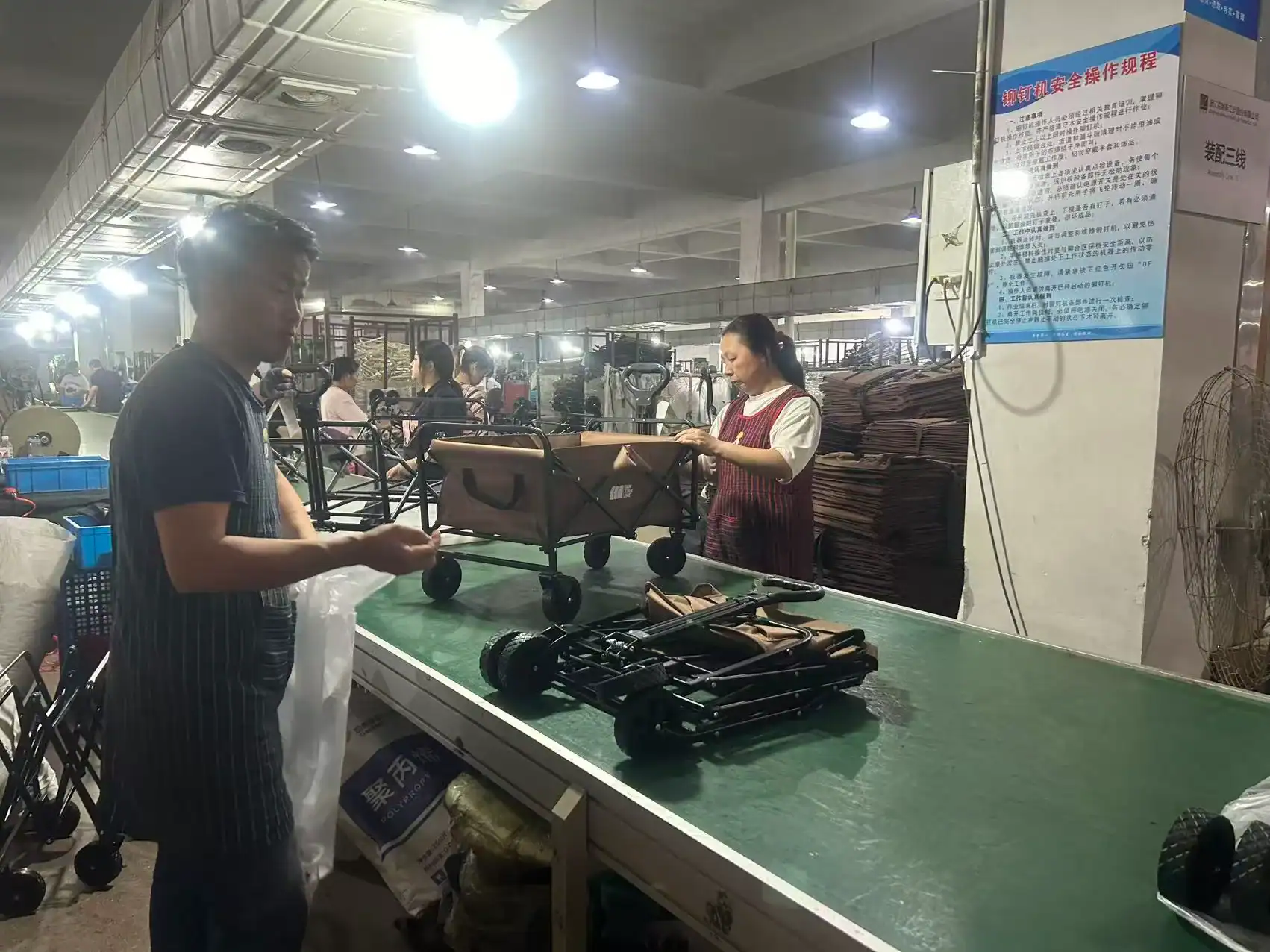
Kelyland’s folding wagon factory in Jinhua, Zhejiang, has run CE and ISO 9001 certified lines since 2017, producing one million units a year. That volume means the factory has dedicated molds for standard track widths. Deviating from them triggers new tooling, and that cost lands in your quote.
Mixing Static vs Dynamic Load Ratings
Static load is the weight a wagon holds when parked. Dynamic load is the weight it carries while being pushed over grass, gravel, or curbs. Dynamic is 30–50% lower. Put 150 kg on the spec without the word “dynamic” and the factory makes its own call. Some will quote a lighter frame designed for static loads — that fails in the field. Others will over-engineer for dynamic and price you out of the market. During sample approval, ask for the dynamic test result, not just the static label.
If the plan is to advertise 150 kg, write “150 kg dynamic” on the spec sheet. The load range on Kelyland’s standard carts runs from 50 kg up to 200 kg, with heavy-duty models above that. A clear rating lets the factory match frame material and tube wall thickness to actual use instead of padding the price.
-
- Static-only spec: Buyers who skip the word “dynamic” get a lighter frame and field failures, or a heavier frame and a price that kills margin.
- Packed size gap: A fold dimension that is off by 5 cm changes carton size, container count, and freight cost per unit for the whole season.
| Mistake | Impact | Cost Impact | How to Avoid |
|---|---|---|---|
| Underestimating Packed Size | Carton dimensions exceed shipping carrier limits or require oversized freight classification | $0.80–$2.50 per unit in unexpected freight surcharges; delays at consolidation | Provide folded dimensions and confirmed carton size in the RFQ; ask factory for a packing diagram before quoting |
| Mixing Static vs Dynamic Load Ratings | Factory over-engineers the frame for static 150 kg when you only need 80 kg dynamic, raising weight and material cost | $2.00–$4.00 per unit higher; slower production due to heavier steel sourcing | State dynamic load (moving with cargo) explicitly; dynamic ratings are typically 30–50% lower than static |
| Omitting Wheel Track Width | Wagon may not fit through standard 80 cm gate widths; wobbly feel on slopes; factory uses default mold that may not match your market | 2 cm track change can eliminate a wheel mold and save $0.50–$1.50 per unit; retrofitting after sampling adds 2–3 weeks | Specify wheel track width in cm, not just overall width; confirm gate clearance for your target retail market |
| Vague ‘Same as Competitor but Cheaper’ Requests | Factory prices in a risk premium because it must reverse-engineer specs and guess quality expectations | 3–8% higher quote vs. a clear spec sheet; more quote-revision cycles and missed seasonal deadlines | Provide your own spec targets; if benchmarking, name the model and desired deviations clearly |
| Leaving Fabric Denier and Coating Unspecified | Factory defaults to lower-denier fabric to hit a price point; fabric tears or UV-fades in the field and drives returns | Warranty claims of $1.00–$2.00 per unit; brand reputation damage exceeding replacement cost | State fabric type, denier (e.g., 600D or 900D Oxford), and coating (PU, PVC, or none) in the folding wagon spec sheet |
| Skipping Compliance Certifications in the RFQ | Factory sources standard components that fail your market’s testing (e.g., CE, ASTM, CPSIA), forcing rework or air freight | $0.50–$1.20 per unit for re-testing; 2–4 week delay; customs holds can add 5–10% in penalty costs | List required folding wagon compliance certifications up front; confirm which certificates the factory already holds (e.g., CE, ISO 9001) |
| Not Stating Target Retail Price and Market Region | Factory over-engineers to a premium spec or under-specs for a discount channel; either way the margin is wrong | Over-spec adds $3.00–$5.00 per unit; under-spec adds rework and returns; both extend lead time | Share your target landed cost and retail price band so the factory can engineer to your margin |
| Ignoring Fold Type: Flat vs Gathered | Flat-fold wagons need larger cartons and different handle geometry; changing after sample approval invalidates the quote | $0.30–$0.80 per unit packaging cost swing; re-tooling for a new fold mechanism adds 10–15 days | Specify single-fold, multi-fold, or gathered-fold with folded dimensions in your RFQ |
| Under-Specifying Wheel and Brake Requirements | Factory quotes basic PVC wheels; you need PU or EVA tires with brakes for slippery retail parking lots | Wheel upgrade after quote adds $1.50–$2.50 per unit; brake retrofit is rarely possible without redesign | State wheel diameter, tire material (PVC/PU/EVA/TPE), 360° rotation needs, and brake type in the folding wagon specifications list |
| Omitting Baseboard Material Preference | Factory chooses MDF for cost; you need PP for moisture resistance or aluminum for lightweight portability | PP vs MDF can shift cost $0.40–$1.00 per unit; aluminum adds $2.00+; material change after sampling voids the original quote | Specify baseboard material (PP, MDF, or aluminum) and confirm it supports your load capacity target |
Conclusion
Twelve specifications sound like homework; in practice, they shorten the quoting cycle and cut the back-and-forth. Most buyers stop at fabric denier, wheel size, and load capacity — then wonder why the factory over-engineers the frame or misses the retail price point. The last 10% comes down to three numbers most buyers skip: dynamic load rating, wheel track width, and target retail price.
-
- Advertise 150 kg dynamic, not static, or the factory quotes a heavier frame than you can sell.
- A 2 cm change in wheel track width can eliminate a mold and save $0.50-$1.50 per unit.
- Give the target retail price so the factory specs to margin instead of over-engineering.
- Standard lead time from Chinese factories is 30-45 days; confirm it and sample policy before ordering.
Before you send the next request, drop these 12 fields into a one-page RFQ sheet and compare how each supplier responds. Their questions on dynamic load and track width tell you who actually builds wagons rather than resells them. Review the folding wagon production page to see how these specifications carry through a real manufacturing run, then tighten your spec sheet before the quoting round.
Frequently Asked Questions
What specs should I send for a folding wagon quote?
Send the 12-item list covering load capacity, volume, folded size, frame, fabric, wheels, handle, baseboard, branding, packaging, target price, and certifications. Start with the mechanical specs, because those drive tooling, material. Build your RFQ sheet before requesting pricing to get comparable quotes.
Why is my folding wagon quote higher than expected?
A vague RFQ carries a risk premium, so factories quote higher to cover unknown testing, materials, or compliance work. The fastest way to lower that quote is to state static versus. Remove ambiguity in your spec sheet to reduce the risk premium.
What is static versus dynamic load on a wagon?
Static load is the capacity when parked, while dynamic load is what it can safely carry while moving and is typically 30-50% lower. If you do not label the rating. Always mark the load rating as static or dynamic on your RFQ.
What frame material should I choose for a folding wagon?
Powder-coated carbon steel is the common choice for heavy-duty wagons, while aluminum keeps the wagon lighter at a higher cost. Tube wall thickness matters more than the frame name alone, so include it. Confirm tube wall thickness before approving the frame quote.
What is the MOQ for OEM folding wagons?
MOQ for standard folding wagons typically runs 300-1,000 pieces, though some stock or simple programs can start at 50-100 pieces. Custom frames or molded parts will push you toward the higher MOQ. Finalize your custom requirements before asking for a firm MOQ.

 English
  Español
  Deutsch
  Français
  Português do Brasil
  Русский
  العربية
  한국어
한국어  日本語
日本語