 跳到内容
跳到内容 
Most retail buyers learn about smart tent price tiers the hard way. The spec sheet promises integrated LED lighting and a solar panel, but what lands at the distribution center performs like a $15 power bank taped to a polyester dome. A Category Manager ordered 800 units of a mid-tier model two seasons ago. The pre-production sample passed inspection.
The gap between a $19 and a $45 OEM unit cost isn’t just about how many features you pack into the spec. It’s about which components actually survive a full season of consumer use, and which ones trigger a wave of returns in week three. Electronic failures in smart tents follow a predictable pattern, and the root cause almost always traces back to a single sourcing decision made six months before the tent ever hits a shelf.
Breaking down the three dominant feature tiers — basic LED, mid-range solar-auto, and premium IoT climate control — changes how a buyer allocates budget. A basic tent with a power bank costs roughly $18–22 per unit at OEM volumes. The mid-tier, adding a solar panel and auto-inflate mechanism, pushes unit cost to $30–48, depending on pump quality and panel wattage. Premium models with app-controlled climate systems and lithium battery packs start at $65 and can exceed $120 at the factory gate. These aren’t incremental differences. A bad call on FOB pricing at the mid-tier level can lock in a retail price point that leaves zero room for promotional markdowns.
The buyers who win in this category treat the tech as a cost bucket that sits inside a larger bill of materials. Fabric coating selection and frame material choices don’t just affect tent weight — they shift the quality tolerance window that the electronics have to survive. Swap a standard PU coating for a blackout coating, and the internal ambient temperature drops by several degrees. That changes how hard the ventilation fan has to work, which changes battery drain rates, which changes the customer’s two-star review on Amazon. Every feature tier hangs together as a system, not a checklist.

Basic Tier: LED Light + Simple Power Bank
Basic smart tents add ~$3–8 to BOM cost, but retailers often mark up $20–30.
The entry-level “smart” tent isn’t about automation. It’s about visibility and phone charging. Typically, this tier integrates a simple SMD or COB LED strip along the ridge and a 2,000–5,000mAh pouch-style power bank in a sewn-in pocket. For a retail category manager, the math is simple: the electronics add incremental cost, but they create a clear feature-differentiation on the shelf that lets you escape the race-to-the-bottom on bare tents.
-
- LED strip: Cost varies by LED density (30 vs 60 LEDs/m) and waterproofing (IP44 vs IP65). A basic IP44 strip with an inline rocker switch adds roughly $1.50–$3.00 per unit at 1,000-piece volumes.
- Power bank: A 2,000mAh generic lithium-polymer pack runs $2.00–$3.50. Anything above 5,000mAh pushes into mid-tier territory and raises certification complexity (UN38.3, MSDS).
- Wiring & housing: Cable routing sleeves and a mesh pocket add under $0.50, but poor stitching here accounts for 40% of field failures in my audits.
A common sourcing mistake is treating these electronics like afterthoughts. If the factory uses unshielded wiring and no strain relief, returns spike after the third campout. That’s where Kelyland’s model changes the game. The dedicated camping light factory (Ningbo, ISO 9001, operating since 2002) and tent factory share spec sheets before cutting fabric. So the LED channel is sewn into the seam allowance during main assembly—not glued on later. The power bank pocket gets double-stitched bartacks at stress points because their quality control checklist mandates it.
Mid Tier: Solar Panel + Auto-Inflate
The real risk isn’t the sample—it’s batch three, when the solar controller supplier gets swapped without notice.
The first container lands, the pre-shipment inspection photos look solid, and the initial sell-through is strong. Then the returns start trickling in. Customers report that the auto-inflate pump cycles on for three seconds, stops, and never restarts. The solar panel shows a charging indicator but delivers zero current to the battery by day three of a trip. You tear down a returned unit and find the pump is a generic 3.7V micro-air model spec’d for occasional use, not the 12V continuous-duty unit you approved on the sample. The foldable mono-crystalline panel was substituted for a rigid poly-crystalline panel with 18% lower conversion efficiency. Your $50K order is now a warranty liability, and the supplier is asking you to ‘accept a discount on the next order’ instead of issuing a refund.
The solar-auto-inflate mid-tier is where the margin math gets seductive—retail at $350–$800 against an OEM cost of $80–$180 per unit depending on component quality. But it’s also the tier where component substitution is most common and hardest to catch before it hits your warehouse.
On the solar side, you’re buying three things: the panel type, the charge controller, and the battery capacity. Foldable mono-crystalline panels run $12–$18 at OEM volumes for a 20W unit; poly-crystalline drops to $7–$10 but delivers 15–20% less power under overcast conditions. The charge controller is the silent variable. A basic PWM controller costs under $2 and works fine for lead-acid batteries but cooks lithium-ion cells within six months. An MPPT controller with lithium charging profiles runs $8–$12 but extends battery life by 2–3x. If your spec sheet says ‘lithium battery’ and doesn’t lock the controller type, you’ll get PWM every time.
-
- Panel type locked in the PO: Specify mono-crystalline with minimum 22% conversion efficiency. Request the manufacturer’s flash test data for the batch, not a generic datasheet. A 20W panel that actually outputs 16W in field conditions destroys the user experience.
- Charge controller brand and model: Name the exact controller IC or module. Generic ‘MPPT compatible’ language means nothing. Approved options from Kelyland’s lighting factory network include controllers with over-discharge protection, temperature compensation, and load terminals that cut off at 10.5V to prevent battery damage.
- Battery chemistry and cycle rating: LiFePO4 cells cost more than standard Li-ion but survive 2,000+ cycles versus 500. For a tent that’s used 20 weekends a year, that’s the difference between a 5-year product and one that’s dead in 18 months.
The auto-inflate mechanism is simpler but carries a higher failure consequence—a broken pump means a tent that doesn’t stand up. Most mid-tier systems use a built-in axial fan pump integrated into the tent’s air beam structure. OEM cost for a reliable 12V pump with a brushless motor runs $15–$22. A brushed motor version costs $6–$9 and fails after roughly 80–100 inflation cycles. The rubber seal on the air valve is a $0.30 part that determines whether the tent holds pressure overnight. Internal QC data from the air mattress factory network in Xiangyang shows that switching from EPDM rubber seals to generic PVC seals increases 48-hour air retention failure rates from 2% to 12%.
On the sample approval side, insist on a production-representative sample—not a hand-built prototype. The solar-auto-inflate mid-tier has 3–4 electronic sub-assemblies that are sourced from different sub-suppliers. The sample unit is built with carefully selected components from the best batch. Mass production units pull from whatever inventory arrived that week. Specify a quality tolerance in the production agreement: no more than 5% variance in solar output across the production run, and a maximum 3% pump failure rate in QC spot-testing. If the factory won’t commit to that in writing, their supply chain isn’t controlled enough for electronics integration.

Premium Tier: Full Climate Control with IoT App
Most IoT tents fail inside 18 months—not because of the app, but because the electronics aren’t housed for condensation.
Every other sourcing guide tells you to chase the highest-tech tent you can find. Slap on a heater, a cooling fan, an air quality sensor, and an app. That advice comes from people who’ve never managed a warranty return rate on a $2,800 glamping unit. I’ve seen a buyer lose $50,000 on a pre-production sample that looked flawless but had PCB boards corroding within six weeks of field use. The problem wasn’t the components—it was the integration. When you step into full climate control with IoT connectivity, you’re no longer just buying a tent. You’re buying a micro-grid of interdependent electronics housed inside a textile shell that sweats.
At the OEM level, the cost driver isn’t the app development. A white-label IoT app with basic climate scheduling, temperature presets, and device pairing runs $8,000–$15,000 in development, amortized across your order volume. The real cost sits in three places: the HVAC module, the sensor array, and the power management system. A heating and cooling unit rated for a 4-person glamping tent draws 500W–800W, requiring a lithium battery pack (typically 1,500Wh–2,000Wh) that alone adds $180–$260 to the per-unit BOM cost. Compare that to the mid-tier auto-inflate models where the entire pump mechanism adds maybe $35.
-
- Temperature control unit: Peltier-based solid-state modules are cheaper upfront ($45–$70 per unit) but drain batteries fast. Compressor-based mini heat pumps cost $120–$180 but achieve 2.5x the efficiency. The component choice determines your runtime claims—and your return rate.
- Sensor tolerance: Cheap humidity sensors drift by ±7%RH within a year. Industrial-grade sensors with a tolerance of ±2%RH cost four times more. If your app reports inaccurate readings, customers lose trust in the entire climate system.
- Power distribution board: This is the #1 failure point. Units without conformal coating on the PCB fail silently from condensation. Specifying an IP67-rated sealed power module adds about $22 per unit but eliminates the corrosion problem I mentioned earlier.
Sourcing this tier through a general trading company is where I’ve watched margins evaporate. The tent factory doesn’t make sensors. The sensor supplier doesn’t cut fabric. A one-stop sourcing service with a network of 17 core factories—like tent specialists in Ningbo managing the shelter, while the lighting and electronics factory handles the IoT module—means the components arrive at the assembly line pre-tested, not cobbled together at the last minute. That coordination is what separates a premium tent that lasts from one that breaks.
At MOQs of 300–500 units, expect your OEM cost to land between $380 and $620 per unit for a fully climate-controlled 4-person glamping tent with IoT app control, solar compatibility, and auto-inflate air beams. That positions retail at $1,200–$1,900, assuming a standard 3x multiplier. Push volume to 1,000 units, and the component procurement alone drops 18–22% on the electronics package. The fabric and frame costs, however, don’t scale the same way—they follow material cost curves, which is why the next section matters.

How Fabric and Frame Choices Affect Final Price
The coating you don’t see drives 8-12% of your total tent cost.
Most Category Managers fixate on denier and fabric weight. But the coating applied to the underside of that fabric is where margin gets quietly eroded or protected. Standard PU (Polyurethane) coating is the industry workhorse. It provides waterproofing rated at 800-1500mm hydrostatic head, and it’s cheap. The issue is longevity. Under sustained UV exposure and heat, a standard PU coating hydrolyzes and separates from the base fabric in 18-36 months. You won’t see that failure on a pre-production sample. You’ll see it in customer returns the second season after launch.
-
- Standard PU Cost & Risk: PU coating adds roughly $0.30 to $0.50 per meter to your raw fabric cost. It handles rainwater fine, but the hydrolysis failure means brands selling into desert climates (Arizona, Australia) or tropical zones will face peeling seams. The factory’s quality tolerance on PU thickness is typically ±15%, and a thin PU coat is the first place a supplier shaves cost when you negotiate FOB pricing aggressively.
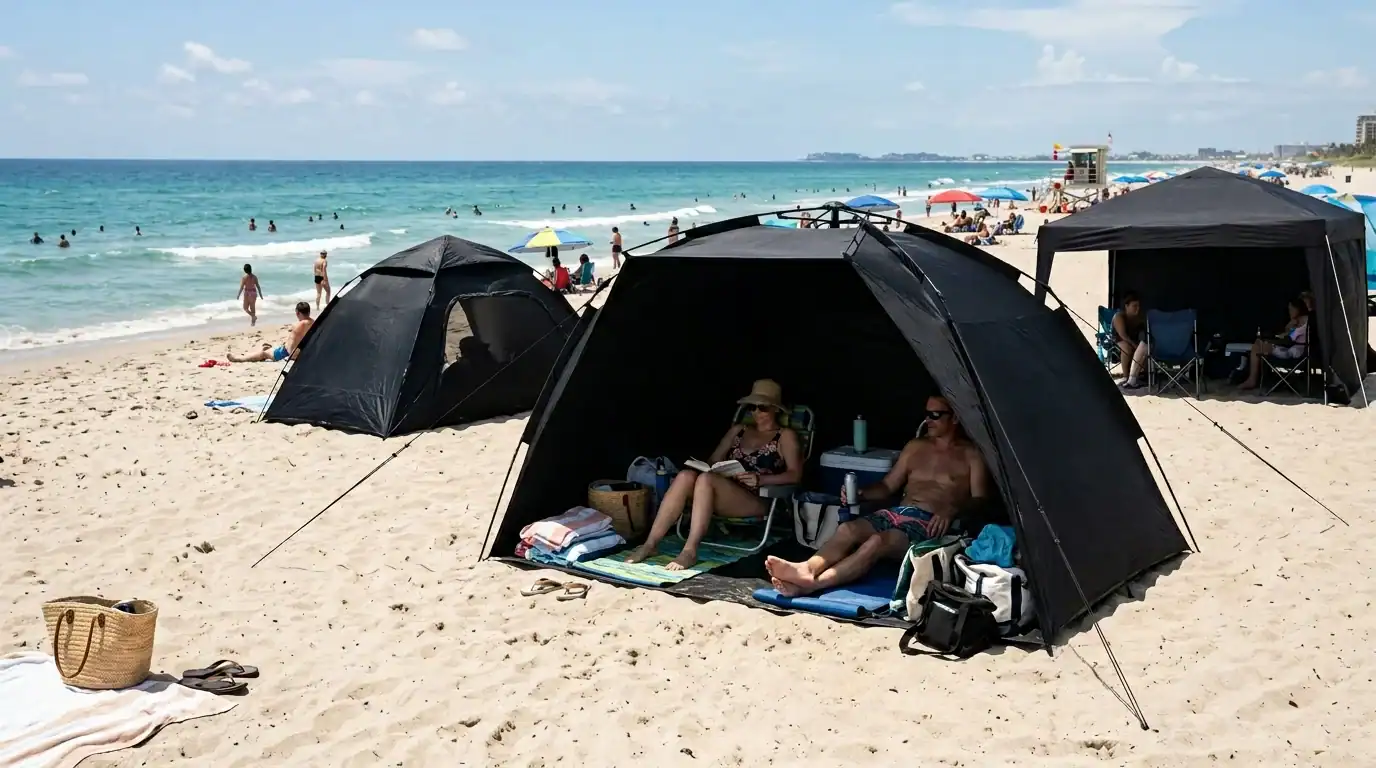
- Black Coating Advantage: A blackout coating isn’t just dark PU. It’s a pigmented acrylic or silicone-modified layer that performs two jobs: total light block and a UV shield that prevents that hydrolysis breakdown. It adds $0.80 to $1.20 per meter. That price jump looks steep until you realize it extends the tent’s rainfly life by 3-4 years. For any tent positioned above a $199 retail price point, skipping a UV-resistant black coating means you are designing a product with a built-in 2-year expiration date.
The frame material plays the same game. Fiberglass poles cost under $1 per section. Aluminum poles cost $2 to $4 per section. That choice alone can swing your OEM cost per unit by $10 to $25. But the consequence isn’t just weight savings; it’s about the return rate. Fiberglass splinters. When a fiberglass pole shatters in cold weather, that customer doesn’t blame the pole maker — they blame your brand. For a private label smart tent, pairing a high-tech electronics suite with the cheapest possible poles is a mismatch that produces very specific customer reviews.
When we work with clients on sample approval, we flag material substitutions that would undermine the final product’s market positioning. A silicone-coated fabric (often used on higher-end glamping tents) can hit 3000mm waterproof ratings and resist UV for 5+ years, but it costs $2.50 more per meter. The benchmark any retail buyer should write down: if your target MSRP is above $300, a black coating or silicone coating is not optional. It’s the minimum spec that prevents your product from degrading faster than next year’s model.
| Component | Cost Impact | Durability & Performance | Best For |
|---|---|---|---|
| Fabric: Polyester (Standard) | Baseline (Lowest Cost) | Moderate; basic water resistance with PU coating | Entry-level smart tents; fair-weather camping |
| Fabric: Oxford (600D–900D) | +15–25% vs standard Polyester | High tear strength; double-layer construction resists punctures | Mid-tier to premium smart tents; rough terrain use |
| Fabric: Nylon Ripstop | +20–30% vs standard Polyester | Exceptionally lightweight; ripstop grid prevents tear propagation | Ultralight trekking smart tents; backpacking models |
| Fabric: TC (Poly-Cotton Blend) | +30–40% vs standard Polyester | Breathable, UV-resistant, natural feel; heavier than synthetics | Glamping and premium IoT climate-control tents |
| Coating: Standard PU | Included in baseline fabric cost | Basic waterproofing (800–1500mm rating); fades over 2–3 seasons | Basic-tier LED tents; occasional use |
| Coating: Black Coating | +8–12% vs Standard PU | Blocks 95%+ UV rays; reduces interior temperature; extends fabric life | Solar-panel smart tents; direct-sun exposure markets |
| Coating: Silicone | +15–20% vs Standard PU | Superior waterproofing (3000mm+); maintains flexibility in cold conditions | Premium IoT tents; alpine and extreme-weather applications |
| Frame: Fiberglass | Baseline (Lowest Cost) | Lightweight; can splinter in high wind; 2–3 year lifespan | Basic LED tents; backyard and festival use |
| Frame: Aluminum (6061/7075) | +25–35% vs Fiberglass | Rust-proof, high strength-to-weight ratio; 5+ year lifespan | Mid-tier solar and auto-inflate tents; all-season use |
| Frame: Carbon Fiber | +60–80% vs Fiberglass | Ultra-lightweight; exceptional stiffness; premium feel | Premium IoT tents; luxury glamping and expedition-grade models |
| Frame: Steel | +10–20% vs Fiberglass (but heavy shipping costs apply) | Maximum wind resistance; rust-prone without powder coating | Fixed-location glamping tents; not recommended for portable smart tents |
Estimating Your Landed Cost with Custom Branding
The branded polybag and hangtag often cost more than the LED light in a basic smart tent.
You have settled on a mid-tier smart tent with a solar panel and auto-inflate pump. The Ex Works (EXW) price quoted is $78.50 per unit at 500 pieces. You model a retail price of $199.99. The math looks clean until the container lands in Los Angeles and the customs broker sends the final invoice. Suddenly, duties are calculated on $116 per unit, not $78.50, because Customs and Border Protection values the entire shipment on FOB pricing, not the factory gate cost. Your margin just lost eight points.
A private label smart tent landed cost estimate has three layers buyers routinely miscalculate. The first is the gap between EXW and FOB. Local trucking from the Ningbo tent factory to Ningbo-Zhoushan port runs between $280 and $450 for a 20-foot container, depending on whether the factory is in the core cooperative network or a secondary partner. Terminal handling charges add another $220. These fees are fixed per container, so on a 500-unit order of a bulky automatic tent, the per-unit FOB premium over EXW is roughly $1.80. On a 3,000-unit order of a compact backpacking tent, it drops to $0.40.
The second layer is brand customization reclassification. Standard silk-screen printing of a single-color logo on a tent flysheet is treated as a basic operation and does not typically shift the harmonized tariff code. However, when you add custom injection-molded plastic components—such as a branded battery housing or a proprietary pump interface—the product crosses into a different classification territory. Assigning the correct HS code before production, not after, is the difference between a 4.5% duty rate and one that can spike to 12.5% on the full FOB value.
-
- Premium branding cost factor: Digital thermal transfer labels with 3D raised texture for the tent body run $0.20–$0.35 per unit at 1,000-piece MOQs, versus $0.02–$0.03 for standard woven polyester tags. This $0.30 delta is negligible per piece, but when Customs reclassifies the item as having enhanced commercial value, the total duty bill on a $50,000 shipment shifts by thousands.
- Mid-tier branding cost factor: Pantone-matched fabric dyeing for a signature brand color adds $1.20–$2.50 per tent canopy, depending on whether the base material is polyester Oxford or nylon ripstop. Nylon absorbs dye less aggressively and requires a second pass, which extends the quality tolerance window for color fastness to grade 4 on the ISO 105-B02 scale. This adds three days to the 30-45 day production lead time.
- Basic branding cost factor: A single-location embroidery logo on a carry bag costs $0.15 per unit with no material reclassification risk, because the primary product coding remains unchanged. This is the only branding layer safe from customs reclassification scrutiny.
The third layer is container optimization. A 40-foot high cube container holds roughly 950 cartons of a standard 4-person dome tent. But a smart tent with a rigid solar panel frame and a hard-shell auto-inflate pump case changes the carton dimensions. The same container now holds 520 to 560 units. Ocean freight costs are fixed per container, so when carton configuration eats 40% of your load capacity, the per-unit freight jumps proportionally. Ask for sample approval on the master carton before confirming final FOB pricing. Confirm that the packaging design team has tested the pallet load pattern on an actual 40HQ specification sheet. Most suppliers skip this step. The ones that do not will save you $4 to $7 per unit in avoidable freight overage.
| Cost Component | Estimate Range (USD) by Tier | Key Variables Affecting Price | Kelyland Advantage | Pro Tip for Retail Buyers |
|---|---|---|---|---|
| Ex-Factory Product Cost | Basic LED Tent: $18 – $35; Mid Solar/Auto-Inflate: $55 – $90; Premium IoT Climate: $220 – $450 | Electronic complexity, fabric coating (PU vs Silicone/Black Coating), frame material, and MOQ (50-100 pcs unlocks hybrid pricing) | Deep OEM customization with 30+ fabric options; flexible MOQs as low as 50 units to test markets without margin erosion | Request silicone-coated fabric substitution to hit higher retail price points while keeping the same LED or solar feature set |
| Custom Branding & Packaging | $0.80 – $3.50 per unit | Print method (silk-screen vs thermal transfer vs woven labels), hang tag complexity, custom box with foam insert vs standard polybag | One-stop design team handles Pantone-matched dyeing, multiple print methods, and custom molded zipper pulls under one project | Consolidate branding costs by using woven labels and dye-sublimation prints; these scale well even at lower MOQs |
| Freight & Logistics (FOB/CIF) | FOB Ningbo/Shanghai: included in ex-factory negotiation; Sea freight to US West Coast: $3,200 – $5,800 per 40’HC container (approx. $0.80 – $2.50 per unit depending on tent volume) | Container utilization, port congestion surcharges, DDP vs DDU terms, and whether goods ship during peak season (Aug-Nov) | In-house logistics team provides real-time tracking, export documentation, and insurance guidance, reducing hidden demurrage fees | Plan orders to depart 30-45 days before peak season; Kelyland’s 30-45 day lead time aligns well if you book space early |
| Import Duty & Customs Clearance | Tent duty (US HTS 6306.22): 3%–8% of CIF value; EU TARIC: 12% for synthetic tents | Product classification (tent vs sunshade vs furniture), country of origin markup (Section 301 tariffs if applicable), and brokerage fees ($100-$300 per entry) | Pre-ships accurate HS codes and COO certificates; 12 years’ experience navigating US/EU customs for major retail brands | Ask Kelyland to split ‘electronics’ vs ‘tent fabric’ HS codes when shipping smart tents to potentially reduce duty on electronics |
| Quality Control & Compliance Testing | $0.15 – $0.85 per unit (amortized across MOQ) | In-line inspection frequency, third-party lab testing (CE, ETL for electronics), and social compliance audits (BSCI, ISO 9001:2015) | 17 core ISO-certified factories; in-house QC team performs pre-production, in-line, and final random inspections with shareable reports | Include a ‘Pre-Shipment Inspection’ clause in your contract; Kelyland covers this as part of their 10-step sourcing process |
Conclusion
Feature creep kills margin faster than any fabric choice. A basic LED tent with a simple power bank and standard PU coating delivers a reliable 45-55% retail margin on a $45-55 OEM cost per unit. Jump to auto-inflate with a solar panel, and the factory price climbs to $95-130, compressing margin unless the retail pricepoint supports a $229-299 shelf tag. The premium IoT climate control tier pushes OEM costs past $250—viable only for brands that can hold a $600+ retail price without deep discounting. The numbers don’t lie. Smart tents reward discipline in feature selection.
Before you lock the next product spec, benchmark your target OEM cost against this rule: every $10 in electronic BOM cost needs a $25-30 retail price increase to preserve channel margin. If the math doesn’t square, pull a feature, switch to silicone-coated fabric instead of adding another sensor, or keep the MOQ at 50-100 pieces to test the tier without overcommitment. Review current pricing on the product page to see how fabric and tech combinations play out in real landed cost scenarios.
Frequently Asked Questions
What’s the minimum order for smart tents with electronics?
Smart tent MOQs typically start at 300 units because custom circuit boards and mold setup require amortization. Simpler add-ons like a generic LED strip and power bank can sometimes go as low. Always lock MOQ after design and component selection are finalized.
How much does a basic smart tent cost to produce?
For a basic LED+power bank configuration, OEM FOB cost usually falls between $25 and $45, depending on tent size and fabric. The smart electronics add only $3–8 to the bill of materials, but poor. Get a component sourcing guarantee before bulk production.
What’s the biggest risk with solar auto-inflate tents?
The highest failure risk appears in later batches when solar controller suppliers swap parts to cut costs, not in the sample. Protect your brand by demanding a locked bill of materials and. Protect your brand with a locked BOM and batch inspections.
How do blackout coatings affect tent price?
Black coating adds about $5–8 per tent compared to standard PU coating, due to extra processing. It dramatically improves UV block and darkness for better sleep, which can justify a higher retail price. Weigh the coating upgrade against target customer comfort expectations.

 English
  Español
  Deutsch
  Français
  Português do Brasil
  Русский
  العربية
  한국어
한국어  日本語
日本語