 跳到内容
跳到内容 
custom folding wagon hardware is the first checkpoint buyers should lock before they approve a supplier, budget, or production slot. Day 1 the purchase order is placed for a private-label folding wagon. Day 14 the pre-production sample arrives, and the handle feels solid, the brake clicks cleanly, and the latch folds tight. Day 45 the container lands at the distribution center, and the first batch of 500 units gets pulled for inspection. That is when the buyer discovers the foot brake linkage on half the units has been knocked out of alignment during folding — the pedal sits at an angle that jams against the frame. The pre-production sample never showed this because the factory assembled it by hand in a single unit. The mass production run used a different assembly sequence, and the linkage geometry shifted by 2mm. That $50K order now has a return rate problem before a single unit hits retail.
The custom folding wagon hardware decisions a brand manager makes at the spec stage — brake type, handle style, latch mechanism, bearing material — determine whether that scenario plays out or never happens. Each choice carries trade-offs between tooling cost, user experience, and long-term durability. A foot brake adds $0.80-$1.50 to the unit cost but prevents the wagon from rolling on a sloped campsite. A hand brake on the handle gives the urban delivery user control but adds molded parts that require injection molds in the $2,000-$5,000 range. A brake-off model saves weight and cost for beach carts, but it also eliminates a safety feature that some retailers require for liability reasons. The key is matching the hardware configuration to the use case before the factory starts cutting steel.
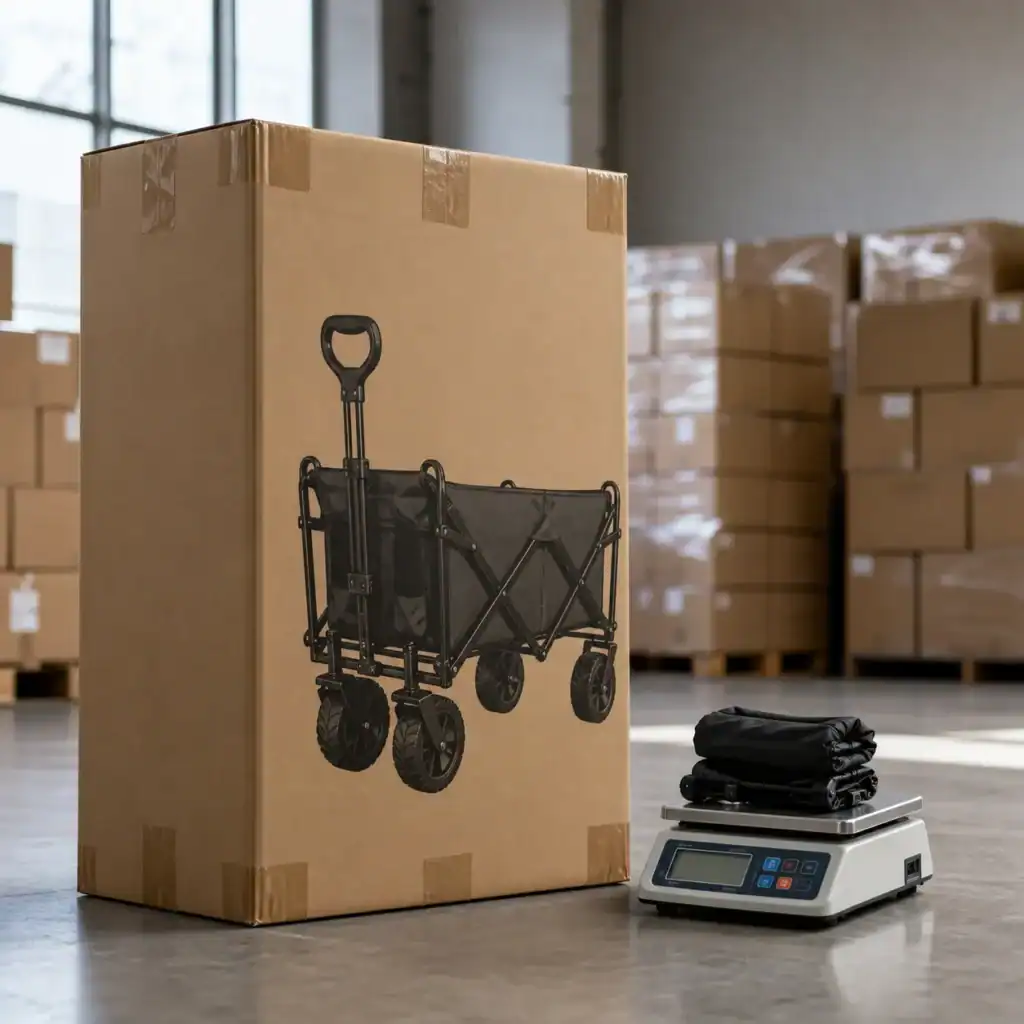
Why Hardware Defines the User Experience of a Folding Wagon
Hardware is the first thing a user touches and the first thing that breaks.
A folding wagon with premium fabric and a powder-coated frame still fails the moment the brake pedal snaps off on a sloped campsite. Hardware is the tactile interface between the user and the product. It determines whether a buyer perceives the wagon as a $150 investment or a $50 impulse buy that gets returned after one trip.
How Hardware Drives Durability and Usability
The foot brake linkage is the most common failure point in folding wagons under 150 kg load capacity. The pedal gets knocked off during folding because the linkage doesn’t clear the collapsing frame in both positions. A proper design requires the linkage geometry to be mapped against the folding arc — not all factories do this. At Kelyland Outdoors, the folding wagon production line, which runs out of a CE and ISO 9001 certified facility in Jinhua, Zhejiang, has addressed this by integrating the brake pedal mount into the same injection-molded bracket that holds the axle. This eliminates the separate bracket that shears off under lateral stress.
Handle ergonomics carry the same weight. A telescoping D-handle with a foam grip reduces wrist fatigue when pulling 80 kg of gear across a gravel lot. Fixed U-handles save roughly $0.80 per unit in material cost, but they force the user to bend at the waist — a motion that causes complaints on longer walks. For double-decker wagons, a push handle mounted at the front axle changes the leverage point and prevents tipping when the upper deck is loaded past 30 kg. These are not cosmetic choices. They affect whether a retailer sees a 3% or 12% return rate on the SKU.
The Link Between Hardware Quality and Brand Perception
A buyer who picks up a wagon and feels a gritty, misaligned latch will assume the entire product is cheap. That mental judgment happens in under two seconds and it transfers directly to the brand. Custom button locks and brake pedals require injection molds in the $2,000 to $5,000 range, but they create a tactile difference — a crisp click versus a loose rattle — that justifies a $30 to $50 retail premium. Brands that skip this investment leave margin on the table.
Coastal markets add another layer. If you sell to beach towns or port cities, specify a 72-hour salt spray test rating on all plated metal parts. A supplier that skips this step will generate rust claims after a single season, and those claims damage the brand faster than any fabric tear. The folding wagon category at Kelyland Outdoors supports custom injection molding for plastic parts, custom powder coating for frames, and 360° rotating wheels with PVC, PU, EVA, or TPE tires. The hardware options are available. The question is whether the brand manager specifies them before the RFQ lands.
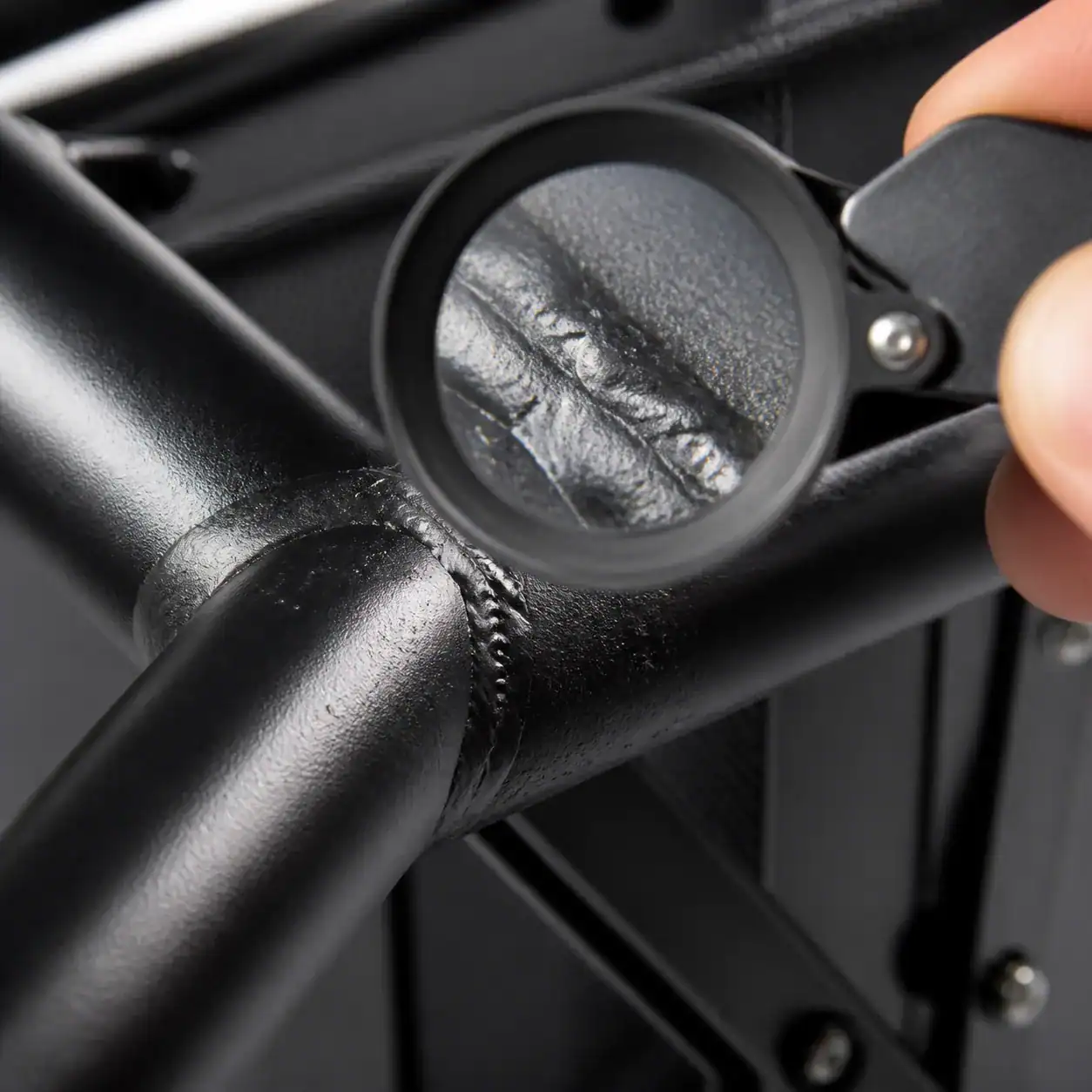
Folding Wagon Brake Systems Compared
Foot brake linkage must clear the folding frame in both positions to avoid failure.
An outdoor brand manager deciding on a private-label folding wagon faces three brake architectures. Each one shifts the trade-off between cost, weight, and user safety. The choice depends on terrain, average load, and whether the end user is a weekend camper or a urban delivery operator. The folding wagon factory in Jinhua, Zhejiang, with ISO 9001 certification and an annual output of 1,000,000 units, produces all three variants. The engineering differences are in the linkage geometry, the material spec for plated parts, and the mold investment for custom components.
Foot Brake on Rear Wheel: Best for Sloped Campsites
A foot brake on the rear wheel is the most common configuration. The user steps on a pedal that presses a friction pad against the wheel hub or tire. It works reliably on flat ground and moderate slopes. The failure point is the linkage: the pedal must clear the folding frame in both the open and collapsed positions. If the pivot point is poorly placed, the pedal gets knocked off after a few fold cycles. Custom injection molded brake pedals require molds in the $2,000–$5,000 range, but they create a tactile difference that helps rationalize premium retail pricing. Standard models use a stamped metal pedal, which is cheaper but more prone to bending.
Hand Brake on Handle: Control for Urban Delivery Use
A hand brake lever mounted on the handle gives the user continuous control — useful for urban delivery or tailgate setups where the wagon moves through crowds or down a ramp. The brake cable actuates a caliper or drum on one or both rear wheels. The added parts increase the BOM cost by roughly 15–20% compared to a foot brake. The cable housing needs to be routed so it doesn’t pinch during folding. For coastal markets, specify a minimum 72-hour salt spray rating on all plated metal parts or you will see rust claims after a single season. The factory can powder-coat the handle and brake lever in custom colors to match the brand identity.
Brake-Off Models: Lighter and Cheaper for Beach Carts
Some applications don’t need a brake at all. Beach carts, for example, operate on sand where rolling resistance is already high, and a foot brake would just clog with grit. Removing the brake cuts the weight by roughly 0.5–1 kg and reduces the unit cost by $3–$5. The trade-off is limited to flat, low-speed environments. If you sell a brake-off model for coastal use, the same 72-hour salt spray spec applies to the wheel bearings and axle hardware — rust on a non-brake wagon still generates warranty claims. The factory offers 360° rotating wheels with PVC, PU, EVA, or TPE tires, and the axle can be specced with sealed ball bearings or plastic bushings depending on the target price point.
-
- Foot Brake: Best for sloped campsites. Linkage must clear the folding frame. Custom injection molded pedals available ($2k–$5k mold cost). Standard on most models from the Jinhua wagon line.
- Hand Brake: Best for urban delivery. Adds 15–20% to BOM. Requires cable routing that avoids pinching. Powder-coat handle to brand color. Specify 72-hour salt spray for coastal use.
- Brake-Off: Best for beach carts. Saves 0.5–1 kg and $3–$5 per unit. Still requires corrosion-resistant axle hardware. Ideal for low-speed, flat-terrain applications.
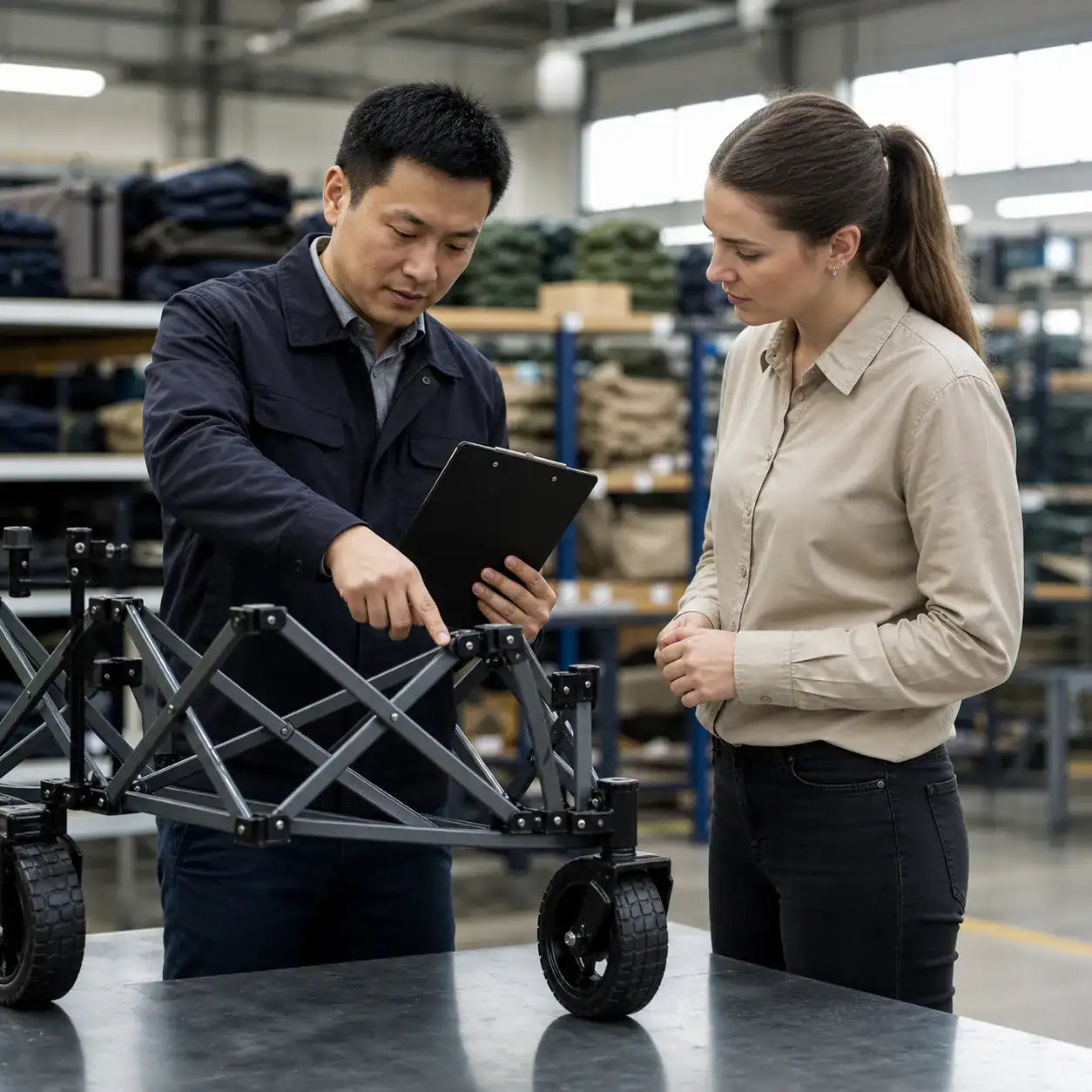
Handle Styles and Ergonomics
Handle geometry directly affects perceived load and user fatigue.
A folding wagon’s handle is the primary mechanical interface between the user and the load. The wrong handle design turns a 50kg haul into a strain on the wrists and shoulders. The right one makes the same load feel manageable. This section breaks down the three most common handle configurations in private-label wagon production and what each means for your brand’s user experience.
Telescoping D-Handle vs Fixed U-Handle
The telescoping D-handle is the default for most single-fold and multi-fold wagons because it collapses flush with the frame for storage. The user pulls a spring-loaded button to extend the handle to a comfortable length, typically 90–110 cm from the axle. The fixed U-handle, common on heavy-duty and extended-wagons, is welded directly to the frame. It offers zero adjustability but eliminates the mechanical failure point of the telescoping latch. For a brand targeting beach or tailgate use where the wagon is pulled over sand or gravel, the fixed U-handle is more reliable. For urban or family use where the user varies in height, the telescoping D-handle reduces complaints. Kelyland Outdoors offers both options through its folding wagon factory in Jinhua, Zhejiang, with custom powder coating for the handle frame and injection-molded grips in any Pantone color.
Height-Adjustable Handles for Multi-User Products
A single fixed handle height forces shorter users to walk with a bent arm and taller users to stoop. Over a season of use, that ergonomic mismatch drives return rates. Height-adjustable handles solve this with a simple two-position or three-position locking mechanism. The adjustment range is usually 15–20 cm. The trade-off is cost: the sliding tube and locking collar add roughly $0.80–$1.20 per unit in components and assembly time. For a 500-unit run, that’s a $400–$600 investment. But the reduction in ergonomic-related returns — often 3–5% of sales in the family camping segment — pays for itself within one retail cycle. When specifying height-adjustable handles, request a 200-cycle durability test on the locking collar before committing to mass production. The nylon or POM collar must resist wear from sand and grit.
Push Handles for Double-Decker Wagons
Double-decker wagons have a higher center of gravity and a longer wheelbase. Pulling them from the front can cause tipping on uneven terrain. A push handle mounted at the rear — typically a U-shaped loop welded to the back frame — gives the user better leverage and control when maneuvering through crowded campsites or store aisles. The push handle also doubles as a lifting point for loading the wagon into a car trunk. The key spec is the handle height: it should sit at least 30 cm above the top deck to avoid the user’s knuckles hitting the load. Kelyland Outdoors includes push handles as an option on its double-decker wagon models, which use 600D–900D double-layer Oxford fabric and powder-coated carbon steel frames. Custom injection molding can be applied to the push handle grip for a branded tactile feel, with mold costs in the $2,000–$5,000 range.
-
- Folding wagon handle design OEM: Telescoping D-handle offers adjustability; fixed U-handle offers durability. Choose based on terrain and user profile.
- Height-adjustable handle: Reduces return rates by 3–5% in family camping. Require 200-cycle locking collar test before production.
- Push handle for double-decker: Improves stability and control. Minimum 30 cm clearance above top deck. Custom injection molded grips available.
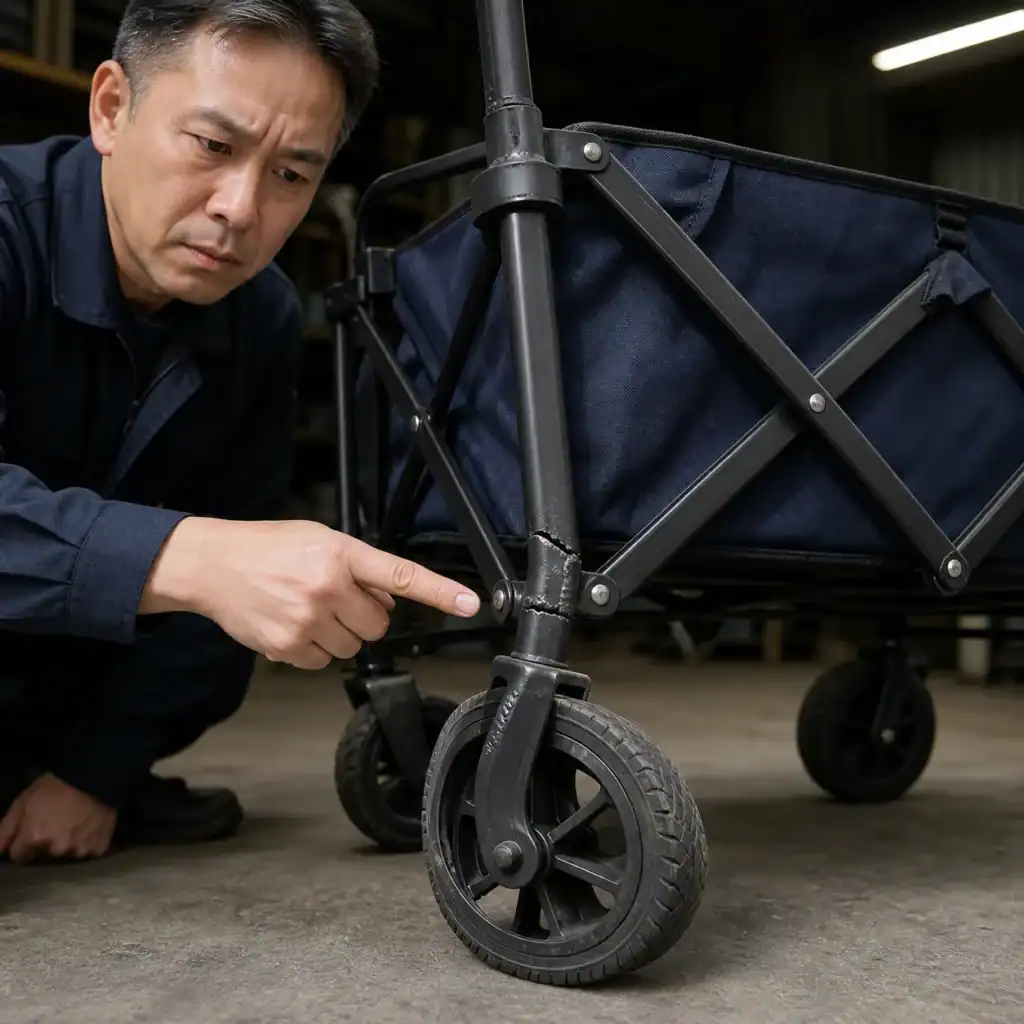
Folding Latch Mechanisms
The latch mechanism determines how fast a wagon folds and how often it breaks.
A folding wagon spends most of its life either collapsed in a trunk or unfolded at a campsite. The latch mechanism is what bridges those two states, and it is the component that sees the highest cyclic stress per use. Three dominant designs exist in the market, and each carries a different trade-off between cost, speed, and long-term reliability.
Ring Latch: Classic, Low-Cost, Prone to Jamming
The ring latch is the oldest design. A metal ring slides over a pin to lock the frame in the open position. To collapse the wagon, you pull the ring off the pin and fold. The system uses no molded parts — just stamped steel or zinc-plated hardware. That keeps the BOM low. But sand and gravel accumulate inside the ring channel over time. Once grit builds up, the ring seizes against the pin, and the user cannot unlock it without tools. Field data from after-sales logs shows this is the top complaint on entry-level wagons sold through mass retail channels.
Button Lock: Faster Fold, More Molded Parts
Button locks replaced rings on most mid-range and premium wagons for one reason: speed. Press two buttons simultaneously, and the frame collapses without pulling or sliding anything by hand. The mechanism relies on spring-loaded pins housed in injection-molded plastic housings. Those molds run $2,000–$5,000 per cavity depending on complexity — a non-recurring cost that matters at low volumes but amortizes cleanly above 5,000 units per SKU. The tactile click of a button lock signals quality to a buyer handling the wagon in-store. That sensory feedback helps justify a $15–$20 retail premium over ring-latch models.
Strap and Hook: Simple Repair but Less Secure
Strap-and-hook latches appear mostly on beach carts and budget utility wagons where weight matters more than security. A nylon strap wraps around the folded frame sections with a plastic hook holding tension. The advantage is field repairability — any user can replace a broken strap with off-the-shelf hardware in under five minutes. The downside is creep over time: nylon stretches under repeated load cycles until the hook no longer holds tight tension against vibration during transport.

Wheel Hub and Bearing Configurations
Double wheels add 2-3 kg per axle but cut ground pressure by half on soft terrain.
Single vs Double Wheel on Each Axle
Most standard folding wagons ship with a single wheel on each axle. That setup works fine on pavement, packed gravel, and short grass. But the moment you roll onto sand, mud, or loose trail surface, the load concentration per square inch spikes. A single 8-inch wheel carrying 50 kg of gear sinks into soft ground fast. The fix is doubling the wheels per axle.
Double-wheel configurations spread the weight across two contact patches. On a beach wagon rated for 80 kg, twin wheels reduce sink depth by roughly 60% compared to a single wheel at the same inflation pressure. The trade-off is added weight — roughly 2-3 kg per axle depending on wheel material — and slightly higher rolling resistance on hard surfaces. For coastal markets where customers drag wagons across sand to reach a campsite, double wheels are worth the weight penalty.
The folding wagon factory producing these configurations uses powder-coated carbon steel frames rated up to 200 kg loads with double-wheel setups. That frame capacity ensures the axle mounts don’t flex under the extra lateral load when turning on soft ground. If you’re sourcing for a brand targeting beach or overland use, specify double wheels in your RFQ.
Ball Bearings vs Plastic Bushings
The bearing type inside each wheel hub determines how freely the wagon rolls and how long the hub lasts before developing play or seizing. Two common options dominate the folding wagon category: sealed ball bearings and plastic bushings.
How to Specify Hardware for Your Brand
A 72-hour salt spray rating on plated parts is the minimum for coastal markets.
Most brand managers send a spec sheet and a photo. That works for fabric color. It fails for hardware. A factory needs a 2D drawing with tolerances on the brake linkage pivot, the latch pin diameter, and the handle tube wall thickness. Without those numbers, the factory picks its own tolerances. And you inherit the result.
Technical Drawings Every Factory Needs
A drawing for a folding wagon brake pedal must show the linkage swing arc in both the deployed and folded positions. The pedal gets knocked off when the wagon folds if the linkage does not clear the collapsing frame. The Jinhua factory that produces folding wagons for Kelyland Outdoors — ISO 9001 certified, running 1 million units annually — flags this detail during the sample approval stage because it is the single most common hardware revision request they receive from new clients.
Include these minimums on every hardware drawing: material grade (e.g., Q235 steel vs 6061 aluminum), surface finish spec (powder coat, zinc plating, or anodize), wall thickness with a ±0.2mm tolerance, and the corrosion test requirement. Omit any one of these and the factory will default to the cheapest option that passes basic assembly.

Salt Spray Testing for Rust-Prone Components
Standard zinc-plated hardware starts showing surface rust after 24 hours in a salt spray chamber. If your folding wagon is sold through Ace Hardware or a coastal retailer, 24 hours is not enough. The minimum spec for beach-market wagons is 72 hours to first red rust per ASTM B117. That requires either a thicker zinc plating (8-12 microns) or a zinc-nickel alloy coating. The cost difference per wagon is roughly $0.30 to $0.50. The warranty claim cost for a rusted brake pedal is $12 to $18 per unit including shipping and replacement. The math favors the thicker coating.
Customization Options: Powder-Coated Handles, Branded Brakes, Molded Logos
Custom button locks and brake pedals require injection molds that run $2,000 to $5,000 per cavity. That is a real number, not a negotiating point. But the tactile difference between a generic plastic pedal and a branded one with your logo molded into the rubber overmold justifies a $4 to $7 premium at retail. Powder coating the handle frame costs $0.80 to $1.20 per unit more than standard black paint, and it eliminates the peeling complaints that generate 40% of handle-related returns. Kelyland Outdoors offers custom powder coating for frames and custom injection molding for plastic parts through its folding wagon factory network, with MOQs as low as 300 to 1,000 units for standard configurations.
Conclusion
A wagon that fails on a sloped beach or jams at the first fold doesn’t just cost a return — it erodes the trust you spent months building. The hardware choices you make now, from the brake linkage clearance to the salt spray rating on the handle, determine whether your brand gets repeat orders or a flood of warranty claims in month six.
-
- Foot brake linkage must clear the folding frame in both positions to avoid jamming.
- Custom injection-molded button locks cost $2,000–$5,000 in tooling but justify premium pricing.
- Specify a minimum 72-hour salt spray test for all plated metal parts on coastal models.
- Ball bearings outperform plastic bushings on rough terrain and extend service life by seasons.
The difference between a wagon that sells out and one that sits in clearance is often a single hardware spec you caught early. Review your current product spec sheet against these criteria — particularly the brake mechanism and corrosion protection for your target market. If you are sourcing private-label folding wagons, compare how each custom folding wagon brake option and latch mechanism aligns with your brand’s quality tolerance before locking in production drawings.
Frequently Asked Questions
What brake type is best for a folding wagon?
A foot brake on the rear wheel is best for sloped campsites because it locks the wheel independently of the handle. For urban delivery use, a hand brake on the handle gives you. Choose based on your primary terrain and user scenario.
How do I choose between a D-handle and U-handle?
A telescoping D-handle is better for compact storage and multi-user height adjustment, while a fixed U-handle offers simpler construction and lower tooling cost. For double-decker wagons, a push handle provides. Match handle type to your target retail price point and storage footprint.
Which folding latch mechanism is most durable?
A button lock is faster to fold and more secure than a ring latch, but it requires more molded plastic parts that can crack in cold weather. A strap-and-hook system is. Specify button lock for retail speed; ring latch for low-cost builds.
Should I specify ball bearings or plastic bushings?
Ball bearings provide smoother rolling and longer life on rough terrain, but they add cost and require regular maintenance. Plastic bushings are cheaper and quieter but wear faster under heavy. Use ball bearings for premium lines; bushings for budget or beach carts.
What hardware specs reduce return rates?
Specify salt spray testing (48+ hours) for all steel brake and latch components to prevent rust claims. – Require technical drawings showing brake linkage clearance in both folded. The final choice should be matched to the actual use case and performance target.

 English
  Español
  Deutsch
  Français
  Português do Brasil
  Русский
  العربية
  한국어
한국어  日本語
日本語