 跳到内容
跳到内容 
Custom folding wagon MOQ tiers land in two broad ranges: 50-100 units for basic customization like a logo or color swap, and 300-1,000 units for standard catalog models. That gap isn’t a factory quirk — it reflects how cost structures shift when you move from picking an existing fabric to having a mill run dye lots and printing setup for your specs. For most e-commerce sellers, the wagon’s MOQ itself is manageable. The expensive surprise lives in the fabric customization layer.
The thing that separates a profitable first order from a costly one is knowing that custom printed fabric typically triggers a 500-1,000 piece minimum on its own. Dye lots and printing setup fees don’t scale down to a 100-unit run, so a factory quoting you 50-100 units for a “custom” wagon is almost certainly limiting customization to a logo pad-print or a hang tag. Once you ask for 600D Oxford in your brand color, the MOQ math changes — and so does your quality tolerance, because a short fabric run can shift the hand-feel and color rendering that passed sample approval.
What most buyers miss — the final 10% of this whole exercise — is the container math. A folding wagon collapses small enough to nest, which means you can mix multiple customized SKUs into one 40HQ container and still hit factory MOQs across all of them. That collapses per-unit freight. It also lets you test two designs instead of betting your entire run on one market reaction. A one-stop sourcer with a shared factory network can even pair your 300-unit wagon order with camping chairs or coolers from adjacent production lines, making the entire container economical even when the wagon’s MOQ alone would give you pause.

What “MOQ” Really Means at a Folding Wagon Factory
MOQ is not a single number.
When a folding wagon factory quotes a minimum order quantity, the number almost never applies to everything. Most Chinese suppliers work with three separate thresholds: factory MOQ, per-SKU MOQ, and per-color MOQ. Before comparing FOB pricing, ask which threshold applies. Catalog models with standard fabric and black frames can start around 300-1,000 pieces. A custom folding wagon with only a logo change can drop to 50-100 units. A custom printed fabric wagon, by contrast, often requires 500-1,000 pieces because of dye lot and printing setup costs.
Factory MOQ vs per-SKU MOQ vs per-color MOQ
Factory MOQ is the total number of wagons the production line needs to run profitably. Per-SKU MOQ applies to each unique model — single-fold, multi-fold, extended, double-decker, or a wagon that converts into a cot. Per-color MOQ is the minimum yardage for custom dyed fabric. The folding wagon factory in Kelyland Outdoors’ network, an ISO 9001:2015 certified plant in Jinhua, uses all three. A buyer can hit the factory MOQ with three different SKUs, then fail on per-SKU MOQ for every single one.
-
- Factory MOQ: Total order size across all models. Mixable, but suppliers normally reserve enough quantity to fill a production slot.
- Per-SKU MOQ: Minimum run per model or frame style. Changing wheel size, folding mechanism, or frame material counts as a new SKU.
- Per-color MOQ: Minimum run for a custom fabric color. Dye lots and printing setup fees make this the strictest threshold.
Why quantities vary by material and customization level
Materials change the math. Standard 600D-900D double-layer Oxford fabric in stock colors lets the factory cut and sew immediately. Custom printed fabric means sourcing a dye lot, matching Pantone, and paying printing setup fees — that’s why the MOQ jumps to 500-1,000 pieces. A powder-coated carbon steel frame in a standard black powder coat is cheaper to schedule than custom-colored frames, which require washing the paint line between runs. Custom injection-molded wheels or handles push minimums even higher, because the factory needs to spread mold costs over enough units to make the tooling worthwhile.
The cheapest way to go custom is to keep the base wagon and change only the logo. That gets you shelf differentiation without triggering fabric dye lot MOQs. The most expensive way is to change the fabric, frame color, wheels, and packaging at the same time — each change adds its own threshold, and the highest one becomes your effective MOQ.
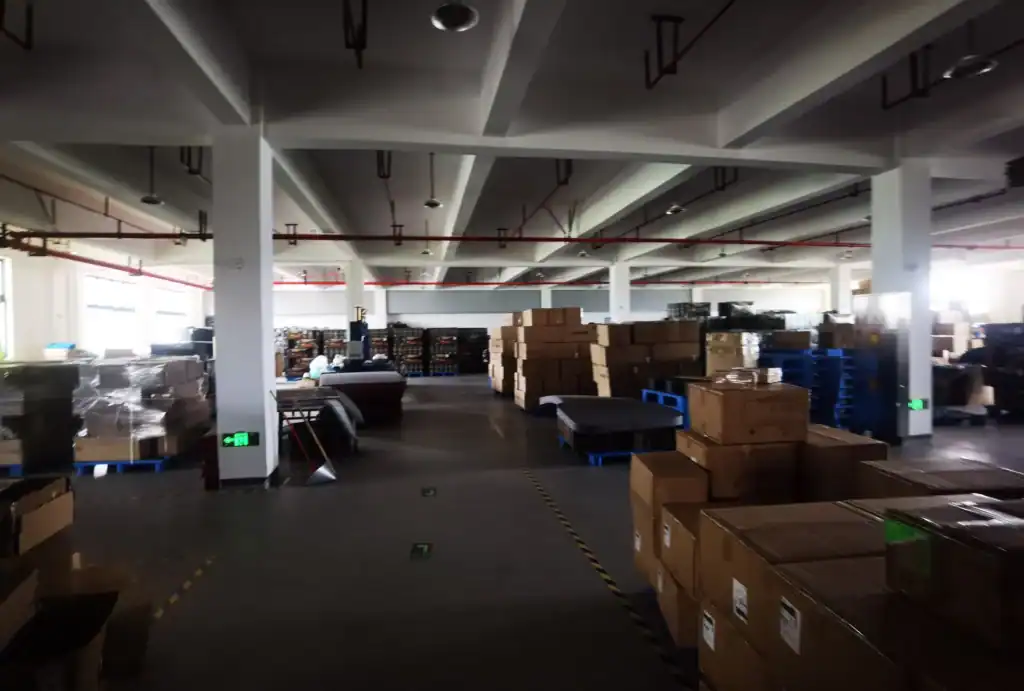
Standard Order Quantities for Folding Wagons
Typical 300–1,000 Unit Minimums for Catalog Models
A stock folding wagon order starts at 300 units and runs to 1,000 units per design. That range comes from the Jinhua, Zhejiang factory that builds the line, which holds ISO 9001:2015 certification and handles 1,000,000 wagons a year. Below 300 units, setup costs do not spread far enough.
The 300-unit floor covers fabric cutting, frame powder coating, and assembly-line setup. Push past 1,000 units and the unit price keeps dropping, but the curve flattens. The bigger savings show up in freight, not the factory gate price.
Read the minimum as per-SKU, not per-account. A 600-unit order split across two colors still creates two dye lots, so the supplier will likely require 300 units per color way. Also remember that the standard catalog minimum assumes stock fabric. Custom printed fabric typically jumps to 500–1,000 units because dye lots and printing setup fees demand a larger run.
Container-Based Ordering and Per-Unit Cost
This is where wagon economics change. Folding wagons collapse and nest, so a 40HQ container often holds enough units to clear the minimum for multiple customized SKUs at once. You can order 300 units of one model and 300 of another without triggering small-batch penalties on each.
The folding wagon container load quantity depends on collapsed height and whether the handle folds flush, so confirm packing dimensions before assuming fit. A half-empty container punishes the per-unit cost more than a higher factory price does.
One practical route: a sourcing partner that pools factory capacity can place a 300-unit wagon order beside camping chairs or coolers from the same production network, fill one 40HQ, and spread the freight across all items. That keeps inventory risk low without killing your landed cost.
Semi-Custom and Full-Custom MOQ Options
Logo-only changes start at 50-100 units; full custom tooling often requires 1,000+ to amortize.
A supplier’s MOQ policy is really three different thresholds. There is the factory MOQ, which is the total production run they will schedule. There is the per-SKU MOQ, which applies when you want multiple wagon models or sizes. And there is the per-color MOQ, which many buyers miss until after they sign. Ask for each one in writing before you request a sample.
Cheapest way to go custom: keep the wagon body and frame stock, change the logo. That is basic customization — heat-transfer or silk-screen printing on the fabric, plus a custom hang tag and carton sticker. The production line does not change. Setup takes minutes, not days. That is why some factories will accept 50-100 units for this level, and why the per-unit premium stays modest.
When MOQs Jump: Wheels, Frames, and Packaging
Custom wheels and frames are a different game. A wheel assembly on a folding wagon might be a PP hub with a PVC or EVA tire and a metal bracket. Changing the wheel diameter, durometer, or hub color requires new tooling or at least a new material run. Same for frame geometry: altering the steel tube diameter or fold mechanism means a new welding jig and bending program. Factories will not eat that setup cost for 100 units. Semi-custom wagon MOQs with these changes usually land around 500 pieces, and full structural redesigns often demand 1,000 or more.
-
- Custom packaging: Printed color boxes with custom artwork usually require 1,000-2,000 pieces before the carton supplier will run offset printing. Flexographic or digital printing can lower that, but expect a printed-box surcharge below 1,000.
- Custom parts (injection-molded): If you need a unique wheel hub, handle grip, or plastic baseboard, the supplier creates a steel injection mold. A simple two-cavity mold for a wagon wheel hub can cost US$3,000-$8,000. A more complex part with slides and texture may run US$10,000-$20,000. You amortize that mold cost by spreading it over the total production volume — at 500 pieces, a US$6,000 mold adds US$12 per unit; at 2,000 pieces, it drops to US$3 per unit.
One useful lever: a folding wagon collapses flat, and nested packaging means you can mix multiple SKUs into a single 40HQ container. A 300-unit wagon order may feel small, but if you stack it alongside camping chairs or coolers from the same supplier network, the overall container becomes economical. Some one-stop sourcing partners, including the network behind this site’s factory partnerships, coordinate that — tapping the same factories that produce folding wagons, chairs, and coolers under ISO 9001:2015 quality systems.
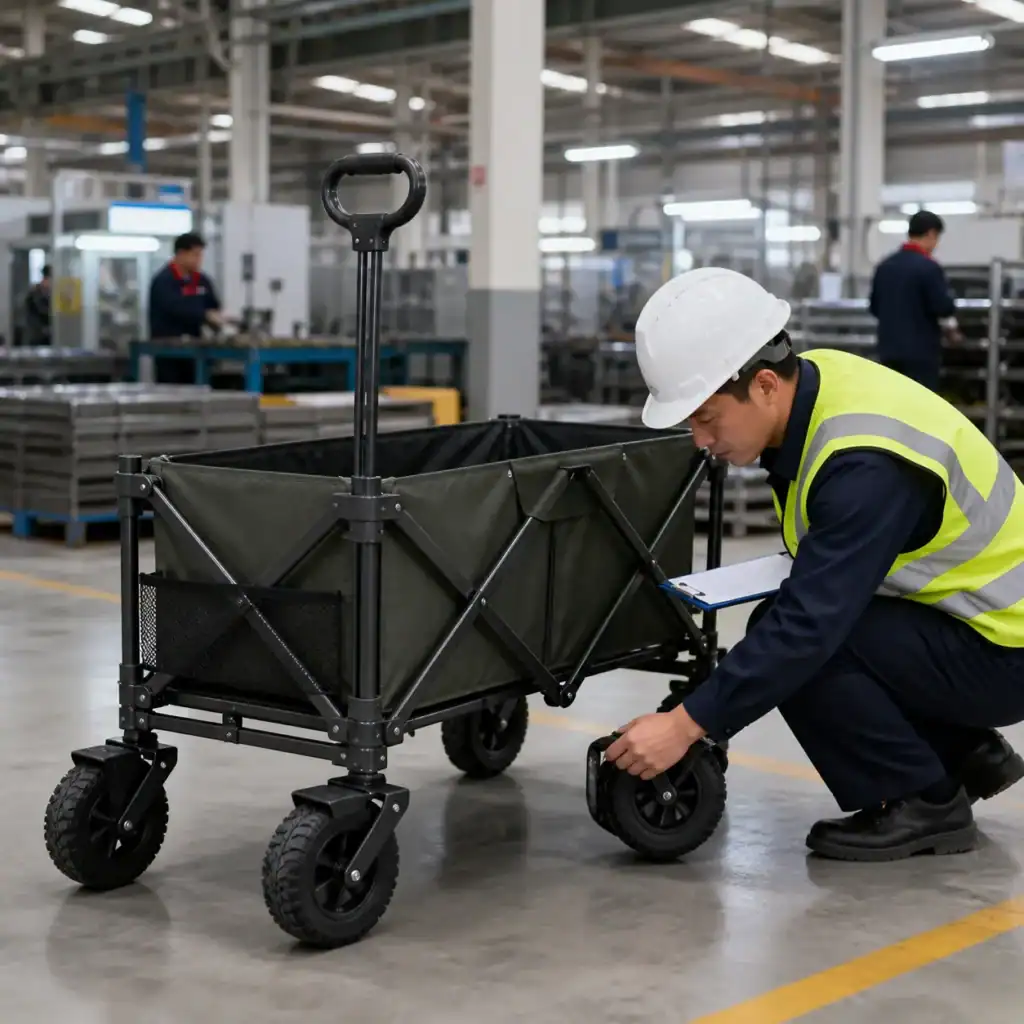
How MOQ Tiers Change Unit Pricing
The real price jump happens between 100 and 500 units — that’s where customization options unlock.
A quote for 100 folding wagons and a quote for 1,000 can look like two different products. The unit price at 100 runs meaningfully higher — not because the factory pads small orders, but because setup, printing, and inspection costs land on fewer pieces. The folding wagon line in Jinhua pushes out 1,000,000 units a year; the fixed costs don’t shrink just because your order did.
100 Units: Logo-Only Customization
A 100-unit order sits inside the flexible range some suppliers accept — Kelyland’s minimums start at 50-100 pieces for select items. But that quantity caps what you can change. Custom printed fabric alone usually triggers a 500-1,000 piece MOQ because dye lots and printing setup fees don’t scale down. At 100 units, the economical play is a logo swap on an existing wagon, not a fabric or frame change.
500 Units: Semi-Custom Becomes Realistic
At 500 units, semi-custom opens up. Fabric colorways and custom logos work without wrecking the unit price because setup spreads across enough pieces. This lands inside the standard 300-1,000 unit MOQ range for catalog wagons. You stay on a proven platform — 600D-900D double-layer Oxford over a powder-coated steel frame, PP or MDF baseboard — but the product stops looking like everyone else’s.
1,000 Units: Full Custom and Tooling
At 1,000 units, tooling costs become tolerable. Custom injection-molded wheel hubs, a proprietary frame geometry, custom packaging — these require molds with real upfront cost. Spread across 1,000 wagons, the per-unit tooling hit is manageable. Spread across 100, it’s disqualifying. That’s the engine behind every folding wagon manufacturer MOQ policy worth reading.
Hidden Costs Behind the Unit Price
-
- Samples: Paid samples, potentially refundable once the bulk order is confirmed.
- Tooling: Injection molds for custom wheels or plastic parts — the real MOQ driver.
- QC: ISO 9001:2015 factories run staged inspections, with reports on request.
- Packaging: Custom labels, manuals, and printed cartons each add setup fees.
One workaround for e-commerce sellers: a wagon’s collapsed size allows nested packing, so multiple customized SKUs can share a single 40HQ container. A one-stop sourcing partner can place a 300-unit wagon run alongside chairs or coolers from the same network, hitting factory minimums while keeping your inventory diversified. The wagon MOQ stops being a wall and becomes a line item.
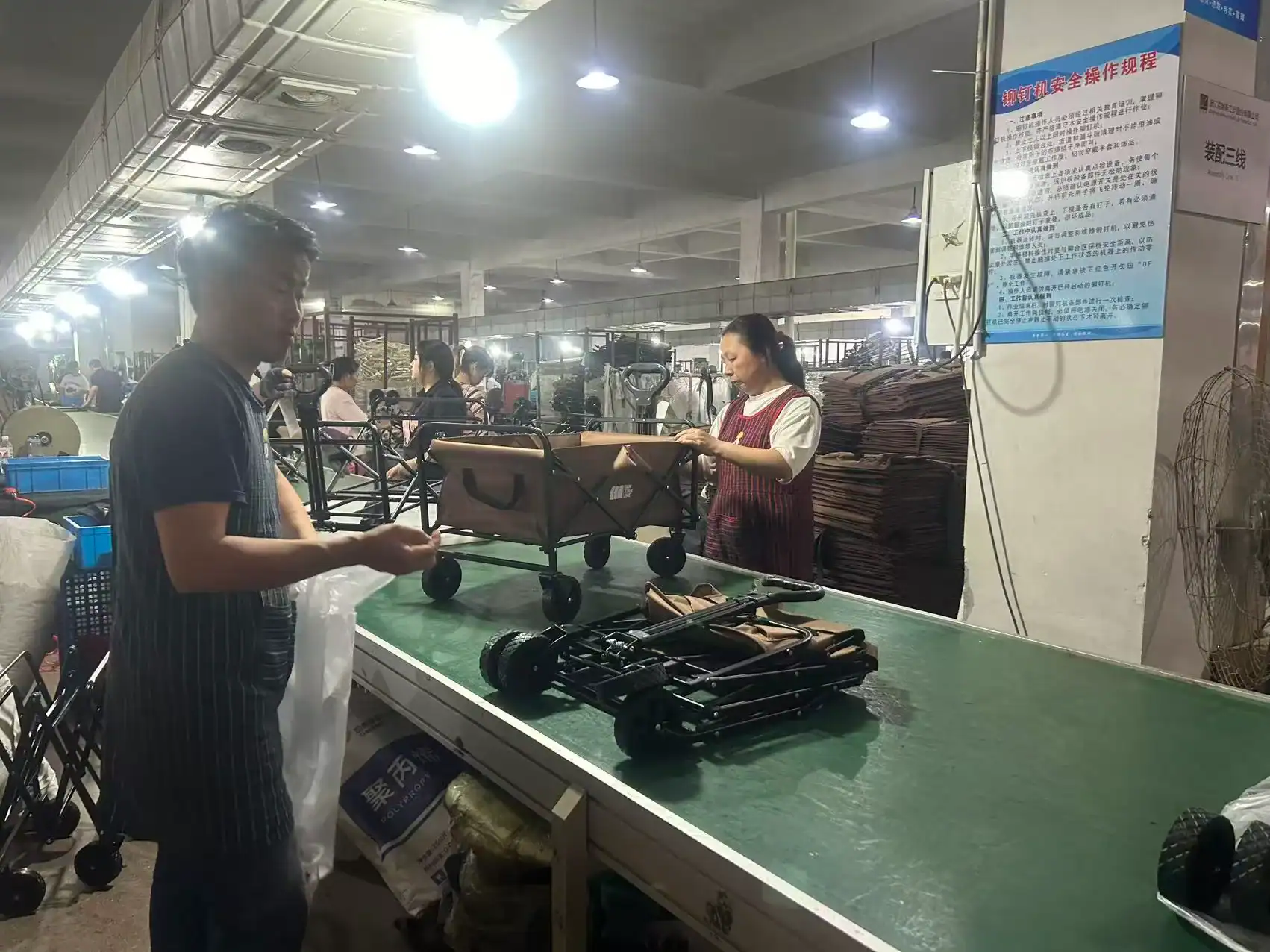
Strategies to Lower Your Folding Wagon MOQ
Mix SKUs, stay on standard parts, and a 300-unit wagon order starts to look realistic.
A folding wagon MOQ is not a fixed number. For standard catalog models, factories typically quote 300–1,000 pieces. But that range assumes one SKU, one color, one factory — the most expensive way to structure a first order.
Pool orders across a factory network
A single wagon factory sets its MOQ against its own production schedule. Work through a sourcing partner with 17 core strategic factories and over 200 manufacturing partners, and that math changes. A 300-unit wagon run can sit alongside camping chairs or coolers from the same network. The container fills, freight per unit drops, and the wagon MOQ stops being the bottleneck.
Mix SKUs in one container
Folding wagons collapse flat, and nested packaging makes them container-efficient. That works in your favor. Two colors or two models in a single 40HQ can each land at a lower minimum while still hitting the factory’s total threshold. You spread inventory risk instead of betting the whole order on one design.
Stay on standard components
The steepest MOQ jump comes from custom-printed fabric. Dye lots and printing setup fees push that to 500–1,000 pieces per design. Changing only the logo keeps you in the semi-custom tier — some items start at 50–100 pieces. That’s the difference between testing a market and betting your entire budget on it.
-
- Standard frame and fabric: 600D–900D double-layer Oxford fabric and powder-coated carbon steel or aluminum frames already run continuously at the Jinhua wagon factory, so they carry no setup premium.
- Custom-molded parts: Custom injection-molded wheels or baseboards need new tooling. That mold cost amortizes into the unit price and pushes the minimum order higher — avoid it on a first order.
ISO 9001-certified lines hold consistent quality tolerance on those standard parts. If a supplier steers you toward a fully custom frame on order one, ask why. Usually it’s their margin talking, not your product strategy. The catalog build already handles 50–200kg loads.
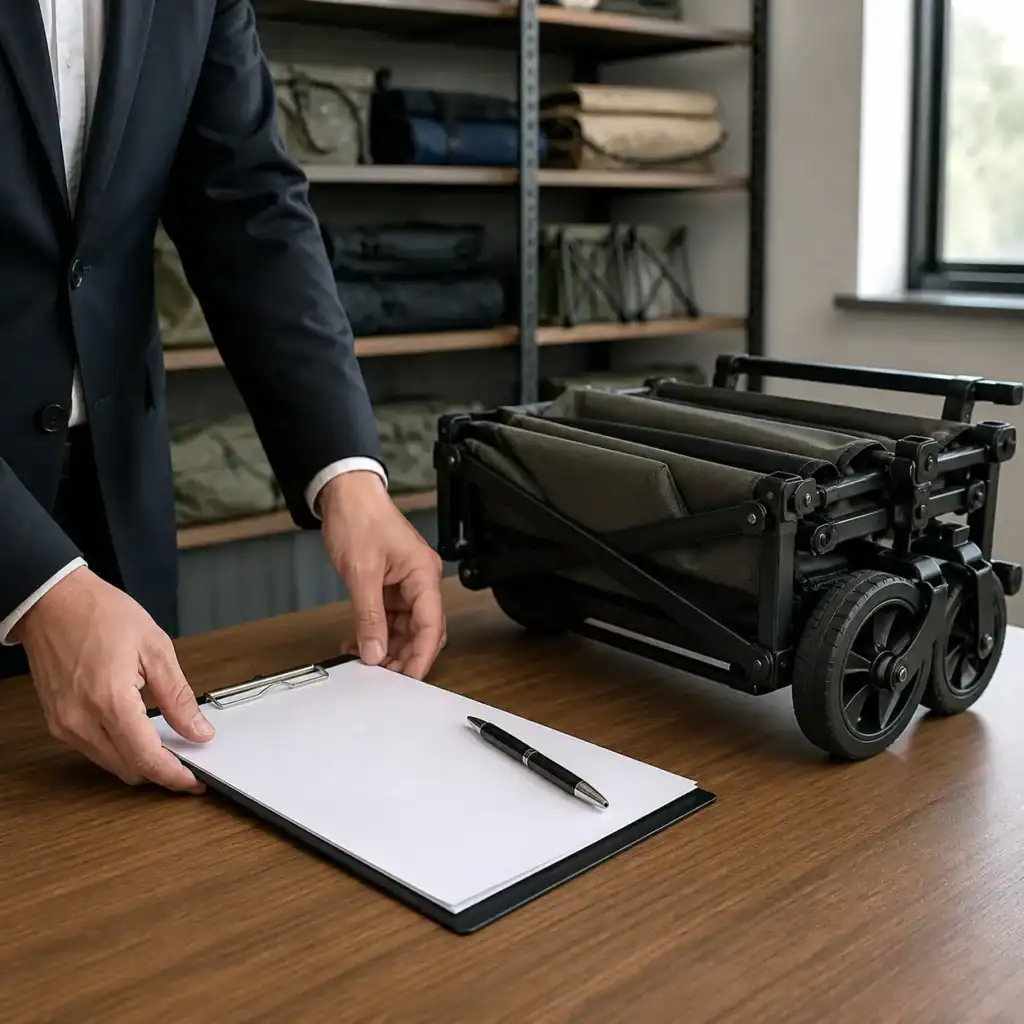
Questions to Ask a Supplier Before Signing
A quoted MOQ means nothing until you know how it splits across colors, SKUs, and fabric prints.
First question to ask: does the quoted minimum apply to the whole order or to each SKU and color way? A supplier that says “300 units” might mean 300 total across four colors, or 300 per color. The difference is 1,200 units of inventory you may not be ready to carry.
Is the MOQ per design or per color way?
Get the exact breakdown: per model, per color, per fabric print. Standard catalog wagons from Jinhua-based factories typically run 300-1,000 units per model. Some items drop to 50-100 pieces for basic customization. But custom printed fabric triggers a separate 500-1,000 piece commitment because dye lots and screen printing setup fees don’t scale down.
Change the logo and keep the stock fabric color, and the MOQ stays at the lower end. Introduce a new 600D-900D Oxford fabric color or custom print, and the factory treats it as a new production run with its own minimums.
What customization is included in the MOQ?
-
- Logo printing: Usually included at the base MOQ. Screen printing on an existing fabric color adds minimal cost.
- Fabric dyeing: A custom Pantone-matched color pushes the MOQ to 500-1,000 pieces per color way.
- Frame components: Custom powder coating for carbon steel or aluminum frames is feasible at mid-tier volumes. Custom injection-molded plastic parts need tooling that only amortizes at 1,000+ units.
- Packaging: Custom printed cartons and labels are usually flexible at 300 units, but the packaging MOQ can differ from the product MOQ. Ask separately.
Can you combine wagons with other camping gear in one container?
This is where the economics shift. A folding wagon’s collapsed design and nested packaging allow multiple customized SKUs to mix into a single 40HQ container. You hit factory MOQs without over-buying one design. A sourcing partner with 17 core factories can pair your 300-unit wagon order with chairs or coolers from other factories, keeping the container economical even when the wagon alone wouldn’t justify it.
Before signing, confirm that mixing SKUs in one container doesn’t void the per-SKU MOQ. Some factories insist each SKU hits its own minimum. Sourcing partners who control multiple production lines can consolidate more flexibly.
Conclusion
The numbers that matter on a custom folding wagon order are the MOQ tier and the calendar. A 300-unit standard order ships fine, but a 50-100 unit semi-custom run with a logo-only change gets you to market faster and with less cash tied up in inventory. Sit on that decision for one month, and the same wagon still costs several dollars more per unit when freight runs alone instead of mixed into a 40HQ.
-
- Standard folding wagon MOQ runs 300-1,000 units; a semi-custom logo order can start at 50-100.
- Custom-printed fabric triggers a 500-1,000 piece MOQ due to dye lots and setup fees.
- Mixing wagon SKUs with chairs in one 40HQ container lowers freight and meets minimums.
- Production lead time runs 30-45 days; a sample approval delay can push past your launch window.
If your launch plan still feels uncertain, align your target sell-through rate with the 300-unit threshold before committing to a full custom build. Review the folding wagon product page for catalog models and semi-custom specs, then compare those options against a mixed container of wagons and camping chairs to see which path protects your margin. That is the cheapest sample you can approve: a desk-level check before the factory presses start.
Frequently Asked Questions
What is the MOQ for custom folding wagons?
Custom folding wagon MOQ starts at 50-100 units for basics like color or logo changes, while standard catalog models typically require 300-1,000 units. Full custom tooled parts can push that number higher. Share your customization level to get the exact MOQ.
Can I mix wagon models in one MOQ?
Yes, a one-stop sourcer can combine multiple wagon SKUs in a single order to help you reach MOQ thresholds. This works best when you stick to standard components instead of fully custom molded parts. Ask your supplier for mixed-SKU MOQ terms.
Why is MOQ higher for custom wagon parts?
Custom wheels, frames, and injection-molded plastic parts require dedicated molds and extra setup, which raises the MOQ. Logo-only or fabric-color changes stay at the lower end of the range. Choose standard components to keep MOQ down.
Does container size affect wagon pricing?
Yes, container-based ordering is the typical pricing unit, and filling a container lowers per-unit cost. The usual 300-1,000 unit MOQ aligns with practical container loads for folding wagons. Ask for container-load pricing before comparing quotes.
Can I combine wagons with other camping gear?
Yes, folding wagons can be combined with other camping gear in one container to reach practical order thresholds. A one-stop sourcer with multiple factories makes mixed-category orders feasible. Use one container to test multiple product categories.

 English
  Español
  Deutsch
  Français
  Português do Brasil
  Русский
  العربية
  한국어
한국어  日本語
日本語