 跳到内容
跳到内容 
inflatable tent quality control is the first checkpoint buyers should lock before they approve a supplier, budget, or production slot. Day 1, the purchase order lands in Ningbo. Day 14, the pre-production sample arrives via air freight—beam structure feels solid, the welds look clean, and the FOB pricing came in 8% under budget. You sign off on the sample approval. Day 45, the container hits Rotterdam. Day 48, the first return request pings your inbox. A glampsite operator in Wales sends a photo: three air beams half-deflated after a single weekend of coastal wind. The mass production run didn’t hold the same quality tolerance as the sample. Now you’re sitting on 400 units with a leak rate that kills any chance of repeat wholesale orders. Inflatable tent quality control isn’t a checkbox at the end of production—it’s a set of pass/fail thresholds that either hold your supply chain together or unravel it in the customer’s hands.
Most sourcing checklists for inflatable shelters stop at a visual once-over and a handshake. That approach misses the three failure modes that actually trigger warranty claims: micro-leaks across high-frequency welded seams, beam wall thickness variation below 0.55mm, and PVC formulations that degrade six months faster than spec because a factory stretched its regrind ratio. A solid QC protocol replaces subjective judgment with measured numbers. If your current spec sheet doesn’t include a 24-hour air retention benchmark, a tensile target for seam samples, and a material thickness tolerance by beam section, you’re not inspecting—you’re hoping.

The Core Tests Every QC Inspection Must Include
Most inflatable tent field failures trace back to defects no visual inspection can detect.
Hidden Failure Modes
-
- Weld micro-channels: Tiny gaps form inside high-frequency welds when tooling temperature fluctuates during production. The outer surface looks sealed. Air escapes through internal pathways that open under inflation pressure.
- Valve seat creep: The rubber gasket inside the inflation valve compresses over time. A visual check confirms the valve is present. Only a sustained pressure test reveals the slow leak rate.
- Coating porosity at fold lines: PVC and TPU coatings develop microscopic cracks where beams fold for packing. These cracks open under inflation pressure but remain invisible when the tent sits deflated on the inspection table.
- Plasticizer migration: When PVC compound lacks enough stabilizer, the plasticizer migrates out. The seam bond weakens. The tent looks fine until someone leans against a beam and the weld peels apart.
A sharp chemical smell off the fabric signals a deeper problem. Factories that regrind production scrap into new compound without adding fresh UV stabilizers produce material that looks identical to virgin PVC on day one. After four weeks of sun exposure, the coating yellows and turns brittle. The beams crack at the crease lines. Smell the fabric during a factory visit. If it stings your nose, request the compound batch sheet.
The gap between visual QC and real quality control is measurement. Pressure decay gauges catch micro-leaks before shipment. A 24-hour hold test with a calibrated digital manometer costs under $200 in equipment and about five minutes of setup time per tent. Compare that to the cost of a single warranty return from a retail partner.
A third-party inspection agency that only does visual checks is not enough for inflatable tents. The contract needs to specify destructive seam pull testing on a sample from the production batch. It needs to mandate a 24-hour pressure hold with documented start and end gauge readings. The better factories run in-line inspection stations at each production stage, not just a final once-over before packing. If a factory pushes back on adding these tests to the QC protocol, that tells you more than any visual walkthrough ever could.
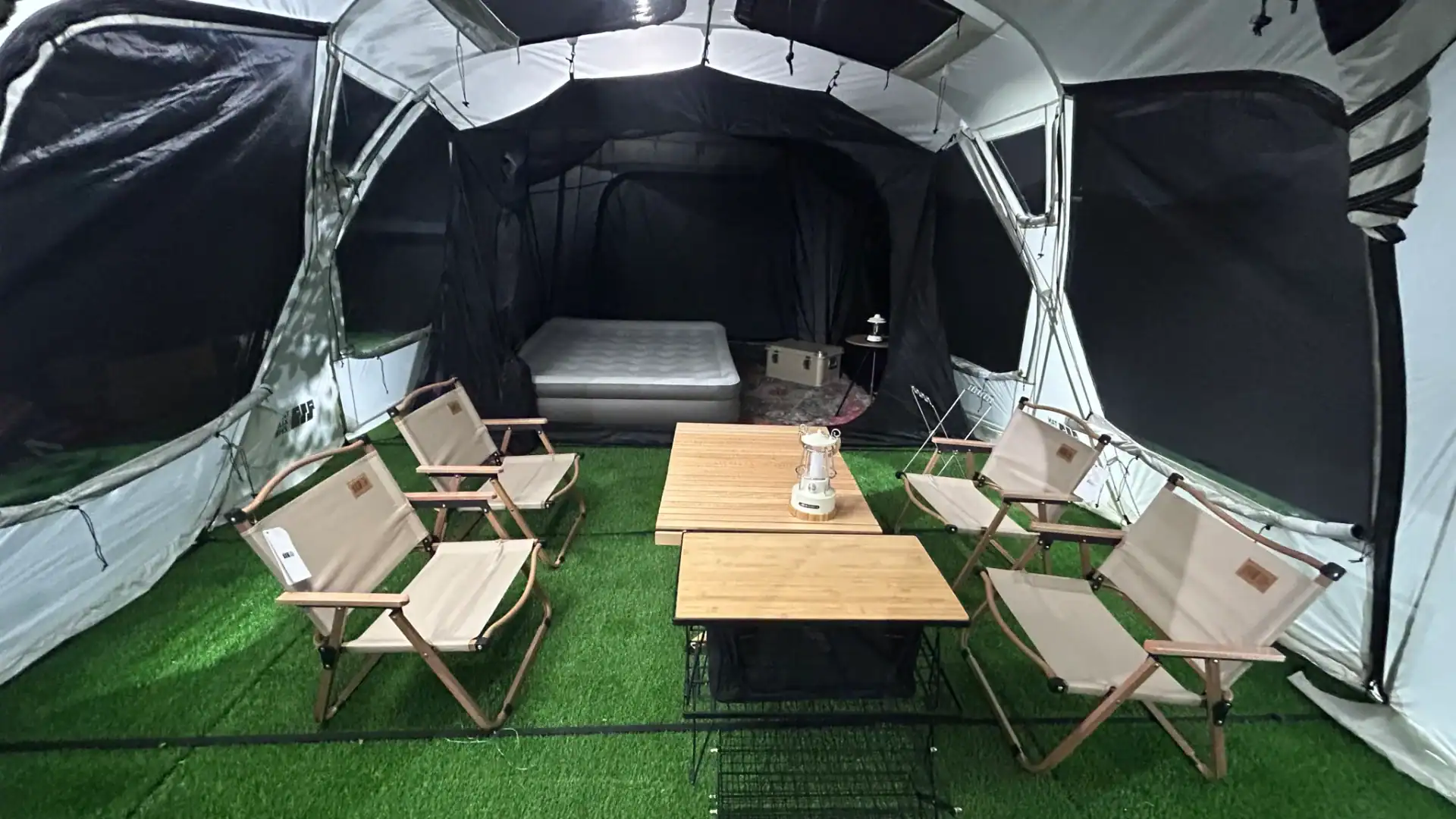
Air Retention Testing: Pass/Fail Criteria
A 10% pressure drop in 24 hours is the industry baseline; brands selling to cold-weather or premium markets tighten the limit to.
The 24‑hour pressure drop benchmark is not a single number you can copy from a competitor’s spec sheet. It depends on the beam diameter, ambient temperature swing during the test, and how the factory interprets “fully inflated.” Most third‑party inspection protocols start at 7–8 psi and consider a 10% loss acceptable. If a 6‑chamber family tent falls from 8 psi to 7.2 psi overnight, the factory calls it a pass. Brands targeting four‑season users or rental fleets often override that, writing a 5% cap into the purchase agreement. That tighter window catches micro‑leaks at valve seats and seam overlap points that a 10% threshold masks entirely.
What a 10% Drop Actually Means for Your Inventory
A tent that loses 10% overnight doesn’t collapse. It sags. The beam geometry shifts, the flysheet loses tension, and condensation channels stop draining. That’s when end‑user complaints start: the tent feels unstable, the door zip snags, the porch roof pools water. Customer returns spike six to twelve weeks after delivery because the product technically holds air but fails the user’s comfort threshold. Supply chain managers who skip this test inherit a defect that no amount of seam tape can fix after the beams are welded.
Equipment That Makes the Test Legitimate
-
- Digital manometer: Measures pressure in 0.01 psi increments. Analog gauges drift with temperature and are useless for a 24‑hour comparison. A manometer with data‑logging removes operator error.
- Climate‑controlled tent bay: Temperature shifts of even 3°F alter internal pressure enough to fake a pass or fail. Factories that run the test on an open factory floor produce garbage data.
- Soap‑film applicator: Locates slow leaks at valve collars, weld termini, and TPU‑PVC transition joints. A pin‑hole at the valve collar can drop pressure 3–5% overnight without producing an audible hiss.
- Calibrated inflation pump with auto‑cutoff: Prevents over‑inflation at setup. If the starting pressure drifts even 0.2 psi between tests, the 24‑hour result is invalid.
Kelyland’s tent‑category partner factories maintain dedicated QC bays with data‑logging manometers and controlled temperature zones. Their internal protocol runs the 24‑hour test on statistical samples drawn from each production lot, not just on pre‑shipment units. The resulting pressure‑drop records become part of the shipment dossier supplied to the brand’s supply chain team. If a batch shows a trend toward the 8–10% boundary, beam welding parameters are recalibrated before the next production run. That in‑line correction cycle, embedded in the ISO 9001 framework across the core factory network, eliminates the standard industry habit of catching a pressure leak at final inspection and hoping the next batch behaves differently.
Seam Welding Strength & Aging Protocol
Seams that test below 60 N/cm are pre-qualified returns.
A seam is not a seam. In inflatable tent construction, the joint where two PVC or TPU panels fuse is the structural backbone of the entire shelter. A visual inspection of a fresh weld tells you nothing about how it performs after 50 inflation cycles under desert sun. The failure mode is clean: the material adjacent to the weld tears because the weld itself was too hot, degrading the polymer. Or the weld peels open because the dwell time was too short. Two different root causes. Both end the same way — a collapsed air beam at 2 AM with campers inside.
The 60 N/cm Threshold Is a Baseline, Not a Target
High-frequency welding creates a molecular bond by agitating PVC molecules under pressure and radio frequency energy. The standard tensile benchmark across most OEM spec sheets is a minimum of 60 N/cm before tearing. Factories that achieve 60 N/cm on a coupon sample but deliver production units averaging 45 to 50 N/cm are not rare. The gap comes from machine calibration drift. HF welders run 8 to 10 hours straight during peak season. Electrode temperatures creep up. Die alignment shifts. Nobody recalibrates unless an inspector demands it.
-
- Low-frequency failure: A weld peeling below 40 N/cm usually traces to insufficient dwell time. The operator shortens the cycle to hit daily output targets. Request a pull-test on five random seams per production lot — not one pre-selected demo seam.
- High-frequency burn: A weld at 70+ N/cm looks good on the gauge but the material beside the bond line has lost elongation. This seam passes the tensile test today and cracks along the heat-affected zone after six months of UV exposure. Cross-section microscopy catches this. A pull-test alone does not.
Aging Protocols That Expose Formula Shortcuts
UV stabilizers and plasticizers are the most expensive components in PVC compounding. A factory running thin margins cuts here first. The result is a tent that welds fine, inflates tight, and ships looking perfect. Twelve months of UV and heat cycling later, the material yellows, stiffens, and the seams delaminate. Accelerated aging condenses this timeline. A QUV test chamber running cycles of 8 hours UV at 60°C followed by 4 hours condensation at 50°C simulates roughly a year of outdoor exposure in about 30 days. Combine this with heat cycling — inflate to rated pressure, deflate, repeat 200 times inside a chamber cycling between -10°C and 45°C — and you expose every material compromise before a single unit ships.
A practical red flag during factory walkthroughs: a strong chemical odor near the welding line. Recycled PVC scrap, when re-ground and fed back into the calender line, carries degraded stabilizers. A factory that does not recalculate and replenish UV inhibitor ratios produces material that ages fast. The smell is unmistakable — sharp, plastic-heavy, not the faint sweet odor of virgin compound. If your inspector can smell the production floor from the office, demand full accelerated aging test reports. Do not accept a passing tensile test alone as proof of material integrity.
Partner factories operating under a structured sourcing network apply in-line inspection at each production stage rather than relying on a single final audit. This protocol catches weld calibration drift and material batch variance before 2,000 units accumulate in finished-goods inventory. The 17 core factories in the Kelyland supply network hold current ISO 9001:2015 certifications and maintain documented inspection records — not as a marketing claim, but as a contractual deliverable tied to each purchase order.
Material Thickness & Coating Consistency
Why Thickness Specs Matter More Than You Think
Most sourcing managers rely on the spec sheet alone. That’s a mistake. Spec sheets from different factories use different measurement baselines. One factory’s “0.55mm” might include the coating layer. Another’s might be base fabric only. You need to standardize the measurement protocol during the sample approval stage, before any mass production commitment.
Measuring Fabric and Beam Wall Thickness
The tool you need is a digital thickness gauge with 0.01mm resolution. Not a caliper. Calipers compress soft PVC and give false readings. A drop-gauge with a dead-weight foot applies consistent pressure — typically 1 kPa for textiles and coated fabrics — and gives you a number you can reproduce across different inspection lots.
For air beam material, take five measurements across the weld zone and five on the main body, at least 50mm from any seam. Record the minimum, not the average. A single thin spot creates the failure point. The internal production specification for puncture-resistant PVC on camping air structures runs 0.4mm to 0.6mm. Below 0.35mm on any single measurement point, reject the lot or negotiate a quality tolerance adjustment before accepting the shipment.
-
-
- Base fabric weight: Oxford weave density affects how the PVC coating bonds. 600D Oxford at 0.5mm coating thickness outperforms 300D Oxford at 0.6mm in tear resistance. Ask for both numbers.
- Coating uniformity: A 0.1mm variation across the same panel signals poor calender control at the coating line. That panel will age unevenly under UV exposure.
- Beam wall concentricity: For tubular air beams, measure wall thickness at four points around the circumference. Eccentricity over 15% means the extrusion die needs maintenance.
-
The Smell Test: Spotting PVC Formula Shortcuts
Open a new PVC tent straight out of the carry bag. A mild, slightly sweet chemical odor is normal — that’s residual plasticizer off-gassing, and it dissipates within 48 hours of airing out. A sharp, acrid, nose-burning smell is something else entirely. That’s the signature of recycled PVC compound that skipped the UV stabilizer adjustment step.
Here’s what’s happening at the raw material level. PVC resin loses plasticizer molecules every time it goes through a heat cycle. Regrind material from production scrap has already been through one or two heat histories. If a factory feeds that regrind back into new tent production without adding fresh UV stabilizers and plasticizers to compensate, the resulting compound is brittle at the molecular level. It looks fine on day one. Under six months of UV exposure, it yellows. Under twelve months, it cracks at the fold lines.
-
- Red flag #1: Strong chemical odor that lingers after 72 hours of ventilation. Virgin PVC with proper formulation off-gasses quickly. Recycled-heavy compound keeps emitting volatiles.
- Red flag #2: Inconsistent coloration across panels. Slight shade variations indicate blended regrind batches from different production runs, each with different pigment histories.
- Red flag #3: Surface tackiness or uneven gloss. Excess plasticizer migration creates sticky patches. Under-formulated recycled material goes matte and chalky within weeks.
Combining thickness verification with the smell check takes under three minutes per unit during incoming inspection. Skip it, and you’re gambling your entire season’s margin on a supplier’s raw material sourcing discipline. ISO 9001-certified factories maintain batch-level traceability on their PVC compound suppliers. If a factory hesitates to show you the compound supplier’s spec sheet, that hesitation tells you everything.
| Feature | Specification | Advantage |
|---|---|---|
| PVC Air Beam Wall Thickness | 0.4 mm – 0.6 mm | Puncture resistance, optimal weight-to-strength ratio |
| Fabric Coating Type | PU / Silicone / PVC coating options | Waterproof integrity, UV stability, tear resistance |
| Coating Consistency Check | Visual streaks inspection + digital thickness gauge | Prevents weak spots, delamination, and premature wear |
| PVC Formula Purity (Odor) | Low or no sharp chemical odor | Absence of recycled scrap; confirms UV stabilizer content, delays yellowing |
| Material Thickness Tolerance | ±5% of nominal gauge across all panels | Uniform stress distribution, reliable seam welding performance |
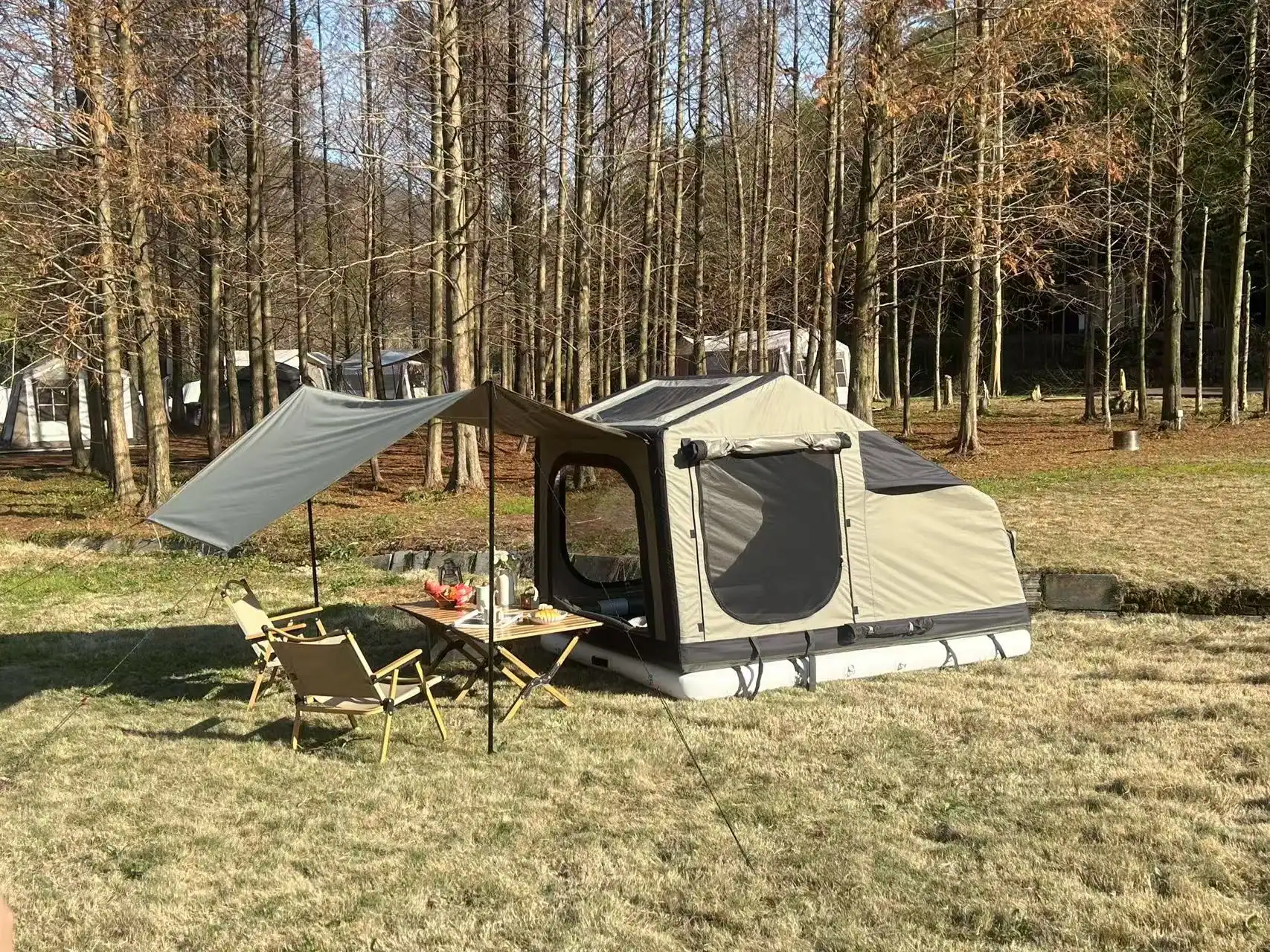
Factory Audit Checklist: Red Flags to Spot
Final-only QC catches maybe 15% of defects.
In‑Line Inspection Stations vs. Final‑Only Checks
Walk a factory floor during production. If you don’t see a dedicated QC station after the high-frequency welding machine, you’re looking at a final-only facility. The difference matters at container scale. In-line inspection places a trained operator or automated gauge directly after each major process step — beam welding, grommet setting, valve attachment — and rejects defective components before the next part gets attached. Final-only inspection looks at the fully assembled tent after it comes off the line. By then, a batch of 300 tents with the same beam weld defect is already boxed and palletized.
Three red flags that signal final-only operations: no pressure decay test station between welding and assembly, unmarked reject bins with zero defect tracking paperwork, and an air retention test area that can only hold 4-5 tents at a time. A line running 500 units per day needs capacity for at least 20 simultaneous tests. Less than that, and math says they skip tests to hit the schedule.
-
- Beam Weld Station: Pressure test each air beam to 1.5x working pressure for 60 seconds before assembly. Rejects identified here prevent downstream labor waste.
- Material Feed Check: Caliper measurement every 50 linear meters of PVC fabric. Thickness drift below 0.55mm on a 0.65mm spec means the extruder temperature is fluctuating.
- Final Assembly Area: Full tent inflation to working pressure with a 2-hour monitored hold. This catches valve leaks and seam micro-porosity that component-level testing misses.
How Kelyland Partner Factories Enforce ISO 9001 Compliance
The camping tent and tarp partner factory in Ningbo carries CE, BSCI, and ISO 9001 certifications. That last one matters for audit consistency. ISO 9001:2015 requires documented procedures, corrective action logs, and traceable inspection records — not just a certificate on the wall. During production, inspectors log seam weld temperatures, pressure hold times, and material batch codes into a traceable system. If a batch of air beams shows a 6% pressure drop at the 24-hour mark instead of the standard 5%, the audit trail identifies which shift ran that weld line and which PVC roll was in use.
Pre-shipment inspection at these facilities pulls an AQL 2.5 sample. They inflate each sampled tent to working pressure, mark the gauge reading, and check again at 2 and 24 hours. The pass mark is a max 5% pressure drop. Seam samples get cut and pulled on a tensile tester — the target is a minimum 60 N/cm before the weld tears in the material, not at the bond line. Coating adhesion gets cross-hatched and tape-pulled. Every checkpoint generates a timestamped record. Ask for it. If the factory hesitates to share inspection reports mid-production, treat that hesitation as a bigger red flag than any single test failure.

Conclusion
Skipping a structured inflatable tent QC protocol doesn’t just risk a batch of leaky products. It risks a container load of warranty claims hitting your desk six months after delivery, devouring the margin you booked on the seasonal order. A 10% pressure drop is the industry’s generous pass mark; a 5% internal bar is what separates a supplier that manages risk from one that manages a returns pile. The 60 N/cm seam tensile minimum isn’t a suggestion—it’s the line between a weekend tent and a tent that survives a windy campsite season without delaminating. Factories that cut PVC stabilisers to save cost telegraph that failure through the plastic smell of the floor before a single UV test chamber runs its cycle.
-
- Demand a 5% maximum air retention loss over 24 hours, not the looser 10% industry norm.
- Require seam tensile above 60 N/cm and ask for accelerated aging evidence.
- A sharp chemical odour from floor material signals a PVC formula that will yellow early.
- Only partner with factories running in-line inspection stations, not just a final once-over.
Your next step is to measure your current supplier’s quality tolerance against these pass/fail benchmarks before the next sample approval window opens. A partner like Kelyland Outdoors already operates its core tent factories under ISO 9001:2015 with in-line checks at every production stage, not just the loading dock. Review the full inflatable tent production specs to compare material thickness, seam construction, and audit trail documentation against what your current supply chain delivers.
Frequently Asked Questions
What is the acceptable pressure drop for inflatable tents?
A 10% pressure drop in 24 hours is the industry baseline. Brands targeting cold-weather or premium markets often tighten this to 5% to prevent early-morning sag. Specify the target pressure drop in your QC protocol before production starts.
How strong should inflatable tent seams be?
High-frequency welded seams should withstand at least 60 N/cm tensile force. Anything below this threshold almost guarantees field failures and returns. Request seam strength test reports for every batch, not just the gold sample.
What equipment is needed for air retention testing?
A calibrated digital manometer and a temperature-compensated pressure logging system are essential. Manual gauge checks without temperature control produce unreliable pass/fail data. Ensure the factory uses a data logger, not just a spot check with a handheld gauge.
What are red flags in an inflatable tent factory audit?
The biggest red flag is a factory that only performs inspection on finished goods instead of in-line checks. Relying solely on end-of-line inspection misses hidden seam and beam. Walk the production line and confirm weld strength tests happen during, not after, assembly.

 English
  Español
  Deutsch
  Français
  Português do Brasil
  Русский
  العربية
  한국어
한국어  日本語
日本語