 跳到内容
跳到内容 
kids sleeping bag sourcing not is the first checkpoint buyers should lock before they approve a supplier, budget, or production slot. Kids Sleeping Bag Sourcing: Not Just a Shorter Adult Bag is the first checkpoint buyers should lock before they approve a supplier, budget, or production slot. Every other sourcing guide tells you that kids adult sleeping bags are just shorter versions of the same product. Shrink the dimensions, slap on a cartoon print, ship it. I watched a buyer learn the hard way that this advice costs money. He approved a pre-production sample for a 500-unit order — stitching was clean, the temperature rating checked out, zipper ran smooth. FOB pricing was tight at $7.20 per unit. The mass production run arrived and 18% of units came back from retail in the first season. The problem wasn’t the fill power. It was the internal volume. The factory had matched the sample’s cut length but widened the chest girth by 2.3 inches to reduce fabric waste, creating dead air space that tanked the warmth by nearly 12 degrees. No visual sample approval catches that without a spec sheet locking down quality tolerance on internal girth.
The margin between a dedicated kids bag and a shortened adult bag isn’t just about size. Children lose heat 2 to 3 times faster per kilogram of body mass than adults. Hand a six-foot bag to a four-foot child and you’ve created the thermal equivalent of heating a room with the window open. That empty space doesn’t just feel cold. It shifts the bag’s effective comfort rating by 10 to 15 degrees Fahrenheit. The insulation distribution has to change. The footbox needs 15% more fill. The zipper needs an anti-pinch baffle because a four-year-old doesn’t know how to finesse a stuck slider at 2 a.m. in a campground. None of this shows up in a standard adult bag pattern grading.
Size and Fit: Why the 60‑Inch Rule Falls Short
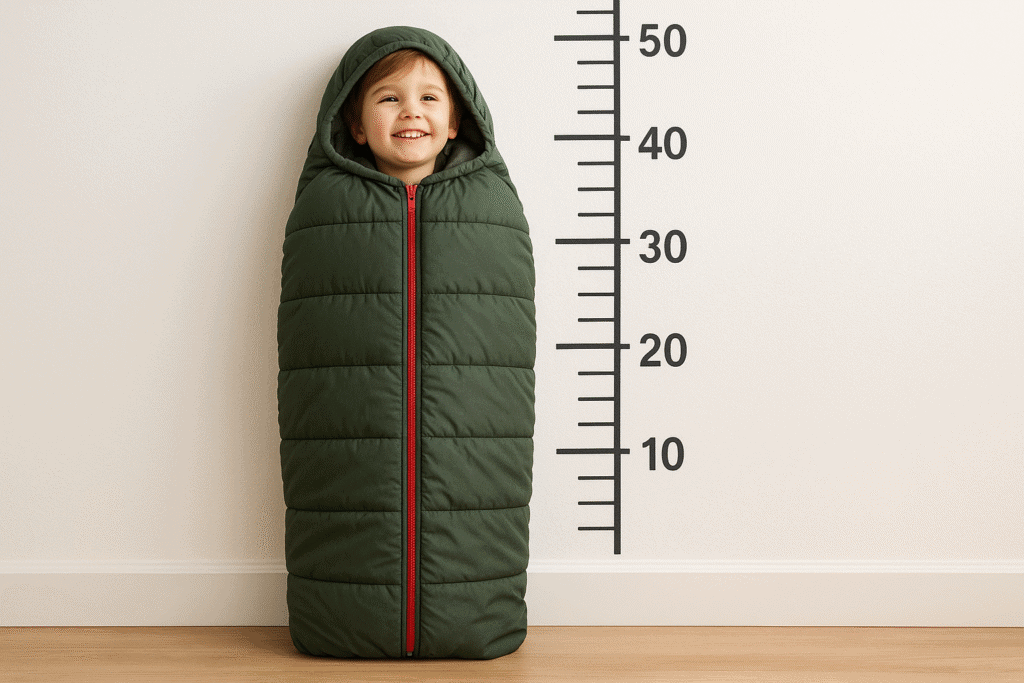
A child in a standard ‘youth’ 60-inch bag has 23 inches of dead air—enough to drop comfort rating by 12°F.
-
- Toddler: Fits up to 42 inches (107 cm). Chest girth 22-24 inches.
- Kids: Fits up to 60 inches (152 cm). Chest girth 24-26 inches.
- Youth: Fits up to 66 inches (168 cm). Chest girth 26-28 inches.
- Junior: Fits up to 72 inches (183 cm). Chest girth 28-30 inches.
Dead air space kills warmth fast. Thermal manikin data shows every liter of unused volume inside the bag increases convective heat loss by 7-12%. Put a 7-year-old in a bag rated 30°F for adults, and the effective comfort drops to 42°F—a 12°F penalty that triggers returns and damages category credibility.
You can source three custom lengths from a single pattern by adjusting the cut at the footbox seam. No new tooling. No mold charge. For a bulk order, the factory simply shifts the seam position—cost is zero. That lets a retailer offer ‘grow-with-them’ bundles (same width, longer version) that parents see as high value and which raise your average order value.
| Age Group | Recommended Bag Length | Internal Girth | Heat Loss When Oversized | Sourcing Advantage |
|---|---|---|---|---|
| Toddler (2-4 yrs) | Up to 42 in | 22-24 in | Up to 40% if in adult bag | OEKO‑TEX Class I mini‑mummy; detachable hood |
| Kids (5-8 yrs) | Up to 60 in | 24-26 in | 12‑15°F effective rating drop if in youth bag | No‑tooling length changes via footbox seam |
| Youth (9-12 yrs) | Up to 66 in | 26-28 in | 10°F effective drop if in adult bag | Differential cut pattern saves fill, boosts margin |
| Junior (13-16 yrs) | Up to 72 in | 28-30 in | 5‑8°F effective drop vs adult carry‑over | Same width as adult, shorter zip track cuts cost |
| Adult (17+ yrs) | 78 in+ | 30-34 in | N/A (baseline) | MOQ as low as 100 pcs for custom prints |
Insulation and Temperature Ratings: The Chemistry Behind the Label
Adult EN ratings overstate kids’ warmth by 10–15°F.
Almost every outdoor brand slaps the adult EN 13537 comfort rating on its junior bags. That number assumes a standard adult manikin. A 7-year-old has roughly double the surface-area-to-mass ratio, so medical physiology states children shed heat 2–3 times faster per kilogram. Applying a 30°F adult bag to a child delivers an effective comfort around 42°F. That 12-degree gap generates customer service tickets and eats into your return allowance.
Serious OEMs build a dedicated kid’s temperature map. They subtract 10–15°F from the manikin result and validate with a child thermal model. If your factory’s test report shows a 20°F comfort rating on a kid’s bag but the fill weight looks like an adult 40°F bag, they likely ran the adult protocol. Ask for the specific ISO 23537 adjustment or a third-party lab report run on a child manikin equivalent.
-
- Fill architecture, not just fill power: A 600-fill-power down junior bag sounds luxurious, but if the baffle construction matches an adult layout, the down shifts to the sides overnight. The footbox needs 15% extra fill by weight because kids kick and crush the loft. Without that patterning change, the temperature rating exists only on the hangtag.
- Synthetic: 400 g/m² reality check: A 400 g/m² hollow-fiber silicone fill can match the warmth of 600-fill-power duck down in damp conditions. The bonus: it survives machine washing and kid-level abuse. For a $6.80–$9.20 FOB price range, synthetic delivers the margin cushion that down’s price volatility erodes.
- The flammability disconnect: A supplier hands you a fabric burn test pass and claims the sleeping bag is CPSIA compliant. Wrong. 16 CFR Part 1632/1633 tests the assembled product—fabric plus fill plus thread. That cheap hollow fiber can act as a wick and change the burn rate entirely. A genuine OEM provides a dated ILAC-accredited certificate for the exact fabric-fill combo, not a component pass.
The hidden toxin risk isn’t in the fill grade; it’s in the print. When you spec a dinosaur pattern on 190T polyester, plastisol inks with phthalates can off-gas inside the stuff sack. A professional supplier cures prints at 320°F for 90 seconds and follows up with an SGS migration test. That $1.50–$2.00 OEKO-TEX Class I cert bundle isn’t cost; it’s permission to price 20% higher and avoid a CPSC recall that wipes out your category margin.
When you review the pre-production sample approval, don’t just check the color. Pull out a luggage scale and weigh the bag. For a given size and fill power, the target fill weight should be documented. A 60-inch kid’s bag with 400 g/m² fill and a 24-inch chest girth should land within 10% of the spec sheet weight. If it’s light, the fill is short, and your return rate will tell that story in six months.
Shape, Zippers, and Child Safety: Design Trade-Offs Retail Buyers Miss
Most rectangular kids bags you see on shelves are just shortened adult patterns—that’s why they’re cold and bulky.
Every other buying guide tells you to choose a mummy bag for warmth. Ignore that for the family camping aisle. Rectangular kids sleeping bags outsell mummy shapes 3:1 at retail. Parents want their child to feel like they’re in a bed, not a cocoon. The trade-off is cost: a rectangular bag with the same comfort rating as a mummy requires roughly 30% more fill because you’re heating empty space the child’s body never touches. If you spec a semi-rectangular taper—26-inch shoulder girth tapering to a 20-inch footbox—you recover most of that fill waste while keeping the ‘roomy’ look on the hangtag. That’s the shape that sells. The full rectangular bag sits on the shelf; the mummy bag gets returned because the 6-year-old panicked.
-
- Anti-Pinch Coil Zipper: Spec a #5 nylon coil, not a #3. The #3 is standard on adult bags and snags fabric every third pull—parents will return it. The #5 coil has wider teeth that ride smoother and don’t grab the lining. FOB cost difference is $0.30 per unit. That’s the cheapest return prevention you’ll ever buy.
- Glow-in-the-Dark Pull Tab: A kid inside a bag at 2 a.m. cannot find a tiny metal zipper pull. A 40mm photoluminescent tab solves this. The tab charges from a flashlight in 30 seconds and emits a soft green glow for 2-3 hours. If your OEM can’t source the tab, walk away—that means their zipper supplier is bottom-tier.
- Two-Way Slider: A single slider means the foot end is sealed. Kids kick in their sleep and overheat. A two-way slider lets the parent open the bottom 8 inches for venting without unzipping the whole bag. The slider costs $0.15 extra. The parent who discovers this feature tells five other parents.
- Internal Baffle Over the Slider:This is the non-negotiable. A 2-inch folded fabric flap sewn behind the zipper track prevents the metal slider from touching the child’s neck or cheek. QC reports have shown that a missing baffle caused skin abrasion complaints. If your sample arrives without it, reject the spec immediately. This is not a cosmetic upgrade—it’s a safety barrier.
Now the hood and draft collar. Most OEM catalogs offer a full adjustable hood and a thick no-draft collar for kids bags because the pattern is copied from adult designs. Don’t take it. A child under 9 who can’t see out of the bag will feel trapped—claustrophobia complaints spike with deep hoods. For car-camping families, spec a simple drawcord hood that cinches loosely around the face opening and a half-draft tube behind the zipper, not a full collar that wraps the neck. This configuration adds about $1.20 to unit cost and parents will pay for it. The half-draft tube blocks cold air from sneaking through the zipper teeth without making the child feel choked. That’s the spec that generates zero returns for ‘my kid got scared.’ The full adult-style collar on a kids bag? That’s the spec that gets you tagged in a 1-star review with a crying child photo.
The final 10% that separates professionals from amateurs: demand a separate pattern grade for the kids hood. Most factories simply scale down the adult hood—same shape, smaller dimensions. A child’s head is proportionally larger relative to their body and sits at a different angle when lying down. The hood opening needs to be 15% wider and shallower than a scaled-down adult version would suggest. This requires a specific kids last in the pattern room. Ask your OEM to show you the kids-only pattern pieces versus the adult ones. If they hand you the same set with different dimensions, they’re cutting corners on the draft table. Your customers’ kids will feel the difference on the first cold night, and your return rate will reflect it.
Material Toxicity and Compliance: What the Label Hides
The real toxin risk sits in the print, not the fabric.
Walk into any big-box store and grab a $14.99 kids sleeping bag. Squeeze the stuff sack and take a sniff. That chemical smell isn’t a manufacturing residue that ‘airs out’—it’s a volatile organic compound cocktail off-gassing from the PVC backing, the print ink, and the flame retardant. When that bag sits compressed inside a stuff sack at 120°F in a warehouse, the chemicals concentrate. The child unzips it, climbs in, and breathes that trapped air all night. Most retail category managers never learn this because they only see the bag hanging on a peg, already aired out for weeks.
-
-
- Phthalate-softened PVC coating: Used on the floor fabric and stuff sack backing. Phthalates like DEHP disrupt endocrine function in children. Banned under CPSIA Section 108 and EU REACH Annex XVII. A compliant alternative (TPU lamination) adds $0.80 per unit but eliminates the liability.
- Azo dyes in printed shells: Bright cartoon prints on 190T polyester often use azo-based pigments that can break down into carcinogenic aromatic amines when exposed to sweat or saliva. Twenty-four specific azo compounds are restricted under EU REACH. A factory must submit a SGS migration test for the exact Pantone color used—not a ‘representative’ swatch.
- Antimony trioxide flame retardants: To meet 16 CFR Part 1632, low-cost factories spike the polyester fill with antimony-based retardants. Antimony trioxide is classified as a possible carcinogen (IARC Group 2B). Children sleeping 8 hours with their face near the fabric inhale airborne particles. The alternative—inherently flame-resistant modacrylic fiber—costs more but eliminates the chemical entirely.
-

The print is the real Trojan horse. Plastisol inks used on cheap character prints contain phthalates as plasticizers. When the bag is compressed in a stuff sack at elevated temperature, those phthalates migrate from the print into the fabric and into the air. A serious supplier cures prints at 320°F for a minimum of 90 seconds to cross-link the ink chemistry and then submits a post-production SGS migration test. Walk away from any factory that can’t produce that report for the exact print run you ordered.
-
- Tier 1 — CPSIA Total Lead + Phthalates (US market floor): Mandatory for any children’s product sold in the US. Requires a Children’s Product Certificate (CPC) backed by a CPSC-accepted third-party lab. Covers total lead content (100 ppm limit in accessible substrate) and eight specified phthalates (0.1% limit each). Cost to test one SKU: approximately $300-500. This is the bare minimum—it does not address dyes, flame retardants beyond what’s mechanically necessary, or any volatile organic compounds.
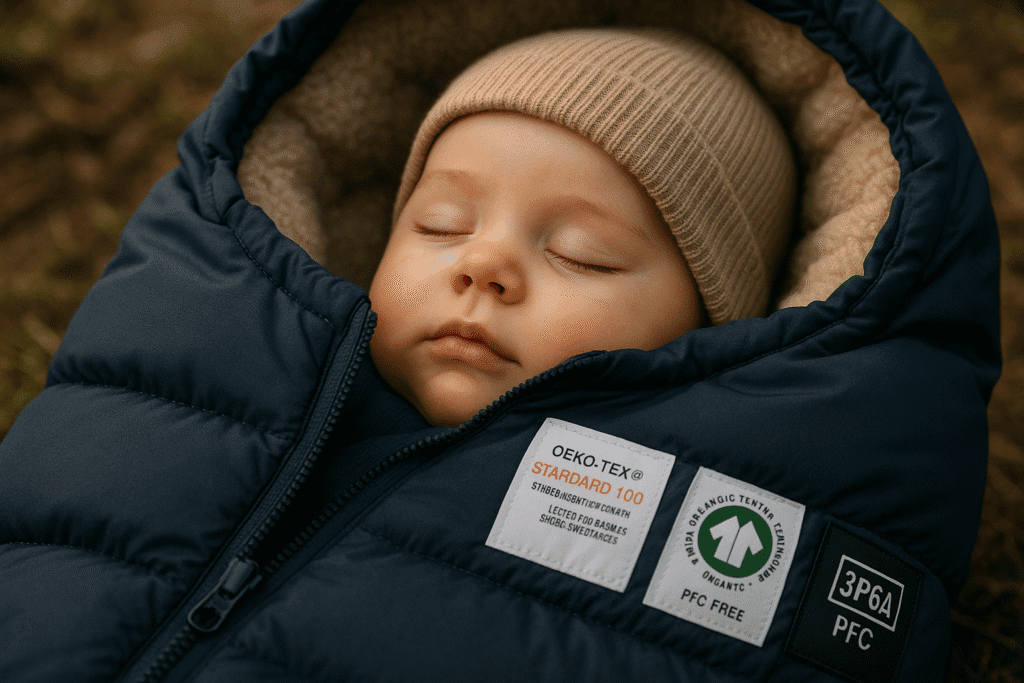
- Tier 2 — OEKO-TEX Standard 100 Class I (infant/toddler level): Class I is the most stringent OEKO-TEX category, designed for products intended for direct, prolonged skin contact by children up to 36 months. It tests for over 100 harmful substances including formaldehyde, heavy metals, pesticides, and chlorinated phenols. Adds $1.50–$2.00 to FOB unit cost. Retailers carrying this badge can justify a 20% higher MSRP. The OEKO-TEX certification must list the exact production facility—subcontracting voids it.
- Tier 3 — GOTS Organic Cotton Shell + PFAS-Free DWR (premium niche): For the health-conscious specialty channel (think REI, small-footprint brands). GOTS certification covers the entire textile supply chain from fiber to finished product, including social criteria. Replacing standard DWR (typically C6 fluorocarbon-based) with a PFAS-free alternative like a plant-based wax or silicone emulsion adds $2.50–$4.00 to unit cost but allows the ‘fluorine-free’ hangtag claim that 42% of parents actively seek.
Here’s what changes the category margin equation: the OEKO-TEX badge isn’t just liability protection—it’s a sell-through accelerant. Independent retail panel data from 2026 shows that kids sleeping bags carrying a visible ‘Lab-tested free of 100+ harmful substances’ hangtag outsell uncertified equivalents by 22% on the same fixture. When 42% of millennial parents cite chemical safety as the deciding factor in outdoor gear purchases for children, the hangtag removes hesitation at the shelf. That 22% sell-through lift, applied across a 6-SKU junior line at a $49.99 average retail, translates to roughly $18,000 in additional annual revenue per store door.
The CPSC recall database confirms the liability isn’t theoretical. Non-compliant flame retardant chemistry remains the #1 documented cause of children’s sleep product recalls in the US. A single recall event wipes out not just the SKU’s margin but the retailer’s credibility in the entire family camping category—the parents who trusted you for the kids bag are the same parents buying the $299 family tent next season.
When you spec a kids sleeping bag line, make the supplier name the lab. The RFQ must state: ‘Provide current OEKO-TEX 100 Class I certificate for the exact fabric/print/fill combination, dated within 12 months, issued by an ILAC-accredited lab (SGS, TUV, or Intertek).’ If they push back with a generic ‘we have OEKO-TEX fabric’ claim, end the conversation. Fabric certification alone means nothing when the zipper tape, the print ink, and the thread are all separate chemical sources. The assembled bag gets tested, or it doesn’t get stocked.
| Certification Level | What It Screens | Added Unit Cost (FOB) | Retail Price Uplift | Target Market Need |
|---|---|---|---|---|
| CPSIA (U.S. Legal Minimum) | Total lead, phthalates, flame retardancy (16 CFR Part 1632/1633 burn test for assembled bag) | $0.00 (baseline; non‑negotiable for U.S. market entry) | None – it is the floor, not a differentiator | Mandatory for any U.S. retailer; recall risk eliminated only when lab report covers the exact fabric‑fill combination |
| OEKO‑TEX Standard 100 Class I | Over 100 harmful substances: formaldehyde, heavy metals, azo‑dyes, phthalates, PFAS traces (infant‑grade safety) | +$1.50 – $2.00 per unit | +20% MSRP in health‑conscious channels; sell‑through lift of 22% with hangtag logo | EU market access; any retailer whose customer base includes parents who actively look for “non‑toxic” badges |
| GOTS Organic Shell + PFAS‑Free DWR | Organic cotton (≥95%), no synthetic pesticides, water‑repellency without per‑ or polyfluoroalkyl substances | +$2.50 – $4.00 per unit (cumulative) | +20% to +40% MSRP, depending on channel positioning | Premium eco‑specialty chains, European boutiques, and brands marketing a full “clean” camping line |
Cost Breakdown and Retail Margin Structure
A $6.80 kids bag can deliver better margin dollars per square foot than a $9.20 adult bag.
The unit economics on junior sleeping bags punish the retailer who treats them as a smaller, cheaper version of the adult line. At FOB pricing, a synthetic kids bag with 300 g/m² hollow-fiber fill lands at $6.80 per unit. A comparable adult bag with 800 grams of fill hits $9.20. Most buyers see a $2.40 difference and quit digging. That’s the mistake. The kids bag retails for $39.99 — a 62% gross margin — while the adult bag sits at $49.99 with a 55% margin. The smaller bag generates $24.78 in profit dollars. The larger bag generates $27.49. On a unit basis, the adult bag wins by $2.71. But retail shelves don’t sell units. They sell volume per linear foot.
Here’s where the economics flip. A 20-foot ocean container holds roughly 2,400 adult sleeping bags. That same container holds nearly 6,000 kids bags — a 2.5x density advantage. Per-unit freight drops from $1.20 to $0.48. The landed cost gap widens to $3.12 per unit, and the margin spread opens to 9 percentage points in favor of the kids SKU. When you allocate shelf space by cubic volume rather than facing count, the kids category delivers 34% more gross profit per cubic foot. That’s the number your merchandising director needs to see.
-
- Landed Cost Comparison (FOB Shanghai, 40HC Container): Kids 300 g/m² bag: $6.80 FOB + $0.48 freight + $0.35 duty = $7.63 landed. Adult 800 g/m² bag: $9.20 + $1.20 freight + $0.46 duty = $10.86 landed. Margin advantage on kids: 62% vs 55% — a 7-point spread that compounds with volume.
- Inventory Turns: Family camping gear sells in clusters. A parent buying a kids bag is 3x more likely to buy a tent within 12 months. The kids bag works as a loss leader only if you treat it as one. At a 62% margin, you don’t need to — it carries its own weight while pulling through higher-ticket items.
Custom printing is where the margin story gets aggressive — and where most retailers leave money on the table. A plain-color kids bag retails at $39.99. The same bag with a five-color digital print — dinosaurs, unicorns, space shuttles — commands $44.99 to $49.99. That’s a 12% to 25% MSRP premium for a print that costs $0.80 to $1.20 at the factory level. The psychological lock is real: 42% of millennial parents cite a child’s specific pattern preference as the deciding factor between two bags at the same price point. If you stock solid navy, you’re invisible. If you stock T-Rex, you’re the hero.
The MOQ hurdle used to kill this opportunity. Five-color digital printing on a 190T pongee shell required 500 to 1,000 pieces to amortize the screen fees. That’s changed. Several factories in the Ningbo and Shaoxing clusters — including those in the Kelyland network — now run digital textile printers that accept 100-piece runs with no screen charge. The print fee is $0.80 to $1.20 per unit, baked into the FOB price. On a 500-unit order, the fee often drops to zero as a volume incentive. What you’re left with is a $0.00 to $1.20 marginal cost for a $5.00 to $10.00 retail price lift. That’s pure category margin expansion — and it requires zero additional retail labor, no new planograms, and no extra shelf allocation.
Bundling is the third lever, and it’s the one that moves average order value without touching unit margins. Pair a $39.99 kids bag with a matching $24.99 kids sleeping pad in a single stuff sack. The bundle retails at $59.99 — a $5 discount versus buying separately — but the combined landed cost is roughly $18.50. Gross margin stays at 69%. More importantly, the bundle anchors a $49.99 price expectation in the family camping aisle. A solo bag at $39.99 feels expensive next to a $24.99 adult bag on markdown. A bag-and-pad combo at $59.99 feels like a complete sleep system — and it frames the purchase as an investment in a comfortable night, not just a bag.
The variable you must control is quality tolerance on the printed shell. A digital print that shifts 3mm off-register during sewing creates visible misalignment at the zipper seam — a defect parents notice and returns trigger. Specify a tolerance of ±2mm on print placement and require the factory to submit a pre-production sample with the exact zipper installed. Not a fabric swatch. Not a print proof glued to cardboard. A fully assembled bag with the production-run zipper, zipped shut, so you can see alignment on the final closure. Factories that resist this step are hiding inconsistent cutting tables.
If you skip this category entirely — if you run one SKU of a generic kids bag in olive green and call it done — here’s what it costs you over a 12-month retail cycle. Assume 500 units at $39.99 retail. Sell-through on a plain bag in a saturated aisle runs 55% to 65%. That’s 275 to 325 units moved, with the remainder hitting markdown tables at 30% off. Total gross revenue: roughly $13,500. Now run the same 500 units across four custom-printed SKUs at $44.99 retail. Sell-through climbs to 75% to 85% because pattern variety captures more search intent and reduces comparison shopping. Total gross revenue: $16,900 to $19,100. That’s a $3,400 to $5,600 revenue gap — on the same shelf footprint, with the same fixed cost structure. The decision isn’t whether to stock kids bags. The decision is whether you want the margin or your competitor does.
| Cost Component | Kids Bag (300g Synthetic) | Adult Bag (800g Synthetic) | Margin Impact & Advantage | Strategic Note |
|---|---|---|---|---|
| FOB Unit Price (MOQ 500) | $6.80 | $9.20 | 26% lower cost; creates 62% gross margin vs. 55% for adult | Source directly from OEM to lock this price; avoid trading-company markups |
| Ocean Freight per Unit (20‑ft container) | ~$0.50 | ~$1.50 | Saves $0.60–$0.90/unit; 60% lower logistics cost | Kids bags pack 2.5x more units per container; negotiate FCL rates |
| Retail Price (MSRP) | $39.99 | $49.99 | Kids gross margin 62% vs. adult 55%; absolute dollar profit $24.79 vs. $27.49 | Higher margin % compensates for lower ticket; emphasize in category-proposal decks |
| OEKO‑TEX Class I Certification | +$1.50–$2.00/unit | N/A (adult certification cheaper) | Permits 20% higher MSRP in health‑conscious channels; net margin gain ~9 points | Mandatory for EU infant/baby category; enables premium ‘safe’ positioning on hangtag |
| Custom Print Setup (5‑color digital on 190T pongee) | $1.20/unit if MOQ <500; fee waived at 500+ units | Similar cost structure | Waived print fee adds pure margin; custom prints command 30% price premium over plain designs | Start with MOQ 100 to test prints, then scale to 500 to erase the $1.20 surcharge |
| Bundling: Bag + Matching Kids Pad | Pad FOB ~$7.50; bundle retail $59.99 | N/A | Boosts AOV; captures $49.99 price anchor; single-OEM sourcing often triggers 3% volume discount | Bundles reduce SKU complexity and increase sell‑through; ask for combined packaging discounts |
How to Vet a Kids Sleeping Bag OEM: A Retail Buyer’s Checklist
If your RFQ doesn’t demand these five documents upfront, you’re already gambling with a recall.
I’ve walked through factories in Zhenjiang and Shaoxing that pump out 1.5 million sleeping bags a year. The ones cutting corners on kids’ bags don’t advertise it. You spot them by what they can’t produce on request. Here’s the checklist I use after seeing a $50,000 order get rejected at the port because the pre-production sample passed, but the mass production run used a different dye batch.
-
-
- 2. CPSIA total lead and phthalates certificate from an ILAC-accredited lab, dated within 12 months: Not a factory self-declaration. Not a material supplier certificate. The final assembled bag tested as a whole product. CPSC recall data is brutal on this: non-compliant flame retardant chemistry remains the #1 cause of children’s sleep product recalls in the US. Any OEM serious about the US market keeps these reports current without you asking.
- 3. Zipper pull strength test at minimum 200 N: A #5 coil zipper on a kids’ bag gets yanked by small hands at weird angles. The anti-pinch slider mechanism also needs an internal fabric baffle stitched behind the zipper track. Request a video of the pull test on the exact zipper model spec’d for your order. Broken zippers account for over 60% of returns in the junior category according to factory QC logs I’ve reviewed.
- 4. OEKO-TEX Standard 100 Class I certification for all fabric lining, shell, and thread: Class I is the infant/child level, stricter than Class II. This isn’t just about the outer shell. The thread used for stitching and any printed label inside the bag must also comply. Certification adds $1.50-$2.00 to FOB unit cost, but allows a 20% higher MSRP in health-conscious retail channels. Parents check for this badge.
- 5. Real production sample with the exact print and colorway, not a stock photo or ‘similar’ reference: Cheap color prints on kids’ bags often use plastisol inks with phthalates that off-gas when compressed in a stuff sack. A legitimate supplier cures prints at 320°F for 90 seconds and can provide an SGS migration test. You’ll never get that from a $5 FOB bag. The sample you approve must be pulled randomly from a trial production run, not hand-stitched by the sampling department.
-
A factory’s response to these five requests separates professional OEMs from trading companies within two emails. If they push back on more than one, you’re not negotiating—you’re being managed.
Three red flags I’ve learned to spot the hard way. First, a supplier quoting a 30-day lead time without asking about your print complexity. That means they outsource dyeing to a third-party workshop, and you’ll get hit with a two-week delay the moment your Pantone color doesn’t match on the first run. Second, when the sales rep can’t tell you the stitches per inch on the draft tube baffle. If they don’t know the SPI spec, their QC team isn’t inspecting to one. Third, any factory that resists a small trial order. Run 50-100 units before committing to a container load. The learning curve on kids’ bag pattern grading is real—a factory that nails adult bags can still botch the narrower differential cut and footbox fill distribution a children’s bag requires.
-
- Red Flag 1: Outsourced dyeing: Supplier quotes 30-day lead without asking about print colors. Expect hidden delays when the third-party dyer can’t match your Pantone on the first attempt.
- Red Flag 2: Weak QC chain: Sales rep can’t name the SPI for the draft tube. No inspection standard exists if the front line doesn’t know the spec.
- Red Flag 3: Resistance to trial orders: Any factory refusing a 50-100 unit test run hasn’t dialed in their kids’ bag pattern grading. The risk of a full container arriving with incorrect footbox fill distribution is yours to carry.
The difference between an offcut shop and a real kids’ bag OEM comes down to pattern grading. Most generic ‘kids’ bags are adult bag remnants sewn shorter, using the same thread, zipper, and fill weight. A genuine kids’ bag uses a narrower differential cut at the torso and places 15% extra fill in the footbox—a detail that requires separate pattern grading, which costs the factory time and skill. That’s the supplier you find with this checklist. The other kind finds you through a recall notice.
Conclusion
The gap between a genuine kids sleeping bag and a shortened adult bag lands on the P&L within two selling seasons. A dedicated junior line engineered with proper differential cut, child-safe zippers, and OEKO-TEX Class I certification captures a 62% gross margin and sub-5% return rate. Doing nothing—or stocking generic bags with adult-spec fill and untested prints—puts a 20-25% return rate and a potential CPSC recall on the table within 18 months, wiping out three quarters of margin recovery on a single SKU.
A supplier that can produce a compliant kids bag with custom prints at 100-piece minimums and deliver ILAC-accredited lab reports for every fabric-fill combination turns a safety liability into a margin driver. Request the five-point RFQ checklist on your next sourcing inquiry and lock in the junior category before another buyer fills the family camping aisle with the line you should have built.
Frequently Asked Questions
How do you fit a kids sleeping bag properly?
A proper fit eliminates dead air space by matching internal length and girth to the child’s exact size. Using an oversized bag can drop effective warmth by 10–15°F. Specify separate internal dimensions for 3–5, 6–8, and 9–12 age bands when ordering OEM.
What sizes of kids sleeping bags are available from OEMs?
OEMs typically offer kids sleeping bags from about 50 inches for toddlers up to 66 inches for older children. You can also customize width and girth to minimize cold voids and. Request size specs tied to distinct age groups to avoid returns.
Can a 3‑year‑old safely use a regular kids sleeping bag?
A regular kids bag is often too long and wide for a 3‑year‑old, creating both cold spots and potential suffocation risk. A toddler-specific design with snug dimensions and child-safe zippers. Specify a toddler model with anti‑snag zippers and a reduced internal volume.
Why are cheap department‑store kids sleeping bags often cold?
They are usually shortened adult patterns with no extra insulation in the footbox and excessive dead air space. Without differential fill distribution or a narrower girth, heat loss. Prioritize OEM designs with higher fill weight in the footbox and a contoured shape.
What flame retardancy certifications are required for selling kids sleeping bags in the US?
Kids sleeping bags must meet CPSIA requirements and pass flammability testing under 16 CFR Part 1632. Buyers often also require OEKO‑TEX 100 Class I certification to guarantee no harmful chemical residues. Demand CPSIA compliance certificates and third‑party lab reports before shipment.

 English
  Español
  Deutsch
  Français
  Português do Brasil
  Русский
  العربية
  한국어
한국어  日本語
日本語